
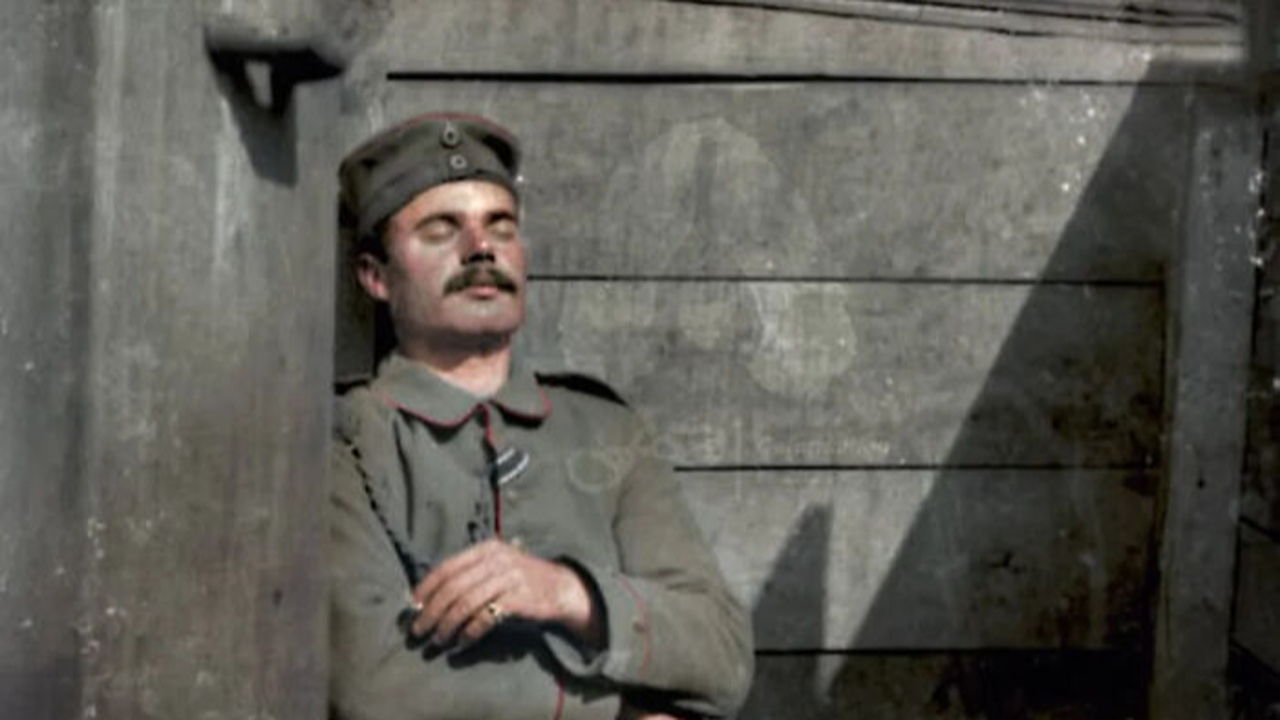
World War I took place from July 28, 1914, to November 11, 1918. The brutal war ended over a century ago, but it’s still an incredibly important part of modern history. And one page that’s dedicated to making sure that people never forget what took place during that time is WWI Stories on Instagram.
We took a trip to this account and compiled a list of their most haunting posts below. We’ll warn you right now, pandas, that some of these images and stories are quite disturbing and upsetting. But these moments from the past deserve to be remembered, so we hope that you learn something new while scrolling through this virtual history museum.
#1
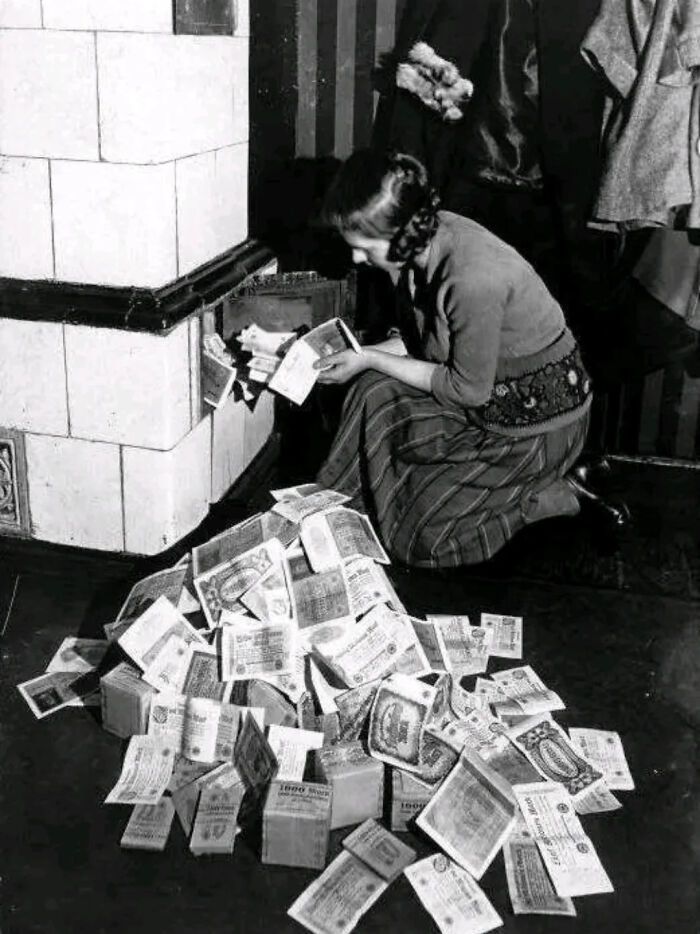
A German woman burning tons of legal paper money during the hyperinflation of German currency in the 1920s. The paper money was cheaper than wood or coal, and families used it to fuel their fires during the crisis.
© Photo: ww1_stories
#2
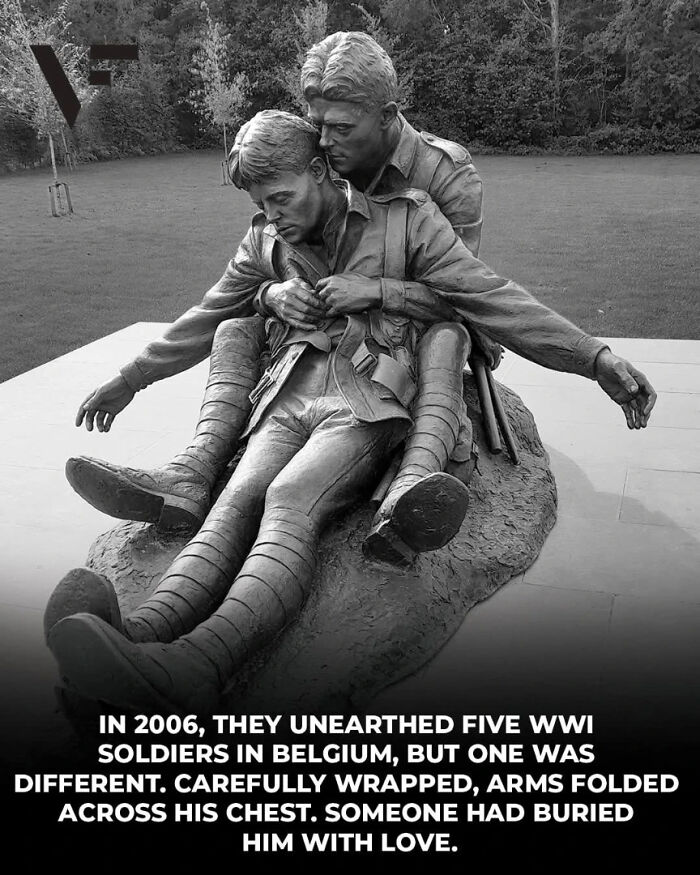
In 2006, construction workers digging near Polygon Wood in Belgium uncovered what remained of the First World War: fragments of uniforms, rusted equipment, and the skeletal remains of five Australian soldiers lost during the fighting of 1917. Most had been swallowed by a century of soil and silence, the kind of battlefield discovery that is tragically familiar in Flanders. But one of the bodies stood apart.
He had been wrapped carefully in a military groundsheet. His arms had been folded across his chest, not by chance or by the shifting earth, but with unmistakable intention. Someone, in the chaos of war, had stopped long enough to bury him with gentleness.
Archaeologist Johan Vandewalle was called to examine the site. He’d seen hundreds of battlefield recoveries over the years, but this one felt personal. Soldiers in the Great War often d**d where they fell, left in the open as battles moved on. A careful burial during the firestorm of Polygon Wood was something extraordinary.
DNA testing, uniform fragments, and surviving service records eventually led to a name: Private John “Jack” Hunter, 23 years old, 55th Battalion, Australian Imperial Force. He had d**d on 26 September 1917, in the brutal opening days of the Battle of Polygon Wood, where thousands of Australian soldiers were k****d or wounded.
When Johan contacted the Hunter family in Australia, they told him something he hadn't expected. Jack Hunter hadn’t been anonymously buried by stretcher-bearers or medics. He had been buried by his younger brother, Private James “Jim” Hunter, who had enlisted with him, marched with him, and fought beside him from Egypt to Belgium.
On that September morning in 1917, amid machine-gun fire, artillery bursts, and the churn of mud and smoke, Jack was hit. Jim saw his brother fall. He fought on until he could reach him, then knelt in the shell-blasted earth and wrapped Jack’s body in a groundsheet. He folded his brother’s arms across his chest. And in one of the most violent battles of the war, he gave Jack a burial shaped by love, not orders.
© Photo: ww1_stories
#3
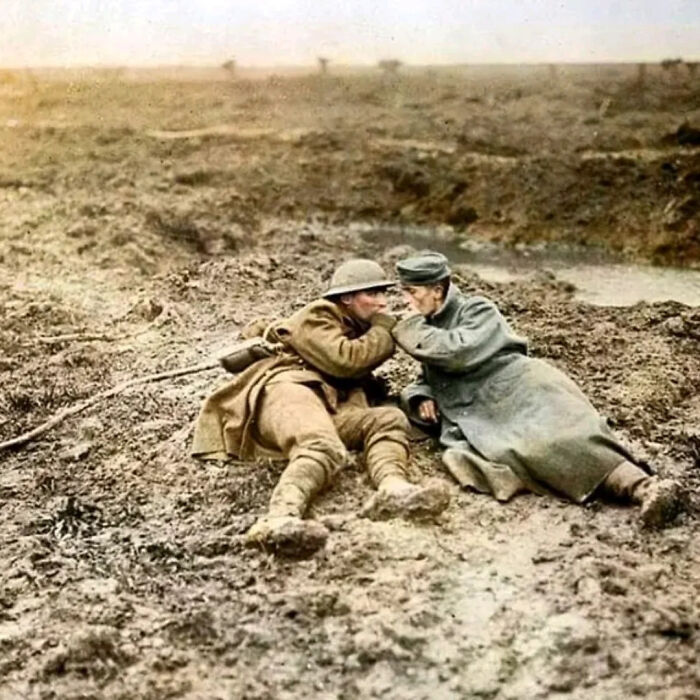
"Enemies and comrades"
Two wounded soldiers, A Canadian and a German soldier lights cigarettes on the muddy Passchendaele battlefield in Belgium, 1917.
© Photo: ww1_stories
#4
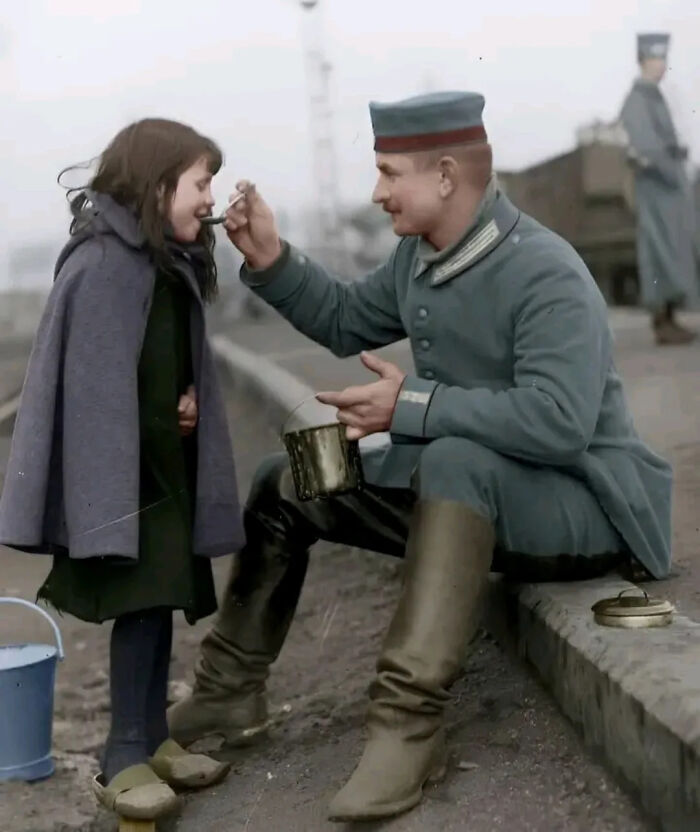
German soldier shares his meal with a Belgian child, 1915.
© Photo: ww1_stories
#5
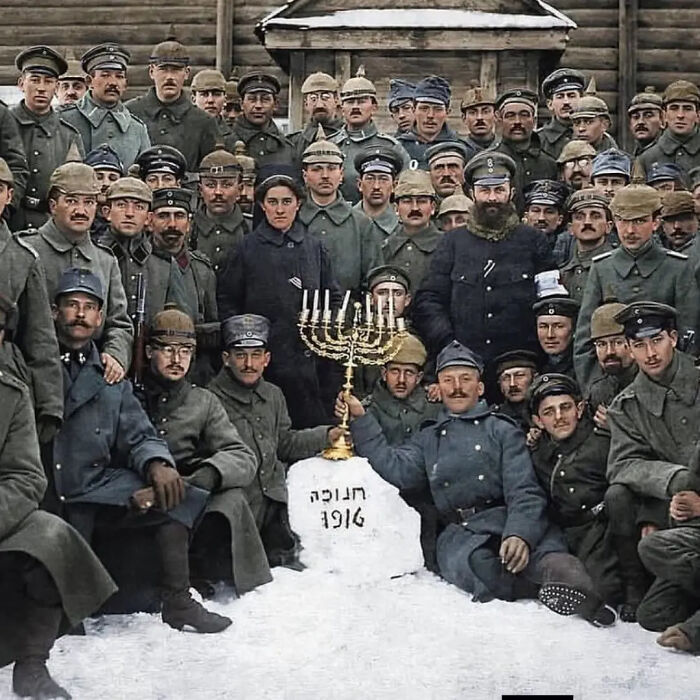
Jewish soldiers in the German Army celebrate Hanukkah on the Eastern Front, 1916, during WW1.
© Photo: ww1_stories
#6
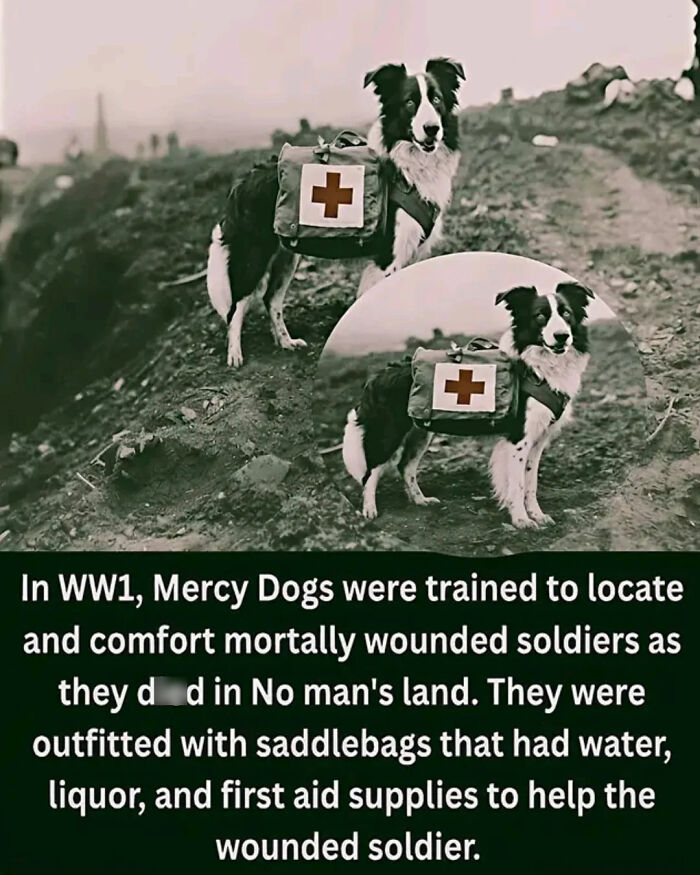
WW1, Mercy Dogs were trained to locate and comfort mortally wounded soldiers as they d**d in No man's land. They were outfitted with saddlebags that had water, liquor, and first aid supplies to help the wounded soldier.
© Photo: ww1_stories
#7
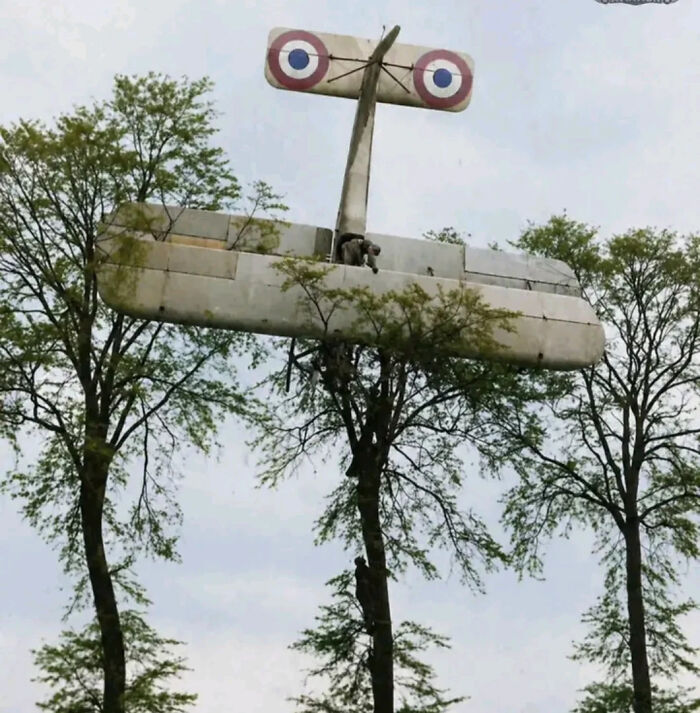
WW1, 1915. After a failed attack on a Zeppelin hangar near Brussels, Belgium, this French pilot flew too low and was caught in tree tops. Note the soldiers climbing the tree to get to the pilot.
© Photo: ww1_stories
#8
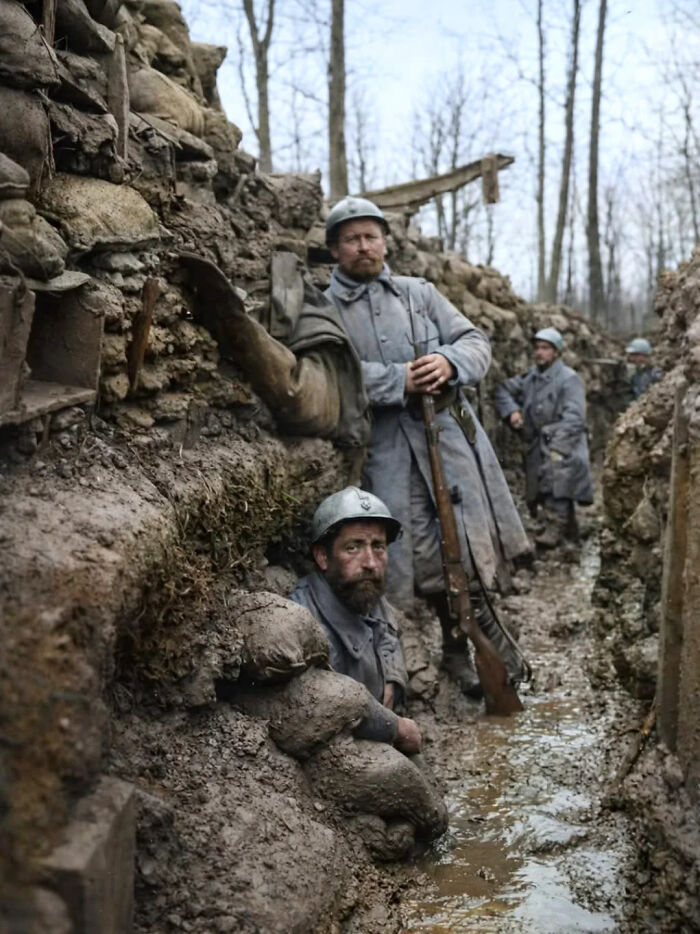
This photo was sent in February 1916. The soldier wrote, "You can believe I'm fed up with being in the water and mud." This is perfectly understandable when you see the picture.
© Photo: ww1_stories
#9
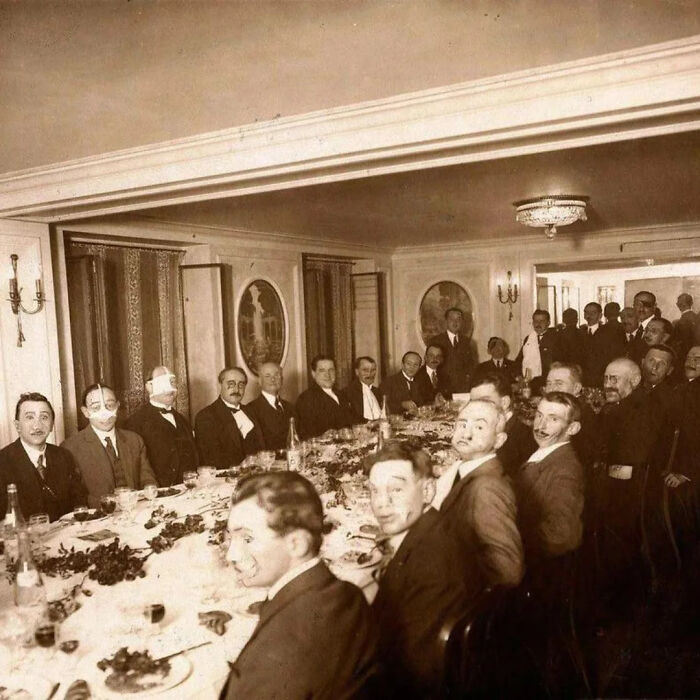
Banquet of the Mutilated Faces", Paris, 1925. (For WW1 veterans).
© Photo: ww1_stories
#10
March 1916 — Life in the trenches.
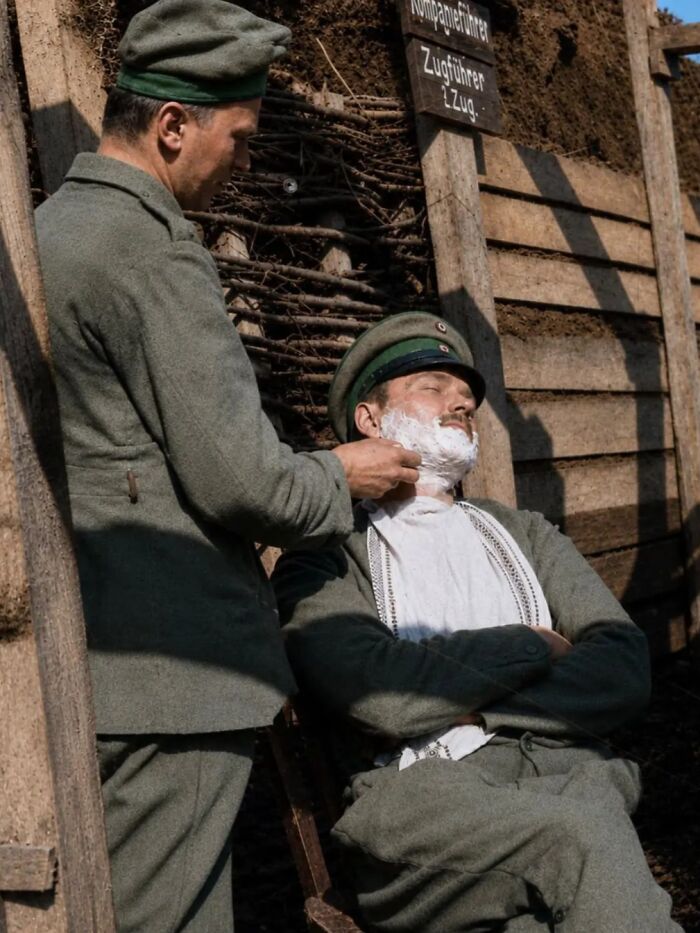
By this point in the war, Lt. Alexander Pfeifer had fought on the Western Front at Neuve-Chapelle, Festubert and Loos, becoming an experienced company commander in the process.
After time away from the frontline, he had returned to the trenches and was settling back into daily life. His diary and this photo of him captures a surprisingly ordinary moment amid the war:
“I have now been in the trench again for two days. I am doing well, and I am already completely used to the activities again. The weather has also gotten slightly better. I sat in front of the shelter in my sleeved vest almost all day today and even had myself shaved outdoors.”
This small moment, recorded in March 1916, is one of many personal details preserved in his wartime diary, published in The Other Trench / Der andere Graben
© Photo: ww1_stories
#11
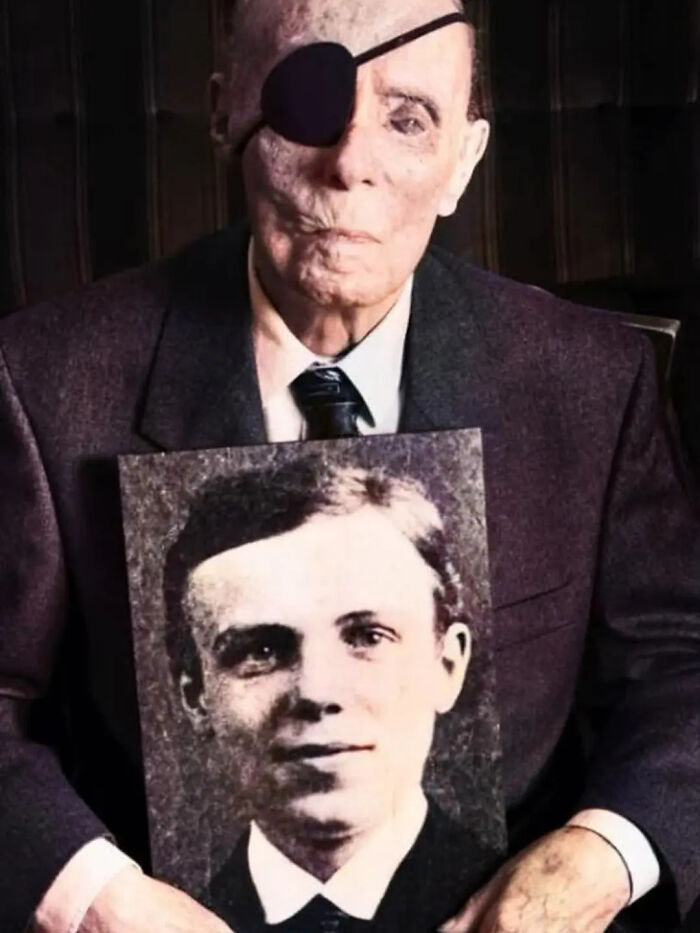
German WW1 veteran Hans Lange holds a portrait of himself as a 19 year old in 1918. Born in 1899, Hans was wounded by a g*****e during the war, gradually losing his sight. This photo was taken in 1998, Hans passed away in 1999.
© Photo: ww1_stories
#12
A veteran returns to the Fromelles battlefield to remember a mate.
An aging Tom ‘Nugget’ Brain stands to attention on the old Fromelles battlefield near the Somme. Behind Tom are the gnarly footings of an old German blockhouse that undoubtedly spat desultory fire across Fromelles’ marshy fields on 19 July 1916. In 24 hours, the 5th Australian Division suffered 5,533 casualties. It remains the bloodiest day in Australia’s military history.
Tom returned to Fromelles in 1993 to commemorate his old mate, George Ramsay. Tom remembered himself and George standing together for the hopover on the drizzly evening of the attack.
A shell shrieked overhead, and fell short. When the dust settled, Tom reached out, touched George, and asked how he was. He soon discovered that shrapnel had struck George in the abdomen. He d**d instantly.
It was ‘not a pretty picture for an 18-year-old lad,’ recalled Tom, ‘George was the best friend I ever had; we shared everything.’ It was impossible for Tom to recover George’s remains; they had to be left in No Man’s Land. Tom was asked to write a letter to George’s family. ‘I couldn’t write a letter like that,’ Tom recalled, so the Padre drafted it and Tom later copied it out.
Tom rarely shared his story about George, but whenever he did, he couldn’t help but cry. Tom survived the war, returning home to marry his childhood sweetheart, Lila. The marriage lasted 68 years and yielded four children. Yet, Tom always yearned to return to the battlefields to remember his old mate.
In this photo, Tom is frail and, in his nineties. Yet, he still stands to attention as a mark of respect for his mates. Tom d**d a few years later. He could finally ‘stand easy’. On the Fromelles’ 109th anniversary, we remember Tom and George, thanks to Lambis Englezos and Robin Corfield’s meticulous work in recording their stories.
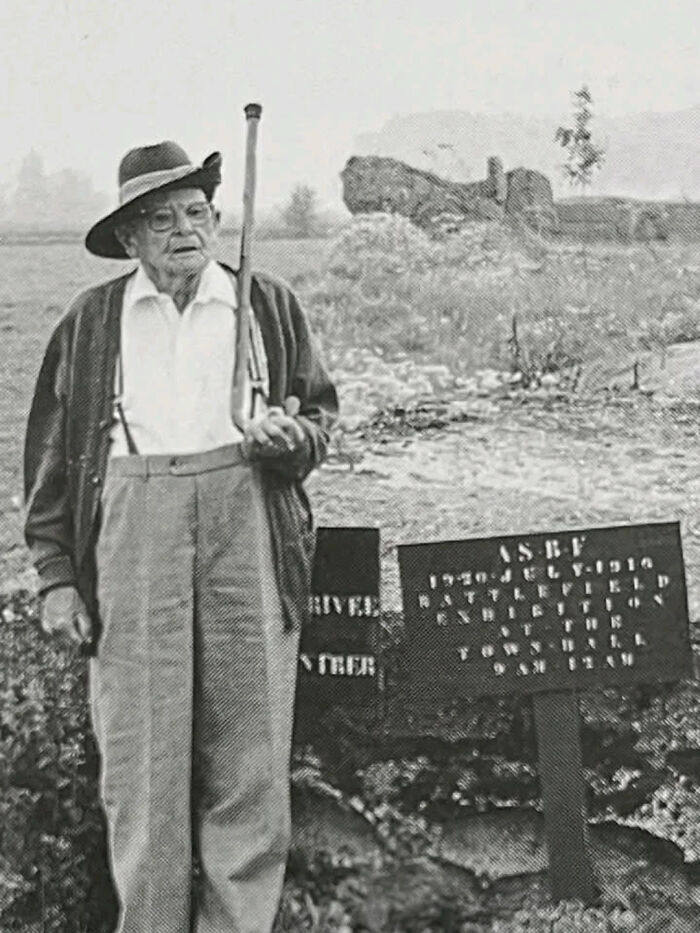
© Photo: ww1_stories
#13
All quiet on the western front.
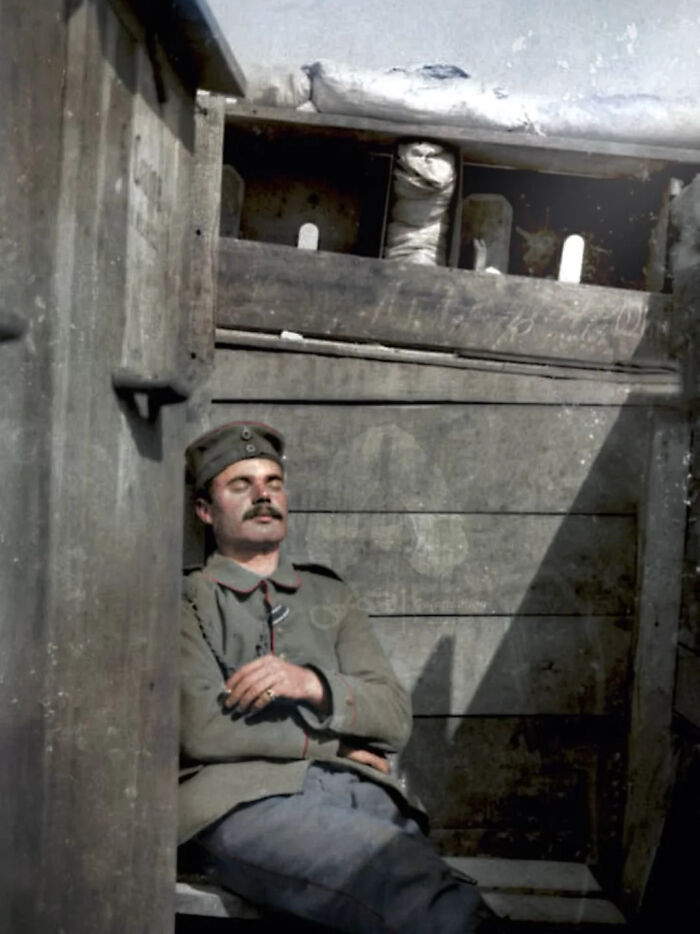
© Photo: ww1_stories
#14
German soldiers point to a fellow soldier's medal.
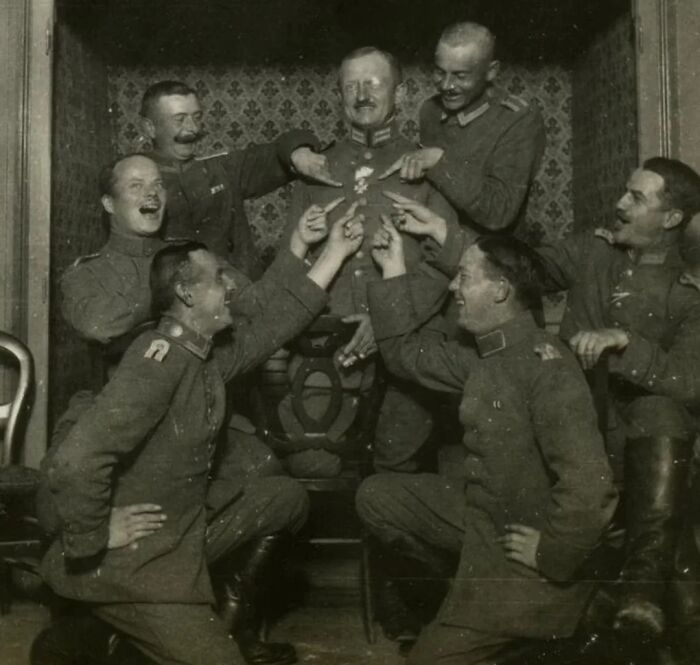
© Photo: ww1_stories
#15
13 June 1918
A British Royal Artillery driver and his horse, Calonne-sur-la-Lys, located in the Pas-de-Calais region of France.
The village was a place where soldiers and their support staff, found temporary refuge on retreating from the Battle of the Lys.
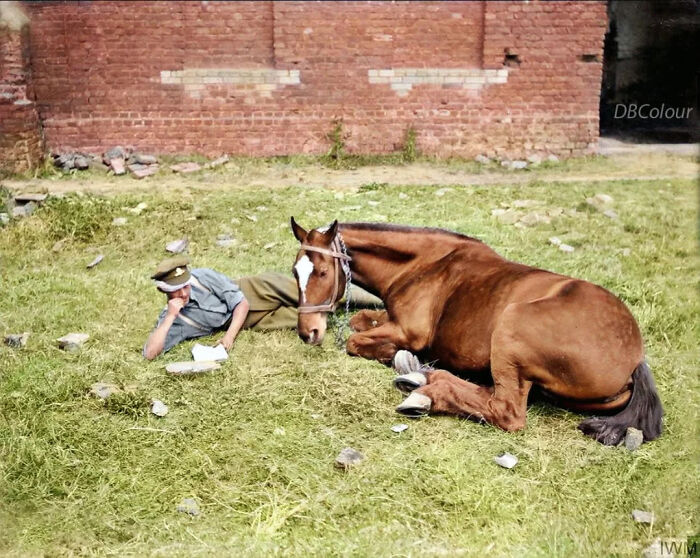
© Photo: ww1_stories
#16
The Christmas Truce shows us that extreme humanity is possible, even in the face of the impossible. World is inspired by the stories from these soldiers who laid down their weapons in a time of war to share in a brief moment of peace.
The Christmas truce also allowed both sides to finally bury their d**d comrades, whose bodies had lain for weeks on “no man's land,” the ground between opposing trenches. The phenomenon took different forms across the Western front.... And of course, it was only ever a truce, not peace.
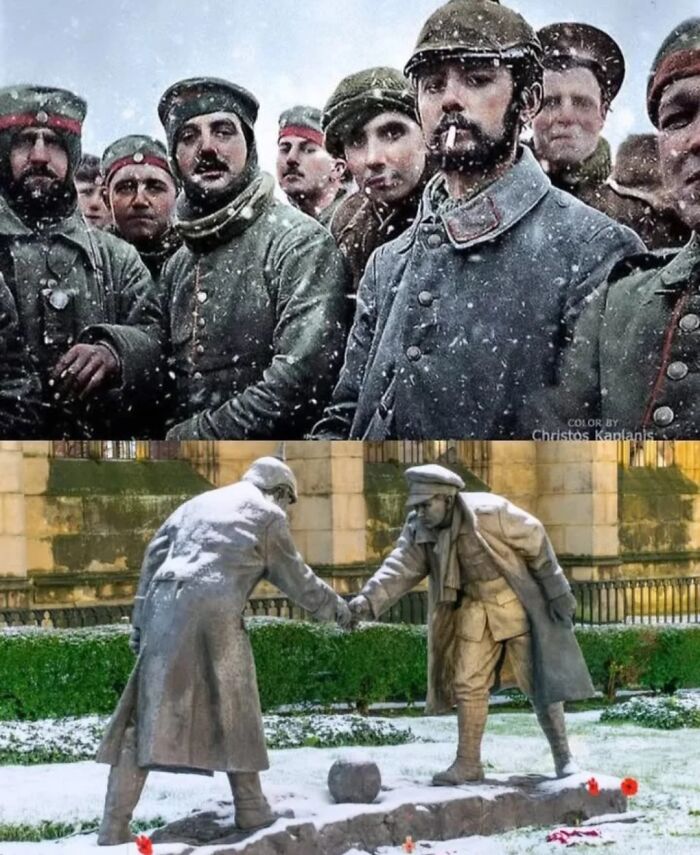
© Photo: ww1_stories
#17
"Wet and Mud"
Scottish soldiers of the 53rd Highland or Welsh Division walking accross the typical Dutch countryside with her windmills near Meijel, The Netherlands. October 1944.
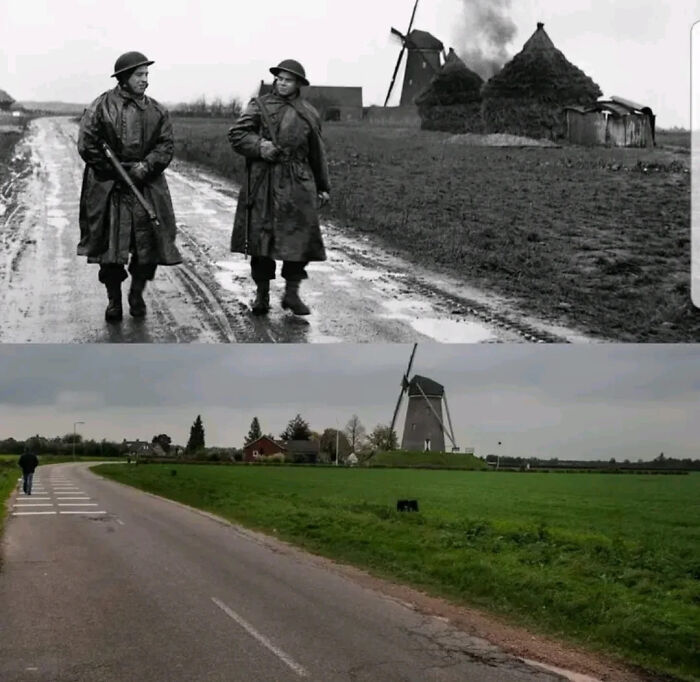
© Photo: ww1_stories
#18
After more than a century, a first world war tank makes its final journey. History is still alive.
This is Deborah, a surviving British Mark IV tank from the First World War, carrying the scars of one of the darkest chapters in human history.
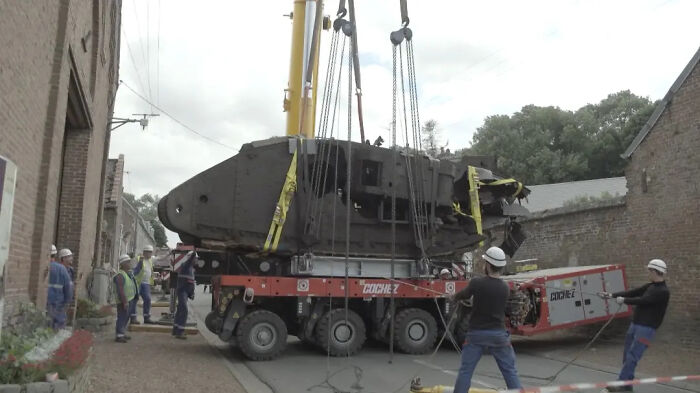
© Photo: ww1_stories
#19
Two British officers rest behind the wreck of a Mark IV ‘Female’ tank, likely in Ypres, circa 1917-1918. Unknown photographer.
The man on the left, seems to be taking a quick smoke whilst his friend next to him fidgets with his whistle. This photo was likely taken by a fellow officer. Private ‘front-line’ photography like this is rare from British troops as photography of this nature was strictly banned. Initially banned in March, April & September of 1915, taking such a photo or possessing a camera could result in a court martial. For ordinary soldiers this risked up to 112 days in confinement and for Officers it could mean being unceremoniously discharged from the military. Most soldiers gave up their cameras and sent them home, however many men did secretly smuggle their cameras to the front. Likely thousands of illegal photos were taken but after 100 years, they are extremely hard to come by.
This 127 film negative was found neglected at the bottom of a box containing unrelated glass negatives, it was in bad condition, but the importance of the photo was evident. After an extremely careful cleaning, nearly all of the white debris that was marking the negative was removed and revealed all the hidden details. For example, the escape hatch under the sponson was almost completely hidden by the damage but is now easily visible. It was likely taken with a Kodak vest pocket camera which was popular with soldiers.
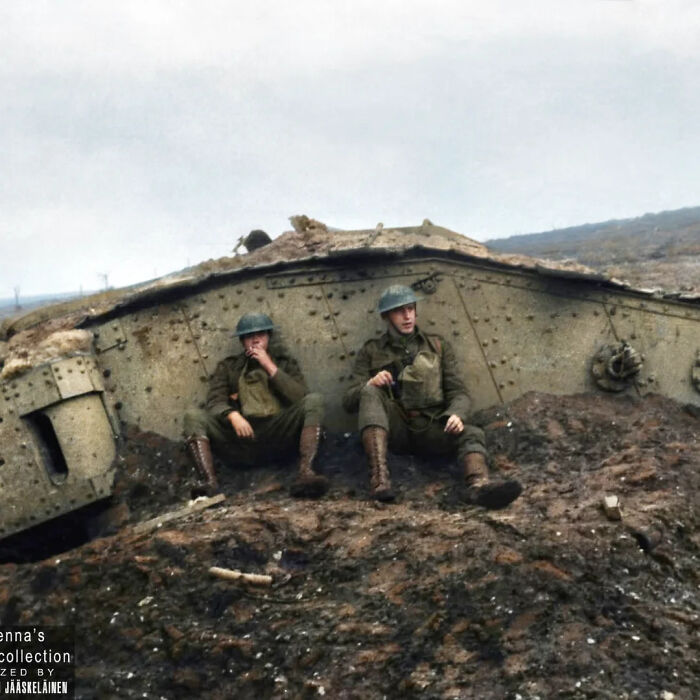
© Photo: ww1_stories
#20
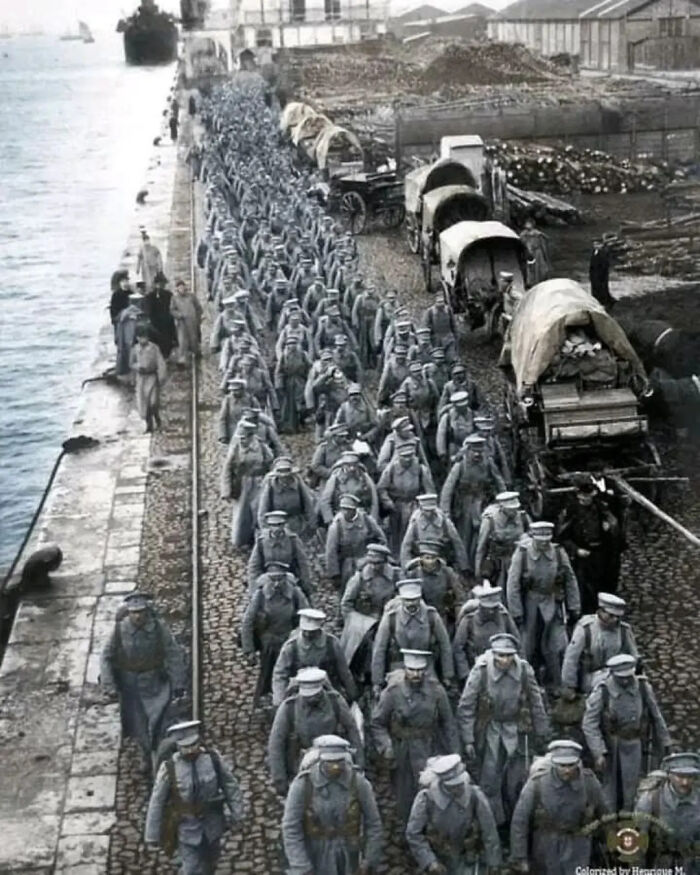
Portuguese troops landing in France, during the first world war, in the year 1917. Portugal and its colonies left for the front.
At the end of the war, Portugal suffered more than 30,000 casualties, with 8145 soldiers d**d and 6,000 missing, the rest of the numbers refer to wounded (mainly by gas) and cripples, these military casualties happened both in Africa and in European battlefields..
© Photo: ww1_stories
#21
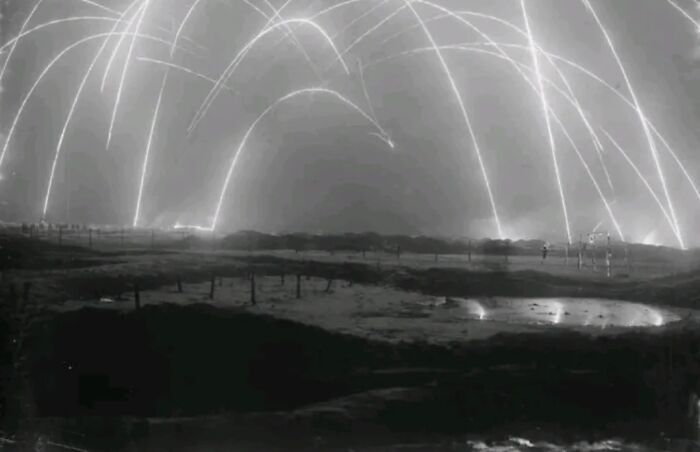
This is Trench Warfare. Photo taken by an official British Photographer during WWI, 1917.
© Photo: ww1_stories
#22
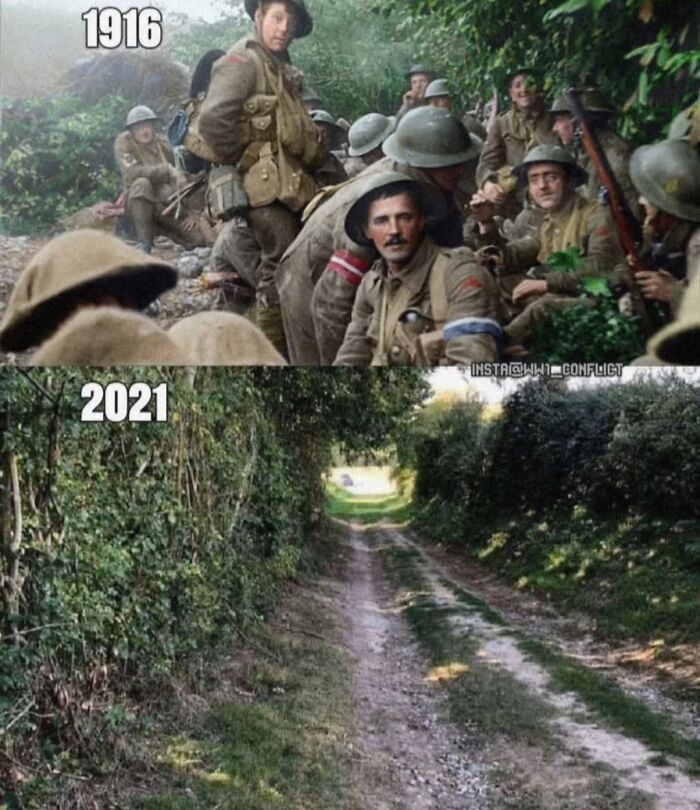
WW1 then & now. (Sunkenlane )
A group of Lancashire Fusiliers wait in the Sunken Lane on the morning of July 1, 1916. At 7:30 a.m. they clamber up the dirt bank to make a rush at the Germans.
This shot was taken about 15 minutes before that attack. What these men don’t know is that the vast majority of them won’t advance more than a dozen paces before being k****d. Inset: The very same spot in 2021.
© Photo: ww1_stories
#23
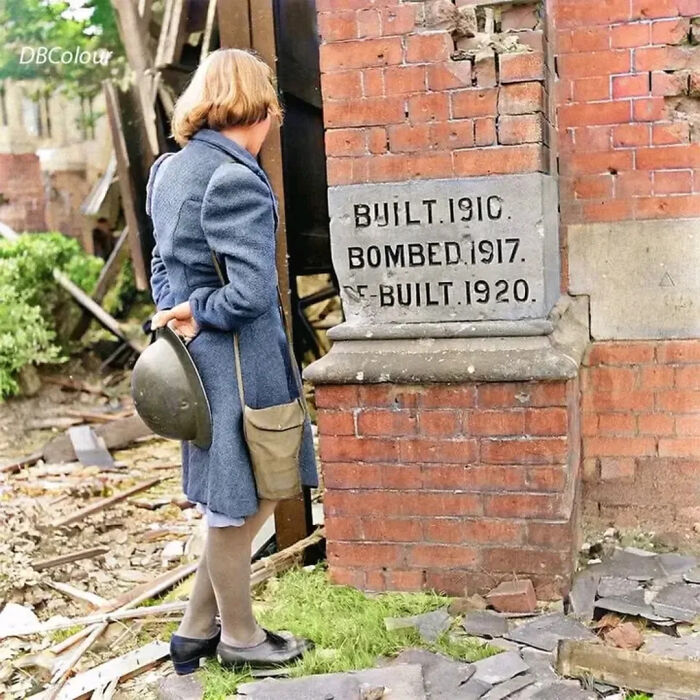
The Wesleyan Chapel on St. Martin’s Hill, Dover, has a resilient history. Built in 1910, it was destroyed during WWI (1917) and rebuilt in 1920, only to be bombed again in 1941 and restored once more by 1949.
Colorized by: Doug.
© Photo: ww1_stories
#24
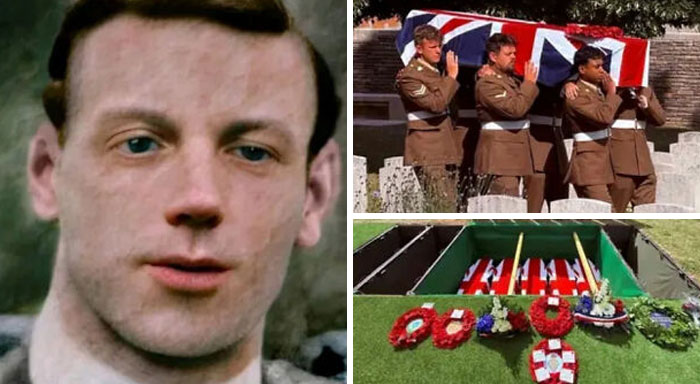
Laid to rest 108 years after being k****d in action.
Corporal Alfred James Morrant Alfred was one of eight British soldiers who were buried with full military honours at Loos British Cemetery Extension on 16th July 2025. The men had been discovered during construction work on a new Hospital near Lens in France.
Alfred was born in Hutton, Essex in 1889. He had seven siblings. Before the war he worked with horses on a farm. He enlisted early in the war and was posted to France in May 1915. He served in 9th Battalion, Essex Regiment until he was wounded in the Autumn of 1915. When he had recovered he was transferred to the Regiment’s 11th Battalion. He was k****d in action on 22nd April 1917. Alfred Morrant was 27 years old.
© Photo: ww1_stories
#25
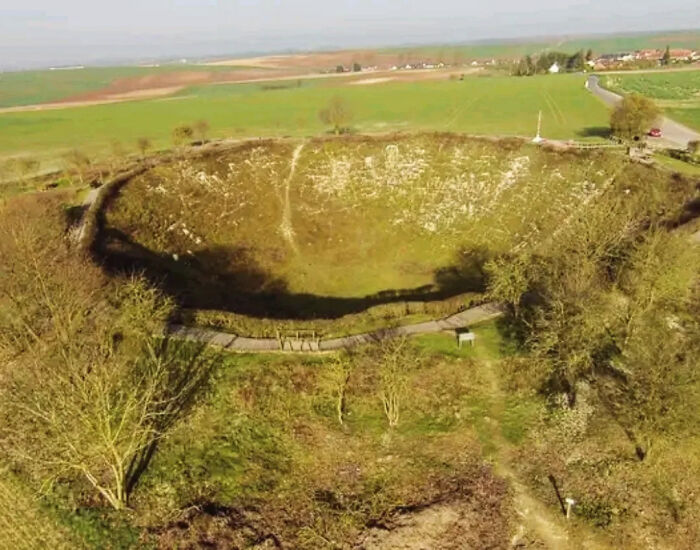
Yesterday was the Anniversary of the Battle of the Somme. This aerial photograph shows the impressive Lochnagar Mine Crater at La Boisselle which was blown under the German positions here on this day in 1916, always an impressive location.
© Photo: ww1_stories
#26
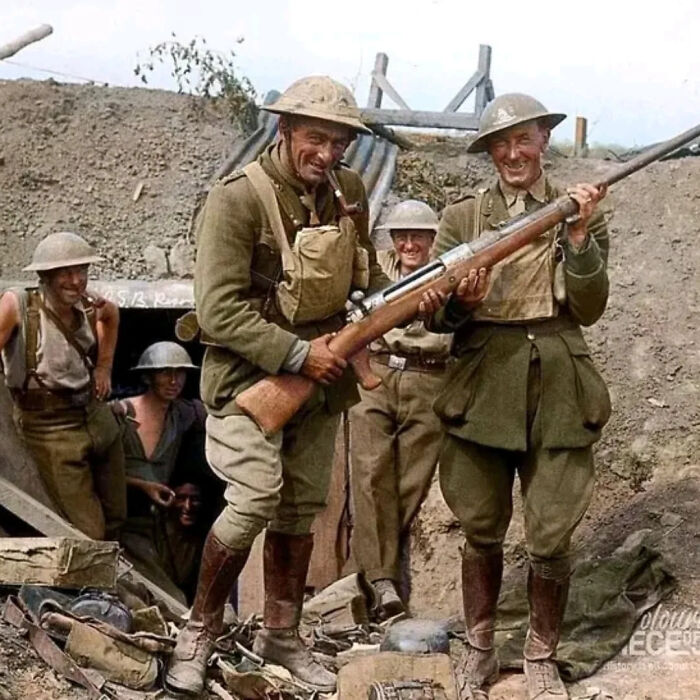
New Zealand Cavalry soldiers pose with a captured German Tankgewehr M1918. The world's first anti-tank rifle!
© Photo: ww1_stories
#27
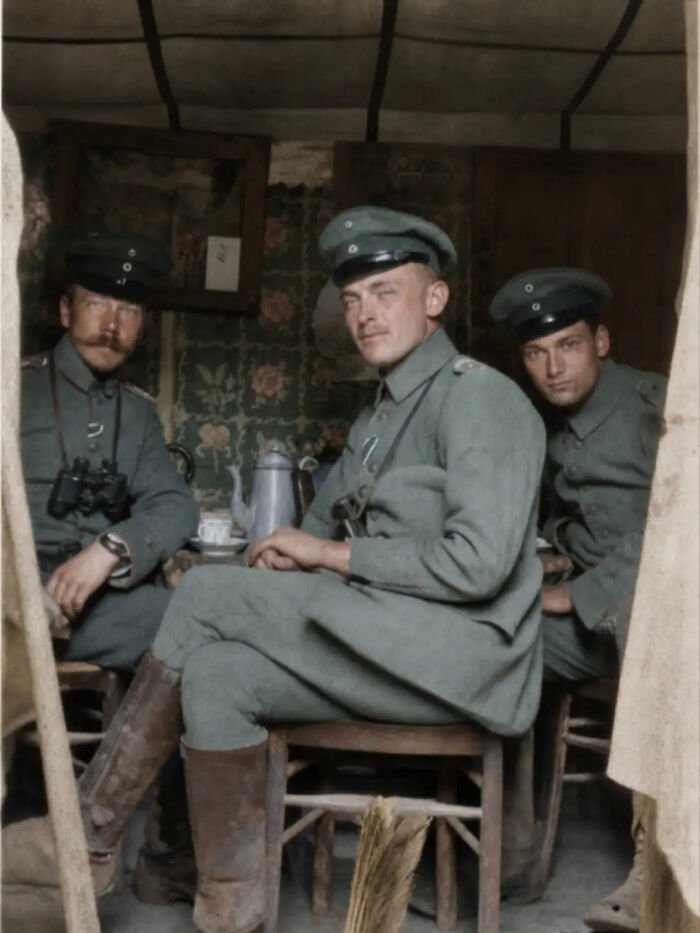
German soldiers in the trench - 1915
By the time this photograph was taken, Lt. Alexander Pfeifer already had numerous battles and war experiences behind him.
After some time away from the front, he returned to the trenches and was struck by how much they had developed in a short period.
Alexander recorded:
“Anyone who hasn’t seen them or helped build them has no idea of the work that goes into these trenches, which are over two metres deep. The walls are covered from top to bottom with thick planks and wicker and braced with beams to prevent them from caving in. The ground is covered with duckboards.”
It is these everyday details that make Alexander’s diary so remarkable — showing not just the battles, but how soldiers actually lived between them.
His diary and hundreds of photographs are preserved in The Other Trench: The WW1 Diary & Photos of a German Officer.
© Photo: ww1_stories
#28
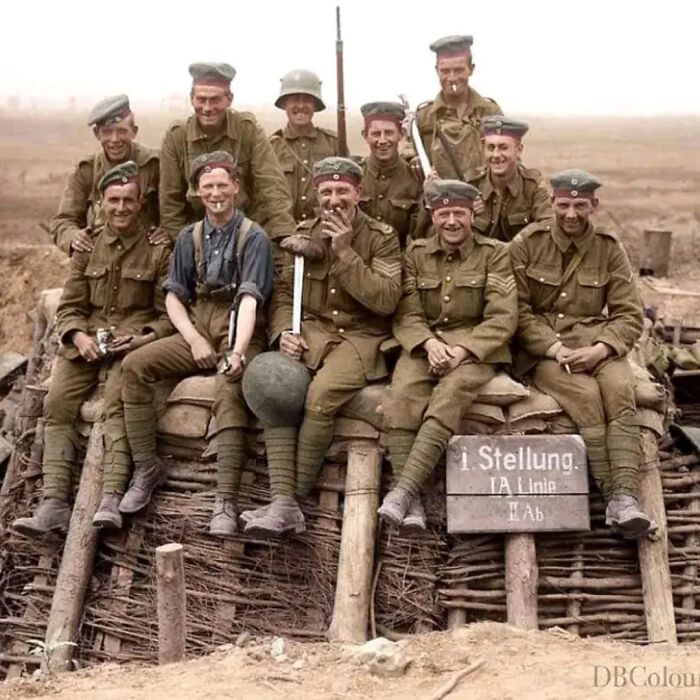
Soldiers of the Duke of Cornwall's Light Infantry wearing German helmets and caps in a captured trench. Note a board with a sign "I.Stellung. IA Linie. II AB". Battlefield near Messines, Belgium, 11th June 1917.
© Photo: ww1_stories
#29
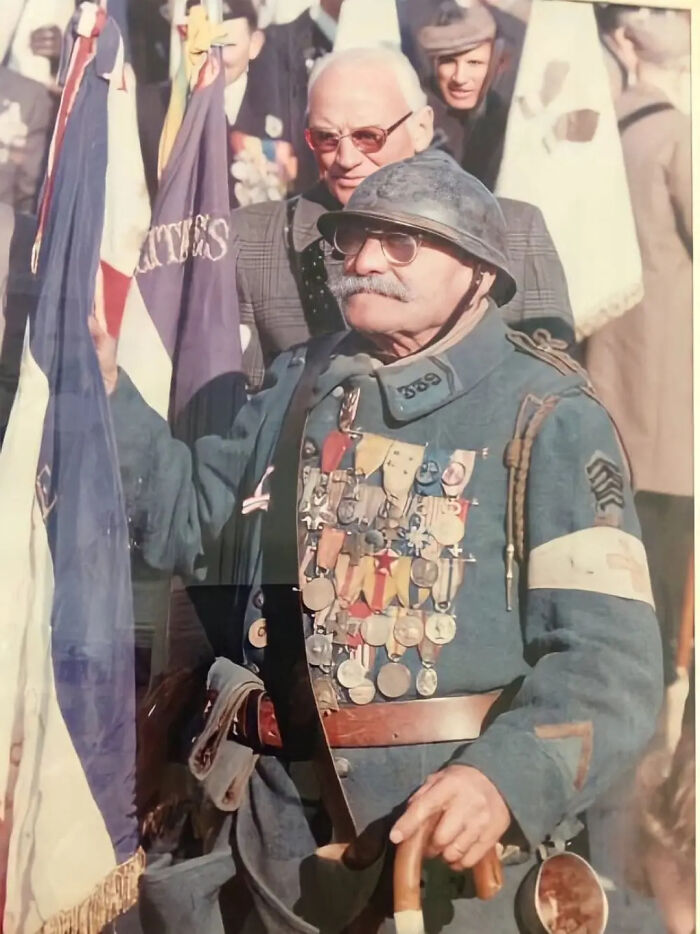
Pierre Recobre, WW1 medic veteran described by his officers as "a dedicated stretcher bearer, daring to the point of temerity".
Picture has been taken at WW1 commemorations in the early 80's. He passed in 1983.
Pierre Recobre (1889-1983) was a stretcher-bearer in WWI, serving from August 1914 until the war's end in November 1918, while also serving in the French army until November 1919.
His commanders described him as "daring to the point of temerity," volunteering to pick up the wounded despite putting himself in grave danger and having been wounded numerous times himself. Recobre had always prioritised the safety of his comrades over his own. A true soldier and hero. With 30 decorations, this man is deserving of the highest regard.
© Photo: ww1_stories
#30
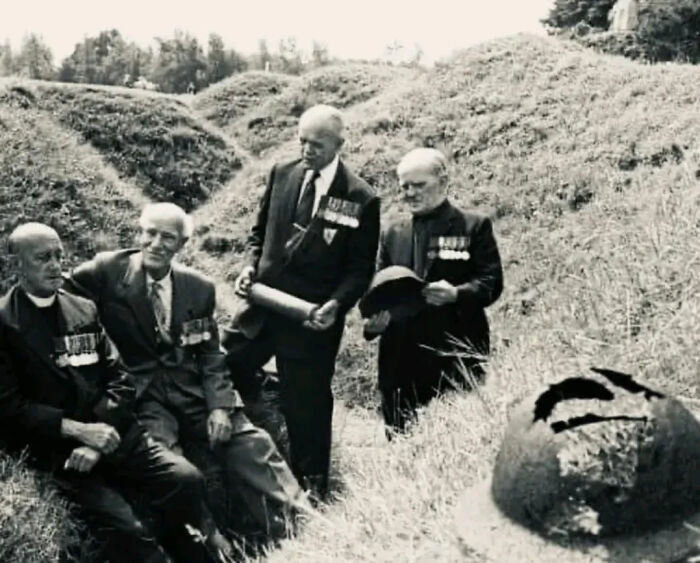
Four World War One veterans who received the Victoria Cross gather together in France in 1966, to mark the 50th anniversary of the Battle of the Somme. L-R: Rev Arthur H Procter, Thomas E Adlam, Theodore WH Veale, and Frederick J Edwards
© Photo: ww1_stories
#31
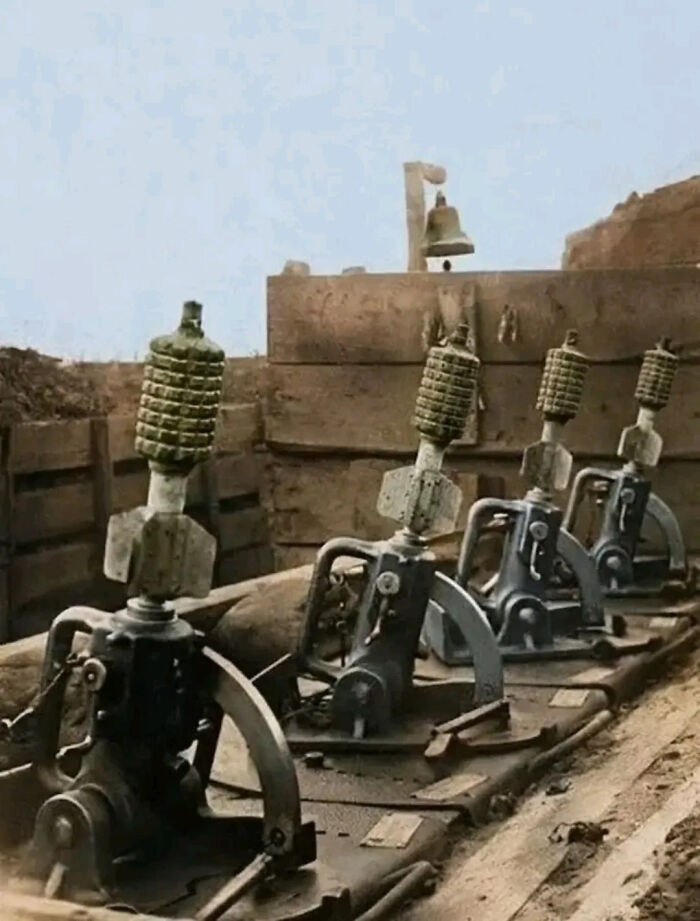
The Granatenwerfer 16 was a German light trench mortar introduced during World War I in 1916. Designed to provide close infantry support, it fired 46 mm fin-stabilized grenades in a high-angle arc, allowing crews to strike enemy trenches, dugouts, and barbed wire positions beyond the reach of rifles and machine guns.
With an effective range of around 250–300 meters, the weapon could be quickly transported and operated by a small crew, making it well suited to the trench warfare conditions of the Western Front. The Granatenwerfer 16 helped bridge the gap between hand-thrown grenades and larger artillery systems, becoming a widely used support weapon during the war.
© Photo: ww1_stories
#32
The Battle of Cambrai (November - December 1917)
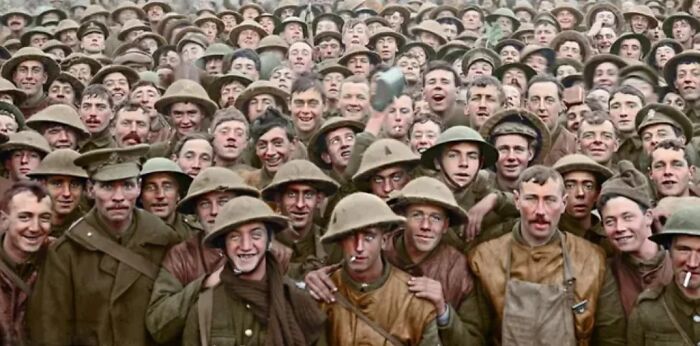
Group of the Royal Irish Rifles, 36th Ulster Division, before parading for the trenches. Near Bertincourt, Pas-de-Calais, France.
© Photo: ww1_stories
#33
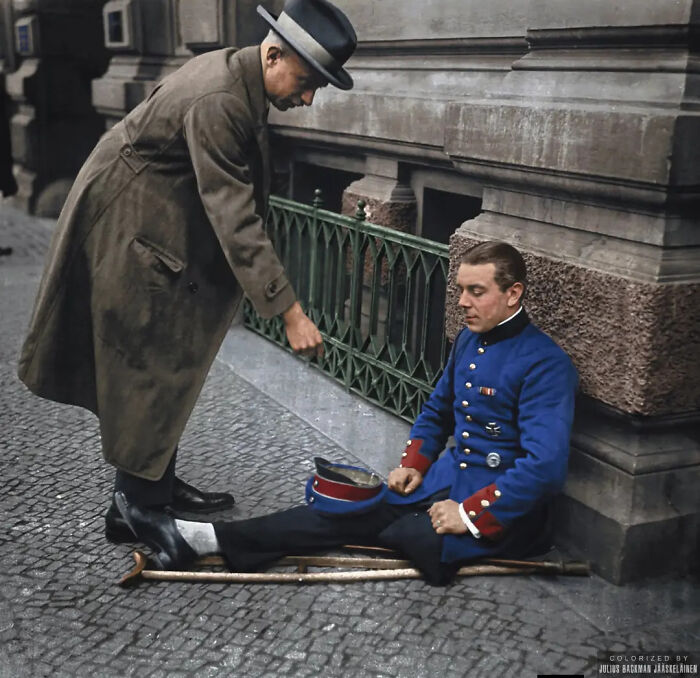
A one legged German veteran from the Great war begging on the streets of Berlin, 1923.
With the 2.7 million disabled or permanently ill veterans who returned from the battlefields of World War I, disability came into view in the public sphere in Germany in a different way and to a greater extent than ever before.
Fifty years earlier, during the Franco-Prussian War, 80 to 90 percent of seriously wounded soldiers had d**d of infections and other complications. By World War I, however, medical advances enabled many more soldiers to survive previously mortal wounds, and advances in rehabilitation technology made it is easier for more disabled veterans to return to work.
© Photo: ww1_stories
#34
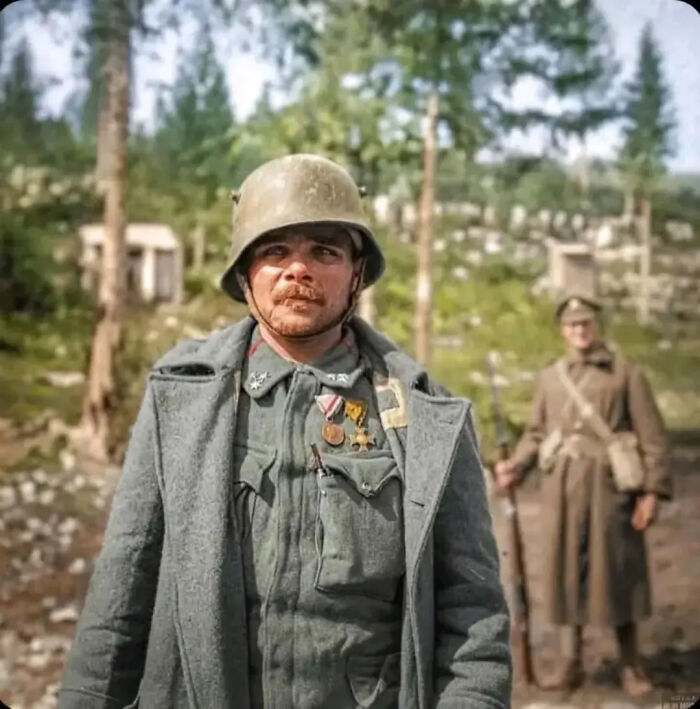
An austro hungarian prisoner of war.
The Austro-Hungarian Empire mobilized approximately 7.8 million soldiers over the course of the war. Because they were heavily outnumbered and fighting a multi-front war, the empire suffered a massive 90% casualty rate (including d**d, wounded, and captured soldiers), forcing them to rely heavily on German reinforcement.
© Photo: ww1_stories
#35
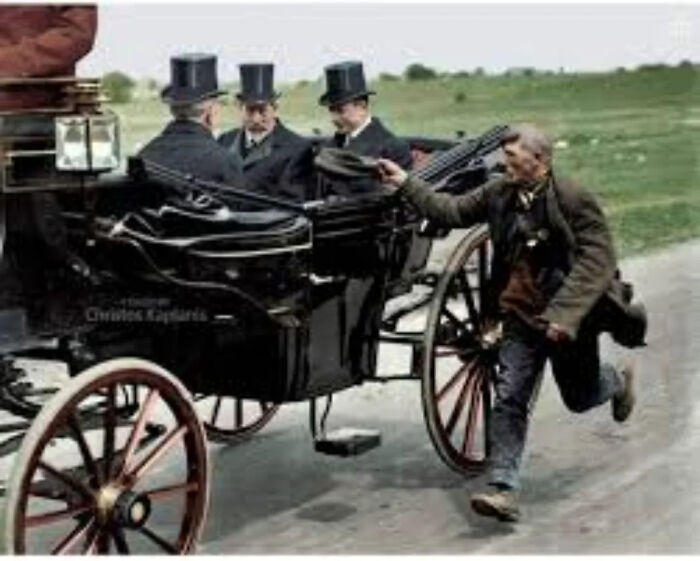
1920. A great war veteran runs next to the carriage of King George V outside London.
In comparison to mental health services available today, there was little expectation of recovery once a Great War veteran was institutionalised. Containment, rather than cure, remained the focus of district asylum care. In an attempt to prevent the Great War veterans who suffered mental health problems from being tainted with the stigma of pauper lunacy, the Ministry of Pensions funded the ‘Service Patient’ scheme throughout British asylums from the summer of 1917.
The scheme enabled ex-servicemen to be dressed in private clothing, receive a small weekly allowance of pocket money, and be buried outside the asylum walls (and spared a pauper’s grave) if a man d**d while under treatment.
In 1922, county and borough asylums throughout England and Wales hosted almost 5,000 Service Patients. The population of each asylum correlated with regional enlistment figures with asylums near densely-populated urban areas accommodating the bulk of veterans.
Despite the scheme being launched to prevent ex-servicemen being treated akin to pauper patients, the practicality of this ambition remains doubtful.
The stigma of mental health problems was seemingly not avoided. For example, due to public dissent over the lack of segregation between mentally ill veterans and general patients, two Ministry of Pensions hospitals dedicated to ‘the hopeful type’ were founded in the mid-1920s.
© Photo: ww1_stories
#36
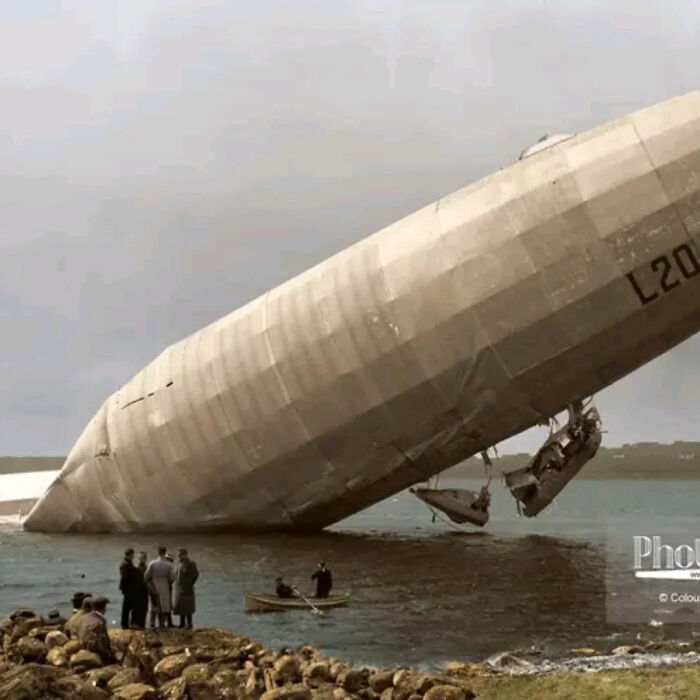
On January 31, 1916, nine airships, including the infamous L20, 'The Raider of Loughborough', set out from Germany and Tønder, Denmark, to target Liverpool's docks, a move that would have stunned the British public with its unprecedented range. However, the airships veered off course and instead dropped bombs on several towns, including Tipton, Wednesbury, Walsall, Burton upon Trent, Nottingham, Derby, and Loughborough. L20 alone claimed the lives of approximately 10 people in Loughborough, among them Mary Anne Page and two of her children, memorialized on a plaque in Loughborough's Carillon Park.
© Photo: ww1_stories
#37
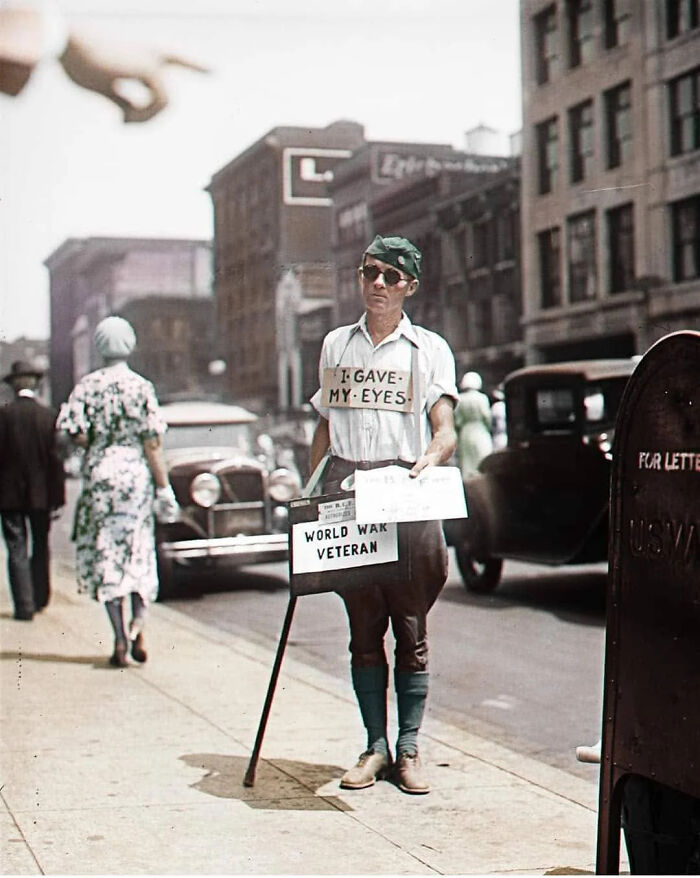
Blind World War I veteran selling newspapers on sidewalk in WashingtonDC.
"I gave my eyes." - World War Veteran. 1932, USA.
He gave his eyes in the "war to end all wars."
© Photo: ww1_stories
#38
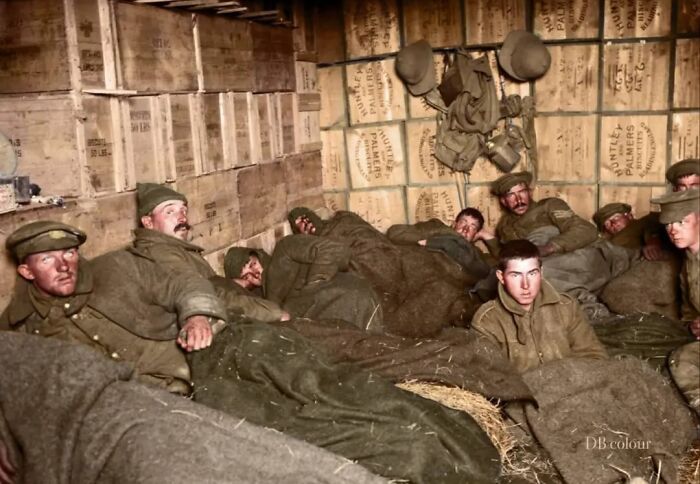
Frost-bitten Allied soldiers lying on straw in shelters constructed of biscuit boxes (Huntley & Palmer) at a store dump at Sulva, Gallipoli, after the frost at the end of November 1915.
© Photo: ww1_stories
#39
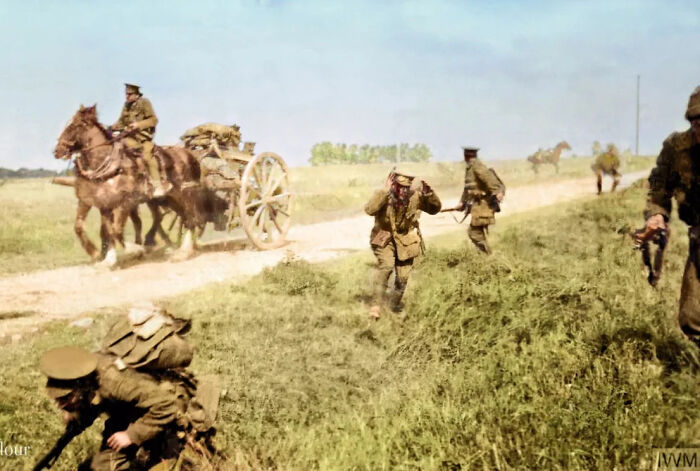
"This photograph was taken during the early weeks of the war and was the first 'action' shot of men under fire to appear in print; as such, it can truly lay claim to having achieved 'iconic' status."
(The Vest Pocket Kodak & the First World War by Jon Cooksey) September 1914.
Troops of the 1st Battalion, Middlesex Regiment (Duke of Cambridge's Own) under shrapnel fire from German artillery on the Signy-Signets road, 8 September 1914. The man with the goggles belongs to the Intelligence Corps. He is badly wounded in the head and his face is covered with blood.
According to the 1st Battalion, Middlesex Regiment, war dairy, the artillery fire k****d nine horses, but all of the transport was saved. Three men were k****d and 30 wounded. It's possible that the badly wounded man was Second Lieutenant Alfred Frederick Sang, who was severely wounded in the head by shrapnel on or about the 9th September 1914 and d**d of his wounds in Nº8 Hospital in Rouen on 2 October 1914.
© Photo: ww1_stories
#40
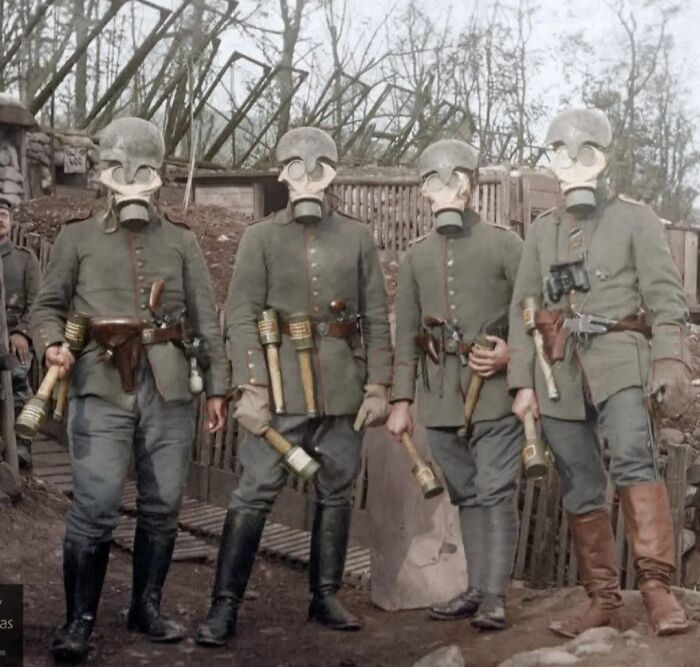
Four German officers in the Vosges sector, 1915
Besides the helmets, these men sport an interesting assortment of weapons:
From left to right, the 1st soldier has a Luger’s holster and a Hebel Model 1894 flare gun tucked in his belt; the 2nd and 3rd soldiers have M1883 Reichsrevolvers and the 4th man has a holster for a Reichsrevolver and another flare gun from the same model as the first soldier. The gas masks are the 1915 ‘Gummimaske’ model and as far as I know, weren’t used during raids and were worn here probably for display purposes only. There is also an assortment of daggers and metal pieces I was unable to identify. Many times these men made use of makeshift weapons so these might be examples of such weaponry. In their hands the most devastating of a*****t weapons: the hand g*****e. The small white device visible at the waist of the left most officer is called a Portepee.
© Photo: ww1_stories
#41
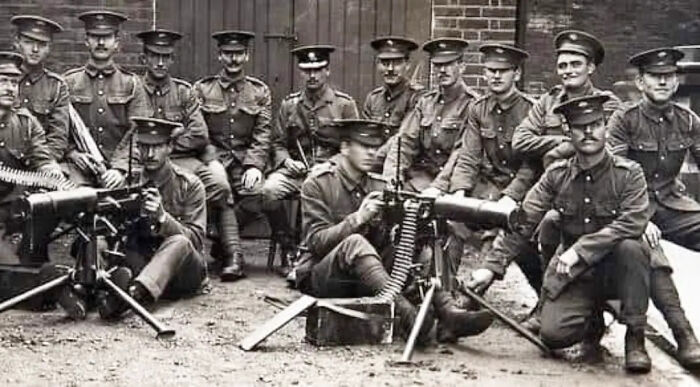
Not a single soldier from this Irish Guards machine-gun team, pictured in 1914, survived the horrific slaughter on the battlefield.
© Photo: ww1_stories
#42
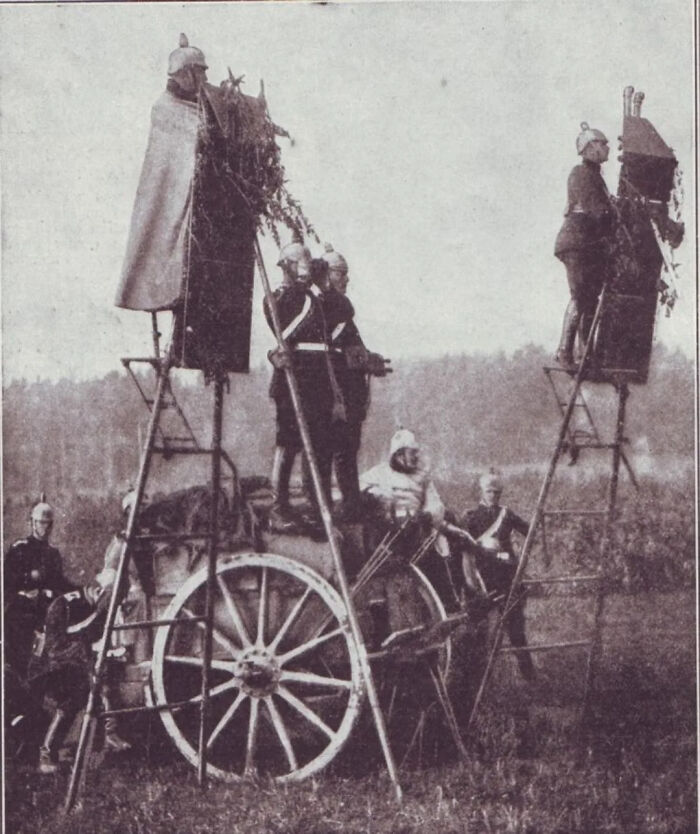
Battle of the Aisne
The battle, fought from 10th to 13th September 1914 in the First World War, that saw the end of mobility and the beginning of four years of trench warfare on the Western Front.
© Photo: ww1_stories
#43
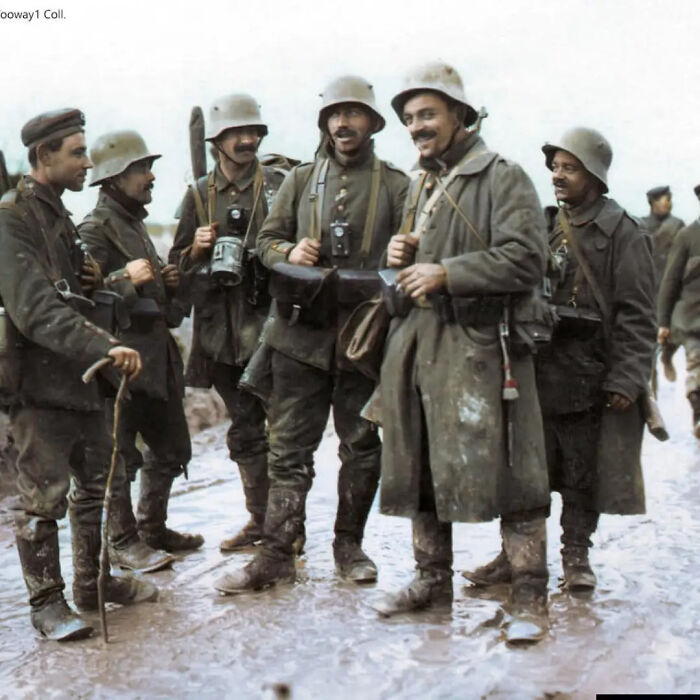
An informal photograph of a mud-covered German squad, likely just out of the trenches during World War I (c. 1916–1918), probably closer to 1916 based on the early-war M1907/1910 tunics and Stahlhelm helmets.
Notable details include a possible Leutnant in the center carrying a large leather map case and wearing reflective officer's shoulder boards while otherwise blending in with the enlisted men.
Two gas mask containers feature rare keyhole-shaped clips that allowed soldiers to wear the canister on their belt during trench raids, reducing noise while protecting the mask. Also visible are rifle covers and cloth-covered shoulder-board numerals used to conceal unit identification.
© Photo: ww1_stories
#44
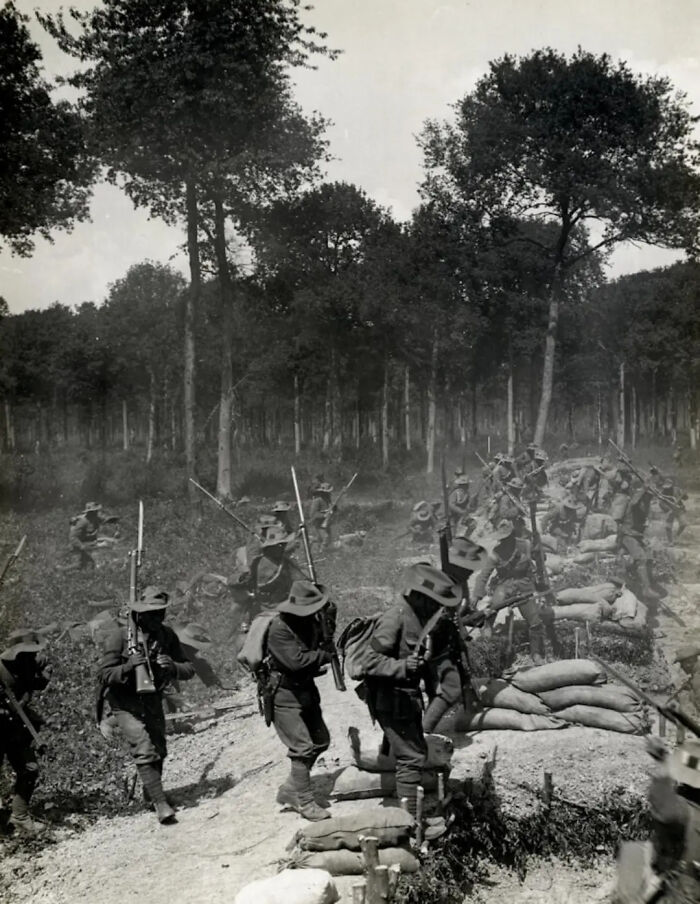
World war 1, Gurkhas charging a trench.
During World War I, more than 90,000 Gurkha soldiers from Nepal served under the British Crown, deploying to the Western Front, Gallipoli, and the Middle East.
Step into the extraordinary journey of a soldier lost at Verdun in 1916 who awakens in 2026. Discover exclusive excerpts, behind-the-scenes insights, historical inspiration, and the story that bridges a century through memory, sacrifice, and hope.
© Photo: ww1_stories
#45
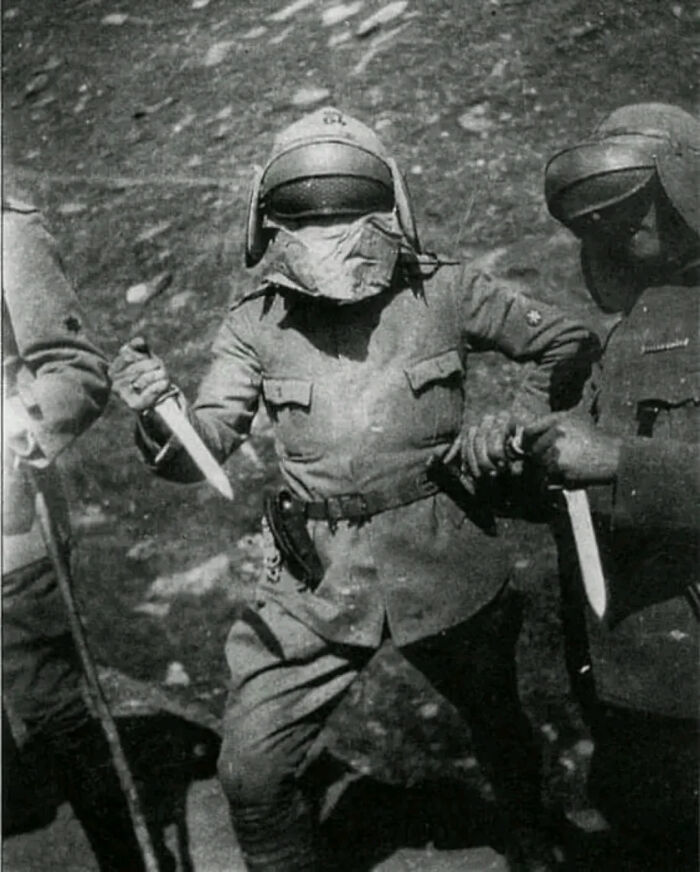
An armoured Italian Arditi trench raider during late WW1 posing with a knife.
Arditi (from the Italian word ardire, which means "to dare," and translates as "The Daring [Ones]") was the name given to an elite special unit of the Royal Italian Army during World War I. They were the first modern shock soldiers, along with the German Stormtroopers, and have been described as "the most feared corps by enemy armies."
Colonel Bassi organised the Reparti d'assalto (A*****t Units) in the summer of 1917 and assigned them the tactical duty of shock troops, shattering enemy lines to clear the way for a broad infantry advance. The Arditi were not considered infantry division units, but rather an independent combat arm.
© Photo: ww1_stories
#46
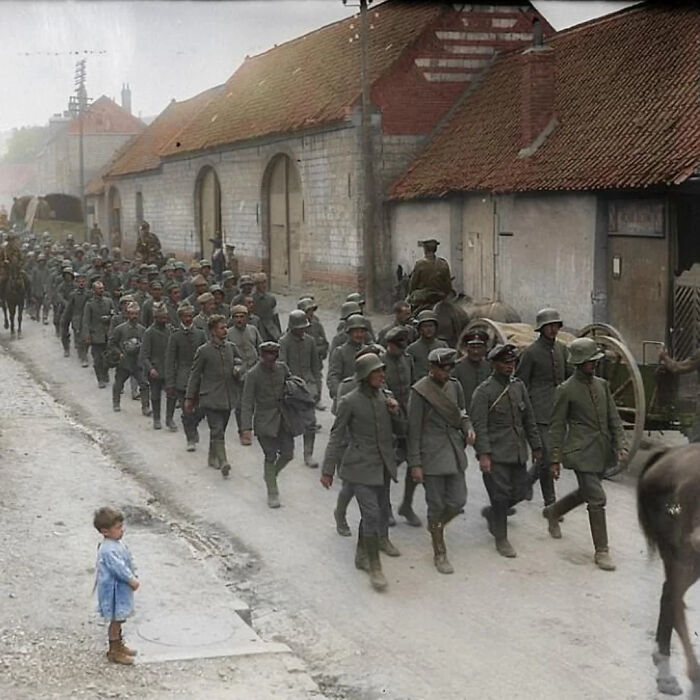
German soldiers captured by Canadians at Hersin-Coupigny in April 1917 during the Battle of Vimy Ridge. More than 10,000 Canadians were k****d or wounded during the battle, although the capture of the ridge was vital to the war effort as it provided the Germans commanding views over allied lines. Previous attempts by British and French forces failed to capture the area.
© Photo: ww1_stories
#47
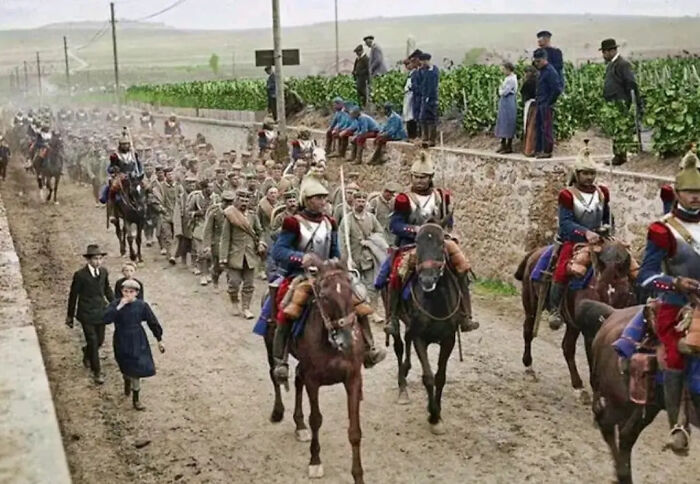
French cavalry returning from the front with prisoners.
© Photo: ww1_stories
#48
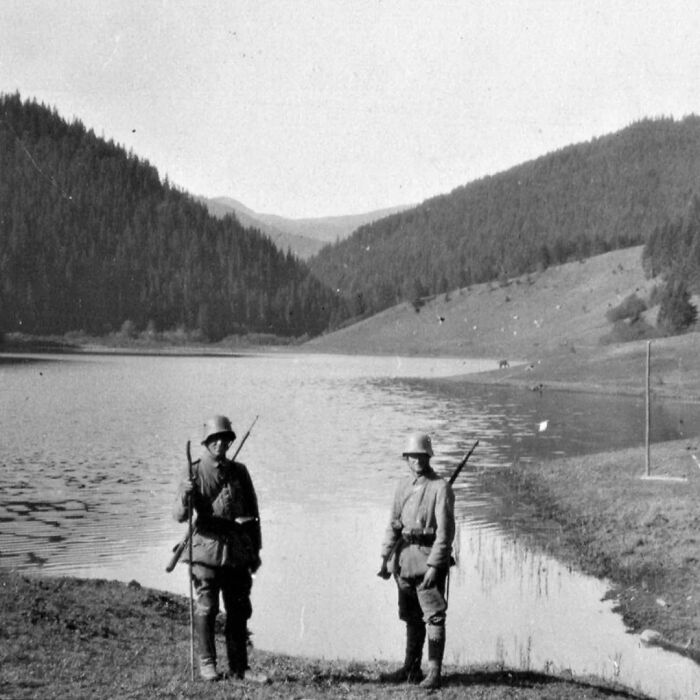
It was June 1916 when Alexander Pfeifer was trained as a stormtrooper company commander and sent to the Carpathian Mountains to fight the Russians. As a specialised mountain unit, he battled the most unfavourable conditions as well the enemy. It was here that he also was awarded his Iron Cross 1st Class. Despite the unfavourable conditions, he writes in his diary how he preferred it here to the Western Front:
“The opinions about our new theatre of war are very varied. Most are thrilled about this wild, adventurous, and truly jäger-like life, yet there are several who long for the cushy and less strenuous life in the West. Anyway, I am happy that I am here.”
His diary and photographs have now been published for the first time in both English and German: The Other Trench / Der Andere Graben.
© Photo: ww1_stories
#49
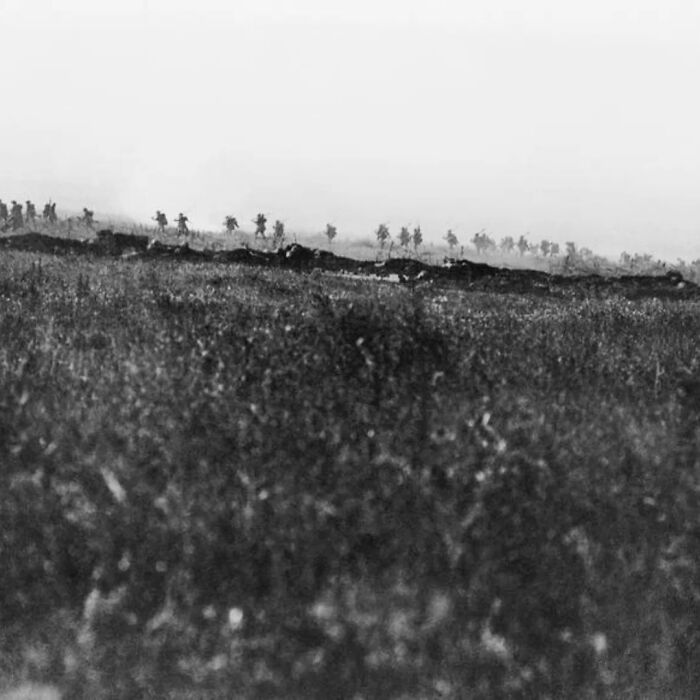
One of the stunning and one of the rare picture of battle of somme. A support company of an a*****t battalion, of the Tyneside Irish Brigade, going forward shortly after zero hour on 1 July 1916 during the attack on La Boisselle.
THE BATTLE OF THE SOMME, JULY-NOVEMBER 1916.
© Photo: ww1_stories
#50
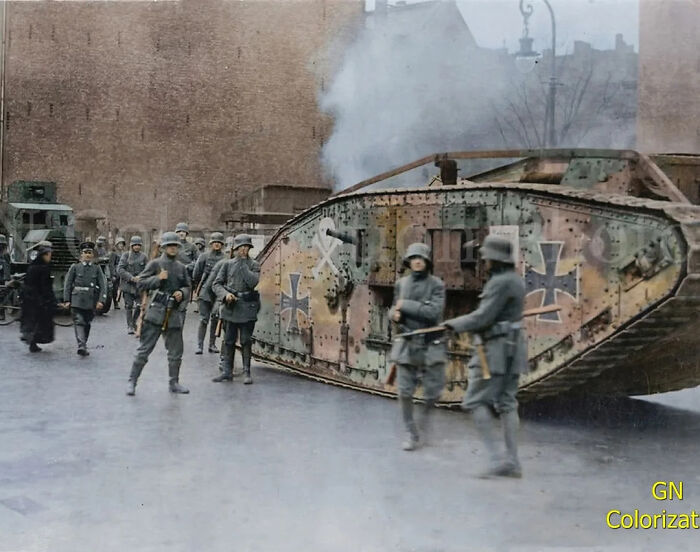
Freikorps utilize a captured British Mk IV tank to put down the Spartacist Uprising, Berlin, 1919
The Spartacist uprising (German: Spartakusaufstand), also known as the January uprising (Januaraufstand) or, more rarely, Bloody Week, was an armed uprising that took place in Berlin from 5 to 12 January 1919. It occurred in connection with the German revolution that broke out just before the end of World War I. The uprising was primarily a power struggle between the supporters of the provisional government led by Friedrich Ebert of the Majority Social Democratic Party of Germany (MSPD), which favored a social democracy, and those who backed the position of the Communist Party of Germany (KPD) led by Karl Liebknecht and Rosa Luxemburg, which wanted to set up a council republic similar to the one established by the Bolsheviks in Russia. The government's forces were victorious in the fighting.
© Photo: ww1_stories
#51
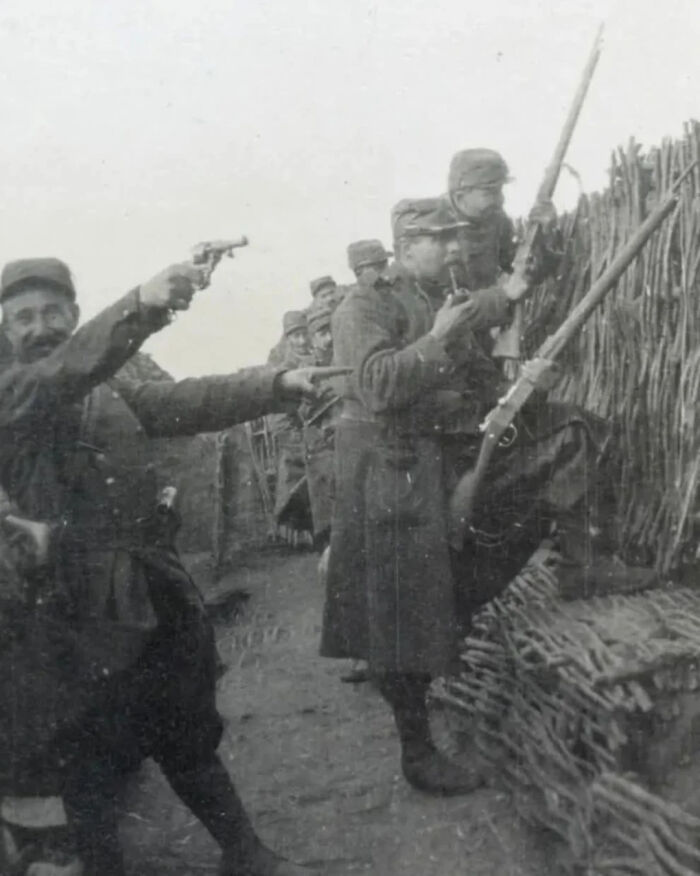
French soldiers in a trench posing as if ready to go over-the-top, 1915.
© Photo: ww1_stories
#52
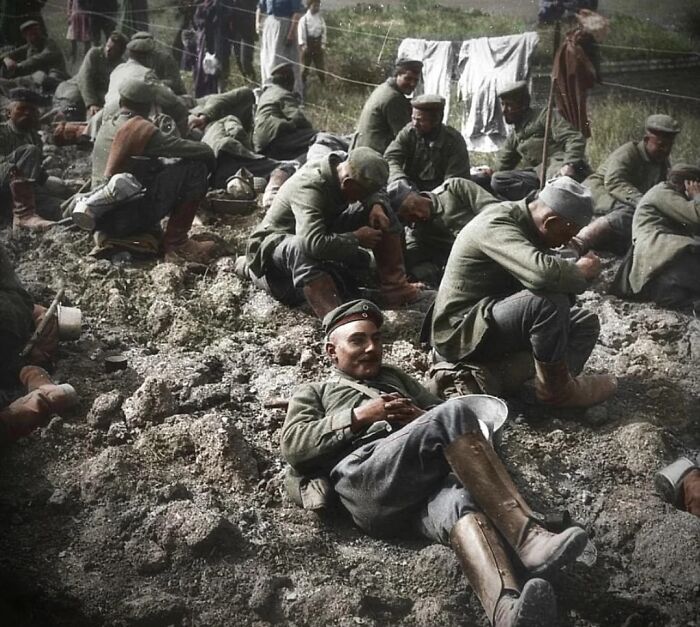
These German prisoners seem content in a field near Villers - Bretonneux in July 1916 early in the Battle of The Somme. On the first day alone 8,000 Germans lost their lives defending the Allied advance which cost 21,000 British soldiers their lives.
© Photo: ww1_stories
#53
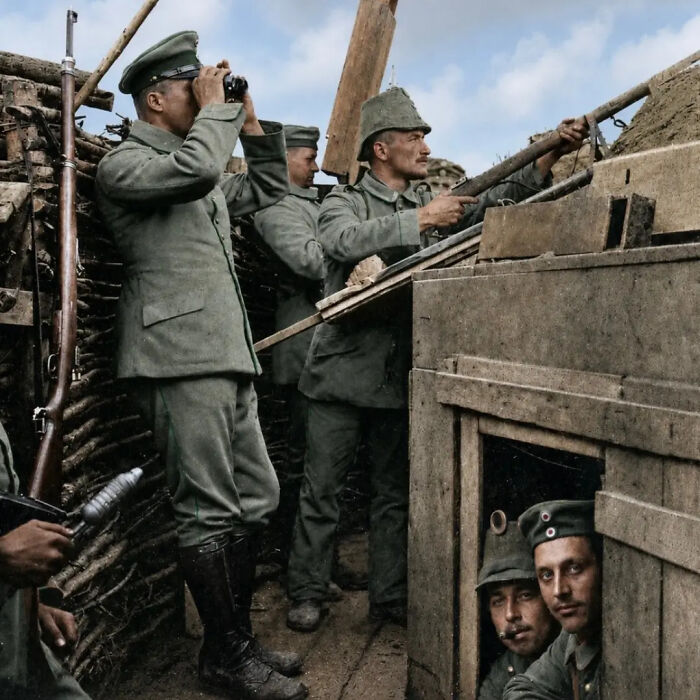
The Western Front, 1915 — German soldiers in the trenches
Taken by Lt. Alexander Pfeifer, an officer of the 11th Kurhessian Jäger Battalion, this photograph offers a rare glimpse into the trenches where he and his men lived and fought.
While being on the frontline, he recorded in his diary:
“Anyone who hasn’t seen them or helped build them has no idea of the work that goes into these trenches, which are over two metres deep. The walls are covered from top to bottom with thick planks and wicker braced with beams to prevent them from sliding together. The ground is covered with duckboards. And yet, this entire huge work has been accomplished only in the d**d of night, under the most unfavourable weather conditions and under enemy fire.”
His wartime diary and hundreds of photographs remained in the family for more than a century before being published in The Other Trench: The WW1 Diary & Photos of a German Officer.
© Photo: ww1_stories
#54
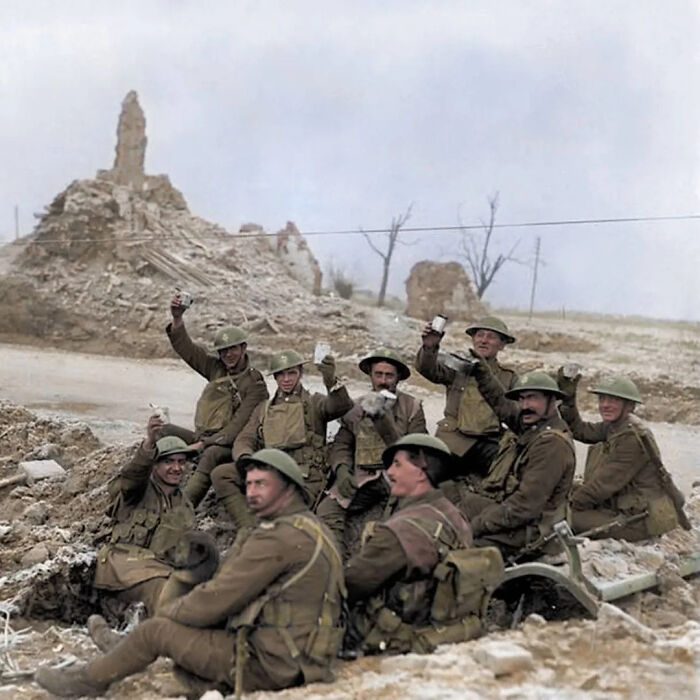
December 1917.
Pioneers of the 11/Liverpool enjoying an alfresco meal in exposed conditions near Ypres.
© Photo: ww1_stories
#55
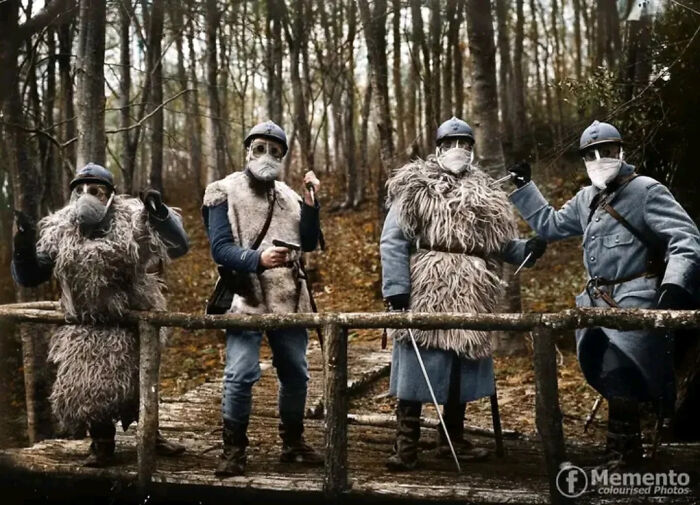
January 1916, forest of Bezange, Lorraine, France,
Four 257th Infantry Regiment Officers with TN gas masks, Coutrot Daggers No. 1, M1892 Revolver and a PA Ruby Gun.
At the beginning of the war, the French soldier had only his bayonet, but it was not adapted to the fighting in the trenches. To be able to face the German daggers (Nahkampfmesser), the French army decided to buy some but the knives were too small (3in / 8cm). To cope with the needs, all the butcher's knives were requisitioned and the French navy gave boarding weapons.
Approved in mid-1915 as a standard military infantry weapon after its development by Lt. Col. Coutrot of the French Army, the “Poignard-Baïonnette Lebel” consisted of a long, needle-pointed, stiletto-profile blade with wood handle and an integrated knuckle guard made of steel. Up to three trench knives could be constructed from a single M1886 Lebel bayonet.
© Photo: ww1_stories
#56
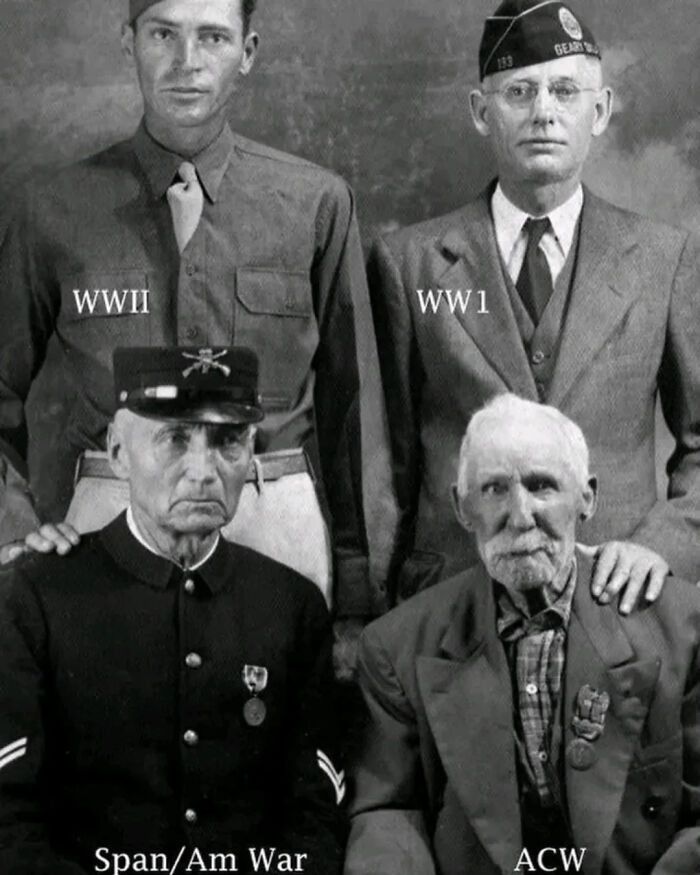
Veterans of four wars from Geary, Oklahoma.
Front: O.P. Ruth, Spanish-American War (1898) and Mr. Everest, American Civil War (1861-1865). Back: Pearl Johnson, World War II (1941-1945) and "Red" Young, World War I (1917-1918). All dates are from the period which the United States was in a state of war.
© Photo: ww1_stories
#57
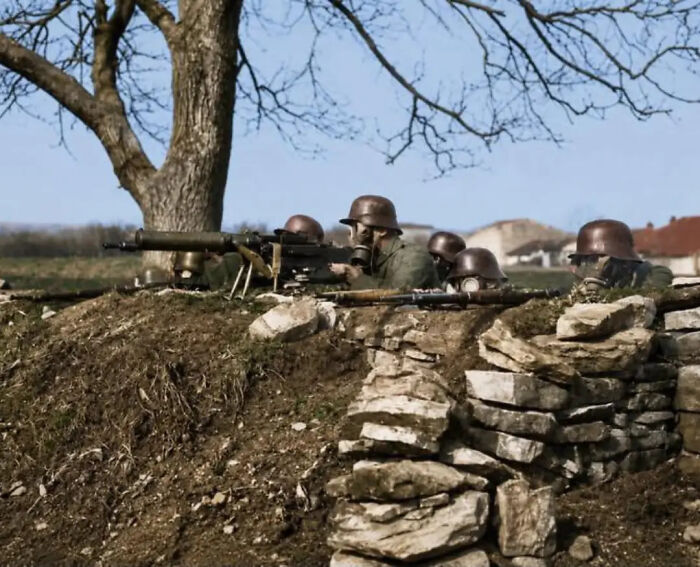
France, 1918. Lt. Alexander Pfeifer photographed men of his shock-troop MG squad in position.
By this stage of the war, Pfeifer was a veteran Stormtrooper company commander who had fought on the Western Front, Eastern Front and Italian Isonzo Front, including the Battle of Caporetto, before returning to France in 1918.
The photograph offers a rare glimpse of the men under his command — part of the personal photographic record preserved alongside his wartime diary in “The Other Trench.”
© Photo: ww1_stories
#58
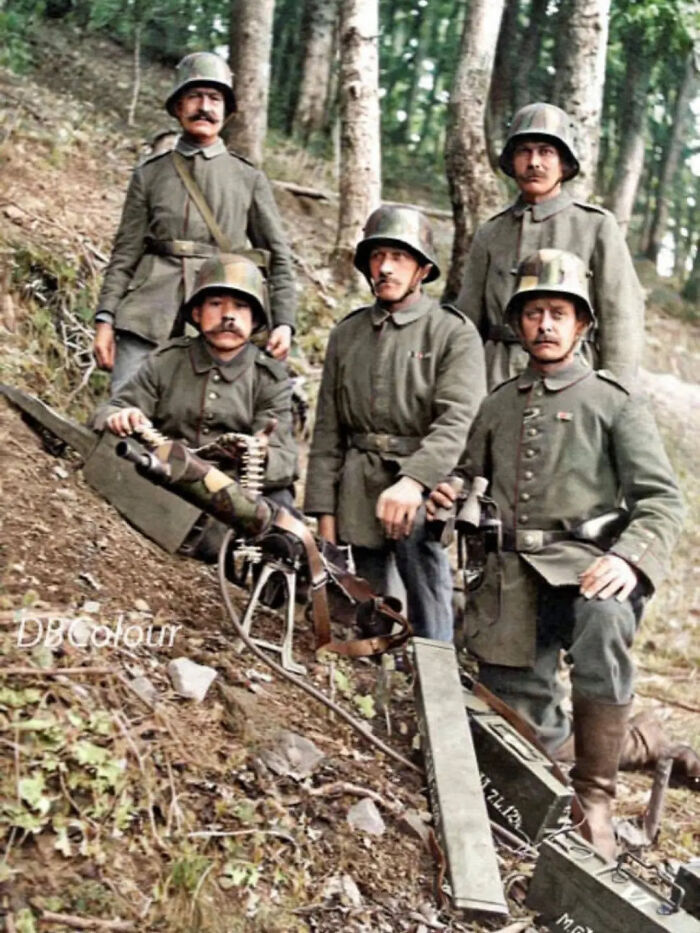
German machine gunners with camouflaged M16 Stahlhelm and MG08/15, summer of 1918.
© Photo: ww1_stories
#59
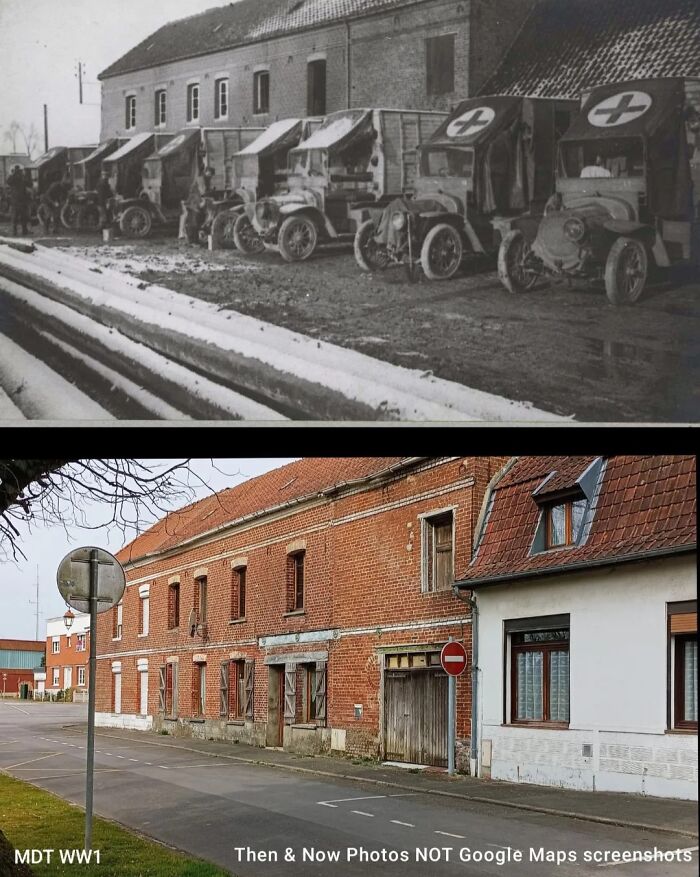
Ww1 then and now, Avesne-le-Comte on November 26, 1915.
Ambulances on what is now Place Louis Mexandeau
© Photo: ww1_stories
#60
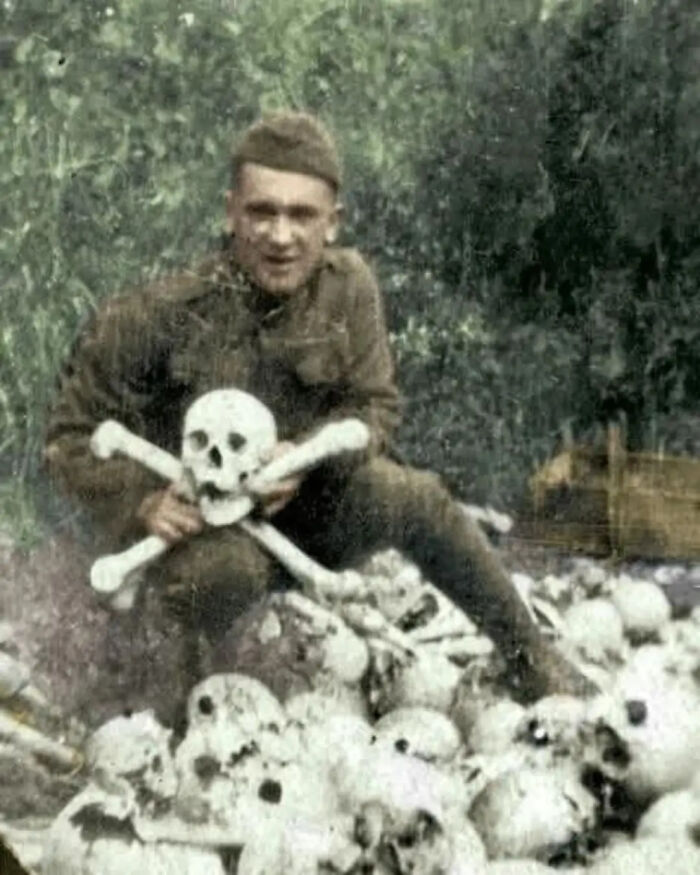
U.S. soldier making the skull and crossbones symbol with bones from an ossuary, 1918.
© Photo: ww1_stories