

The world is full of interesting details and surprises that can change how we see things. Finding something you never knew existed always feels special, like an old photo, a strange invention, or a forgotten moment from history. These discoveries show us there is still so much to explore and learn.
Thanks to the internet, it’s easier than ever to come across amazing stories and photos from everywhere. From overlooked moments in history to incredible human achievements, there are so many things that don’t get much attention but can really stick with you once you find them.
From rare moments caught on camera to details that change how we see history, we bring you a collection of remarkable photos, surprising facts, and stories that seem unbelievable at first. Keep scrolling to check out some of the most fascinating discoveries.
#1
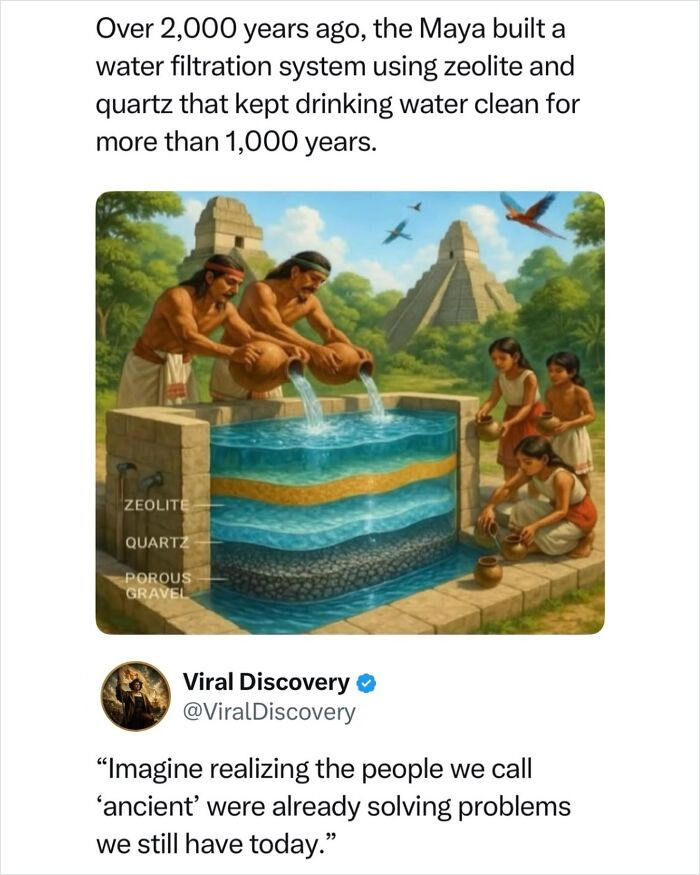
More than 2,000 years ago, the Maya at Tikal were using zeolite and crystalline quartz to purify water. Archaeologists found evidence that the system was operating as early as about 2185 years ago and remained in use for more than 1,000 years.
The zeolite acted like a natural molecular sieve, helping remove harmful microbes and other contaminants from the water. The materials were even transported roughly 30 km to Tikal, showing that this was a deliberate engineering solution, not an accident of nature.
© Photo: viraldiscovery
#2
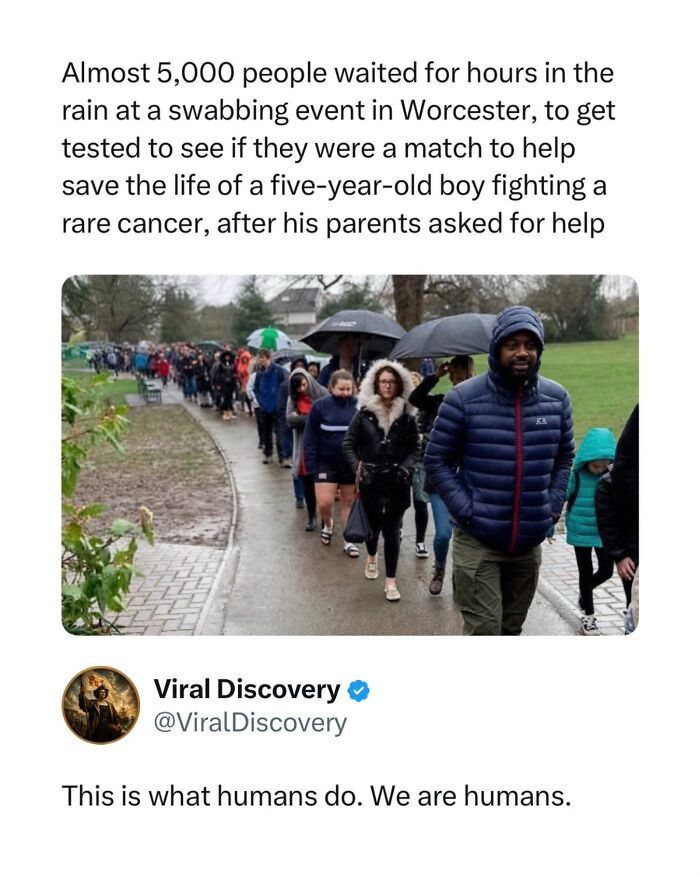
In March 2019, a record-breaking 4,855 people queued in the rain at a Worcester school to join the stem cell register for five-year-old Oscar Saxelby-Lee, who had been diagnosed with aggressive T-cell acute lymphoblastic leukemia.
The two-day drive became DKMS UK’s largest donor registration event at the time. Oscar later received a stem cell transplant in May 2019 after a suitable donor was found.
© Photo: viraldiscovery
Before cameras and recording devices, people still found ways to save information about their lives. In ancient Mesopotamia, communities used clay tablets to record goods, religious events, politics, and other important things. These records give us a detailed look at life thousands of years ago.
Writing soon became more than just a way to keep accounts. By the middle of the third millennium BCE, scribes used cuneiform to record literature, learning, religion, and government. People were already creating a record of their world, leaving details that still help us understand their lives today.
#3
Winston’s first walk did not exactly go according to plan. The tiny English Bulldog puppy went outside for his first-ever walk in August 2022, but apparently walking was a little more exhausting than he expected. Before the adventure was over, Winston ended up taking his first-ever mid-walk nap, curling up beside a pile of landscaping rocks and completely passing out. WeRateDogs shared the pictures on August 23, with one showing Winston ready for his big adventure and another showing him asleep against the rocks. The post quickly went viral, picking up hundreds of thousands of likes. Winston technically made it through his first walk. He just needed a nap along the way.

© Photo: viraldiscovery
#4
Lake Wānaka is one of New Zealand’s major glacial lakes, stretching about 45 kilometres through the South Island’s Southern Alps. At up to 311 metres deep, it’s the country’s fourth-largest lake.
One of its most recognizable landmarks is the Wānaka Tree, a willow growing in the lake that began life as part of a fence decades ago before becoming a famous photography spot.

© Photo: viraldiscovery
Some of the first known examples of writing appeared around 3200 BCE, when the Sumerians invented cuneiform in Mesopotamia, now Iraq. They used a reed stylus to press wedge-shaped marks into soft clay, turning everyday items into records that lasted long after their makers were gone.
In the beginning, people used these tablets mostly for practical reasons like counting goods and managing supplies. Over time, scribes found new ways to express language, so they could write down sentences, names, and ideas. What began as a simple way to track daily business slowly turned into a powerful way to save human knowledge.
#5
Hubert Reeves highlights a profound irony in human behavior by pointing out how we praise abstract spiritual entities while simultaneously damaging the concrete world that keeps us alive. His words serve as a sharp critique of environmental destruction, suggesting that people fail to see the sacred value in the natural world.
By separating spiritual devotion from physical reality, humanity actively poisons the air, water, and ecosystems that provide life. Ultimately, this perspective argues that nature itself is the true force deserving of our reverence, and destroying it is an act of self-sabotage that undermines the very essence of what many claim to worship.

© Photo: viraldiscovery
#6
Yale University’s Beinecke Rare Book & Manuscript Library houses the Mellon Alchemy Collection, one of the world’s most extensive archives of rare texts dedicated to alchemy, astrology, and the occult. Viral social media posts frequently frame this archive as a hidden vault of “forbidden magic books” once banned by religious authorities. The vast collection contains over 300 medieval and Renaissance manuscripts—including original alchemical formulas studied by Sir Isaac Newton—which were curated in the 1940s by Mary Conover Mellon, who was deeply inspired by psychiatrist Carl Jung’s psychological theories on mystical symbolism.
While internet memes dramatically hype up these archives as dark spellbooks, historians view them as priceless windows into early scientific imagination from a time when the boundaries between chemistry, medicine, and magic were blurred. The collection features heavily guarded historical treasures like the 20-foot-long Ripley Scroll, which utilizes intricate illustrations to cryptically map out the creation of the legendary Philosopher’s Stone. Rather than keeping them locked away in a secret occult sanctuary, Yale has actually digitized the vast majority of the collection, allowing the public to freely explore these formerly “forbidden” texts online.

© Photo: viraldiscovery
Many years later, the Joseon Dynasty in Korea became known for its detailed record-keeping. Over its 472-year rule, the royal court kept track of political decisions, official events, and the lives of its rulers. Their records grew to 888 books in 1,894 volumes, offering a thorough account of the dynasty’s history.
Their careful record-keeping included more than just court events. Officials wrote down who compiled the annals, how long it took, and even when workers aired out the books to keep them safe. Even kings could not read these records freely, which helped historians stay independent when writing about royal decisions.
#7
In traditional Korean folk art known as minhwa, particularly during the Joseon Dynasty, tigers were often portrayed in humorous and exaggerated ways rather than as fearsome predators. Artists painted them smoking long pipes, wearing hats, or sitting with awkward, almost human postures. Their cross-eyed, confused, or grumpy expressions were intentionally comedic, turning the powerful tiger into a figure of satire. In many paintings, the tiger symbolized arrogant officials, scholars, or members of the upper class, while nearby magpies represented ordinary people observing and quietly mocking those in authority.
The inclusion of smoking pipes added another layer of social commentary. After tobacco became widespread in Korea during the 1600s, pipe smoking became associated with status, education, and leisure among men. By depicting a tiger leisurely smoking like an elderly nobleman, artists transformed a respected mountain predator into a pompous and somewhat ridiculous bureaucrat. These playful exaggerations reflected the spirit of minhwa, which emphasized symbolism, humor, and emotional expression over realism. As a result, many of these centuries-old tiger paintings still feel surprisingly modern and cartoon-like today.

© Photo: viraldiscovery
#8
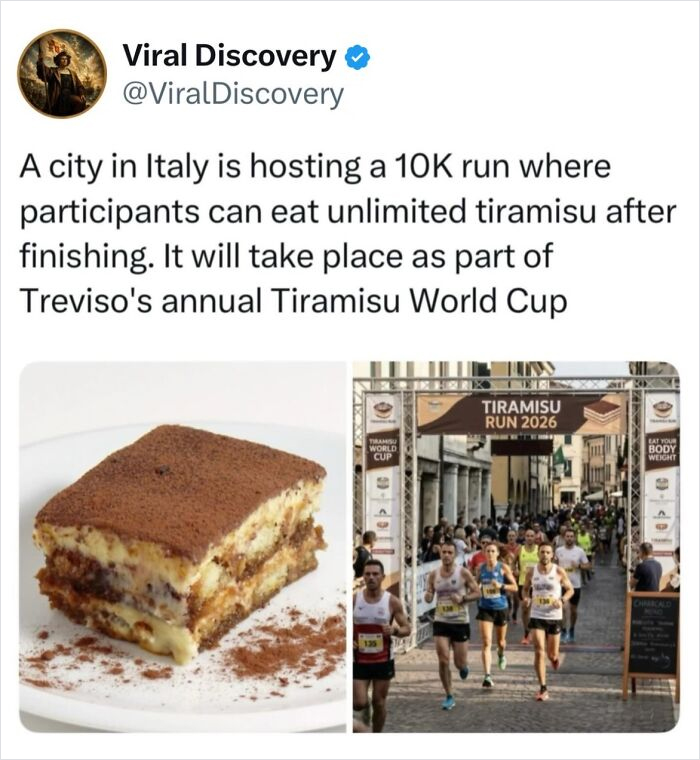
The inaugural “Tiramisù Run” will take place on October 11, 2026, in Treviso, Italy—the official birthplace of the dessert. The non-competitive 10.1-kilometer event winds through the historic center before rewarding finishers with unlimited tiramisu. It coincides with the Tiramisù World Cup weekend, and participant capacity is strictly capped at 1,000 runners.
© Photo: viraldiscovery
#9
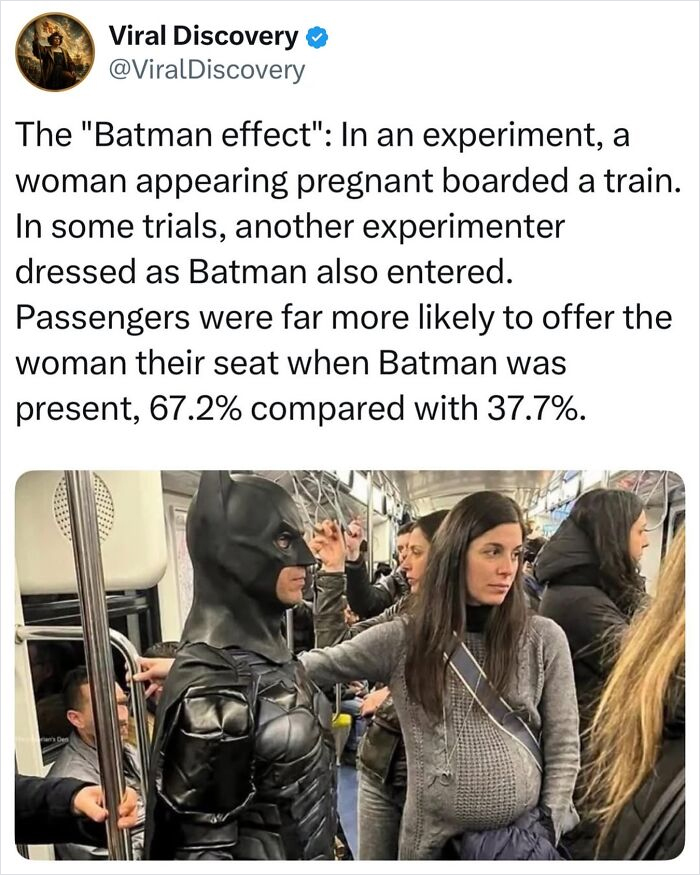
This Italian metro experiment is real, published in npj Mental Health Research.Researchers tested how disruptions alter public kindness using a fake pregnant passenger. In normal settings, commuters offered her a seat 37.7% of the time. When Batman entered another door, compliance surged to 67.2%. Psychologists believe the bizarre sighting jolted riders out of their mental autopilot.
© Photo: viraldiscovery
For hundreds of years, people used paintings, drawings, and written descriptions to record what they saw. This changed in 1839, when photography was introduced to the public. Early methods like the daguerreotype let people capture detailed images of real people and places, giving them a new way to document the world.
Photography soon became more than just an artistic novelty. People could save images of faces, buildings, landscapes, and important moments without needing someone to draw or paint them. As technology improved, photos became easier to make and share, helping future generations see people and places from the past.
#10
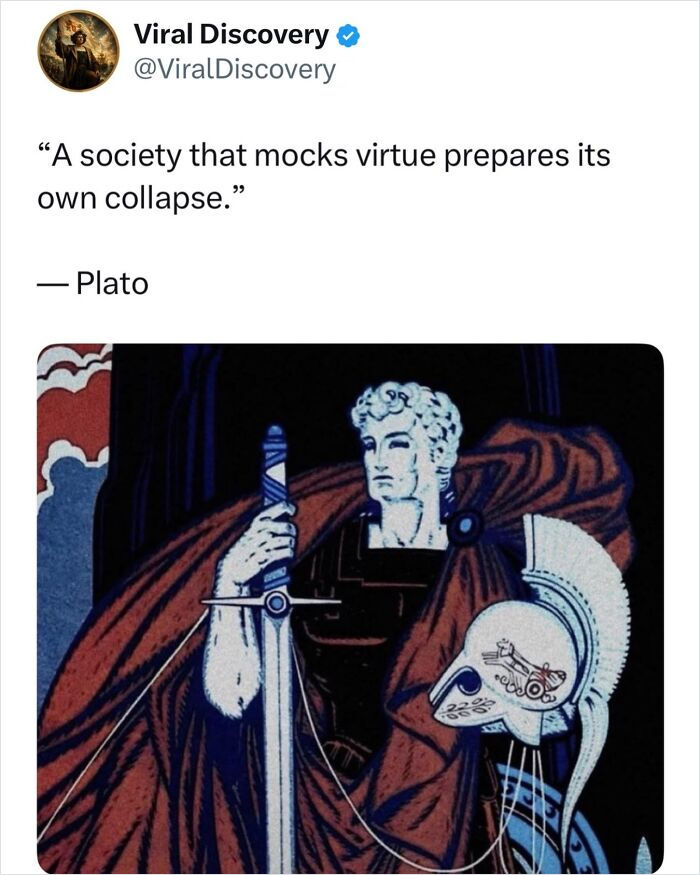
When a society mocks virtue, it systematically destroys the moral foundation required for its own survival. In works like The Republic, Plato argued that qualities such as justice, honesty, and self-discipline are not optional ideals but the essential social glue that holds a community together.
When a culture replaces respect for character with cynicism, treating integrity as a weakness or a joke, mutual trust rapidly evaporates. This internal decay invites widespread corruption and leaves the civilization vulnerable to collapse from within, as citizens prioritize selfish desires over the common good.
© Photo: viraldiscovery
#11
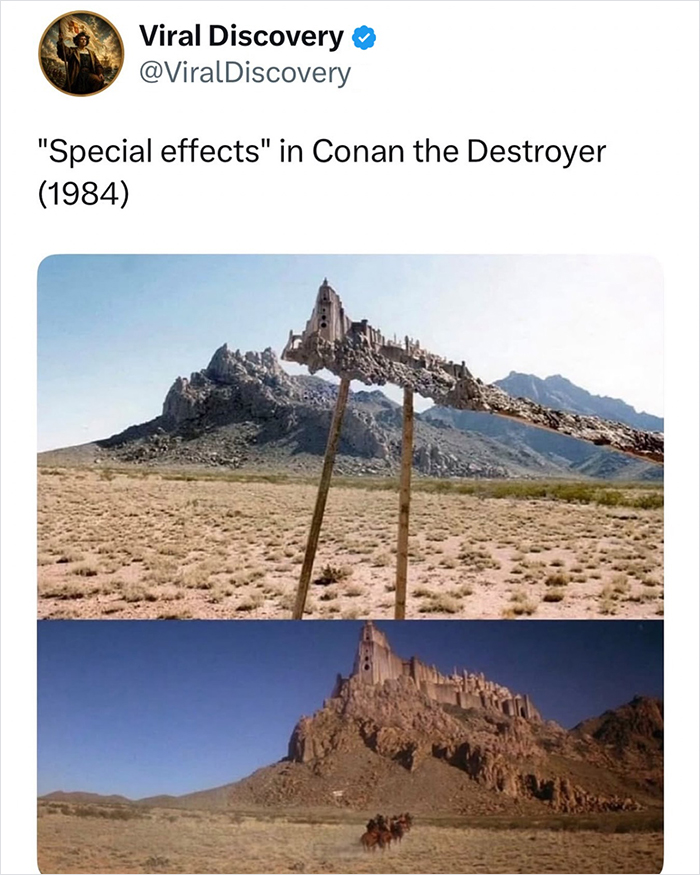
Practical special effects in Conan the Destroyer (1984) relied heavily on ingenious foreground miniatures and forced perspective created by legendary Spanish effects artist Emilio Ruiz del Río. By positioning highly detailed, small-scale physical models close to the camera lens while placing actors far in the background, the crew made small props of castles and temples appear massive.
This entirely practical, in-camera method required exact lighting and precise physical alignment to merge the miniature seamlessly into the live-action environment. Because this fantasy movie was made long before digital visual effects became standard, these physical illusions gave the film a rich and tactile sense of reality that holds up remarkably well today.
© Photo: viraldiscovery
#12
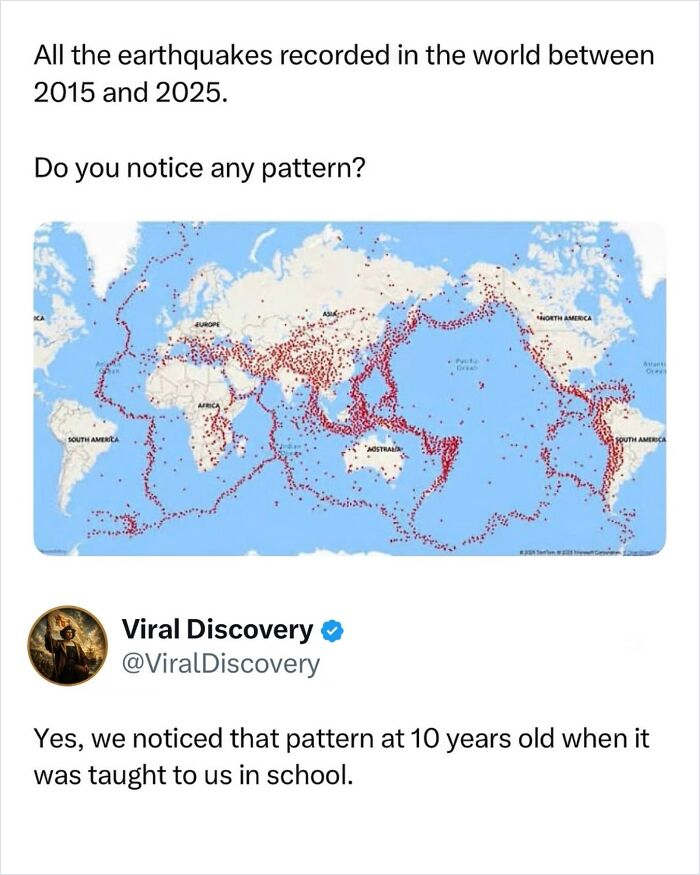
You can practically see the tectonic plates without anyone labelling them
Earthquakes are not randomly scattered across the globe. Instead, they occur in distinct belts that closely follow the boundaries of Earth’s tectonic plates, where massive sections of the planet’s crust are constantly moving. As these plates collide, pull apart, or slide past one another, stress builds up over time until it is released as seismic energy, producing earthquakes.
This is why regions such as the Pacific Ring of Fire, the Mid-Atlantic Ridge, and the Himalayan mountain belt experience frequent seismic activity. The consistent clustering of earthquakes along these plate boundaries has been one of the strongest pieces of evidence supporting the theory of plate tectonics, making it a fundamental concept in geology that has been taught for generations.
© Photo: viraldiscovery
Photography gave people a way to preserve what they saw, but what about the things they heard? In 1857, French inventor Édouard-Léon Scott de Martinville created the phonautograph, a device that traced sound waves onto paper. It could capture sounds visually, although it couldn't play them back.
That changed in 1877, when Thomas Edison introduced the phonograph, the first machine capable of recording and reproducing sound. His first recording featured him reciting the nursery rhyme "Mary Had a Little Lamb." For the first time, people could preserve actual voices and listen to them again, rather than relying on written accounts of what someone had said.
#13
Willie Nelson is an American music icon and one of the pioneers of outlaw country. Over a career spanning more than six decades, he has written timeless classics like “Crazy” and “On the Road Again” while releasing over one hundred albums.
Beyond his massive musical legacy, Nelson is widely recognized for his distinct braided hair, his lifelong activism for family farmers through Farm Aid, and his advocacy for cannabis legalization. His quick wit and enduring vitality have made him a beloved cultural figure who transcends generations.

© Photo: viraldiscovery
#14
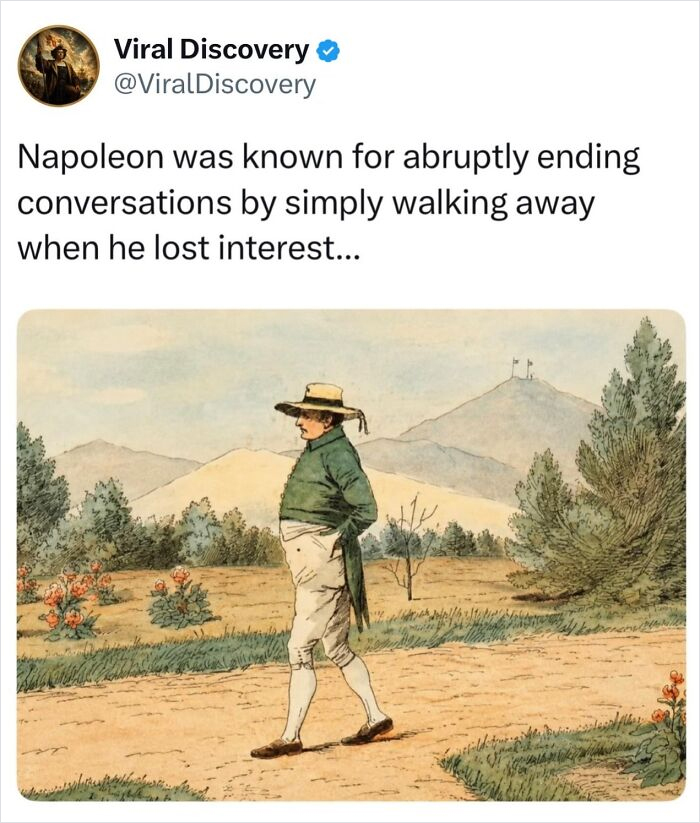
Napoleon Bonaparte often ended conversations by simply walking away the second he lost interest. Driven by efficiency and extreme restlessness, he despised small talk and viewed casual chatting as a waste of time. This abrupt departure was also a power play. It asserted his total authority and kept diplomats and generals constantly off-balance during his meetings.
© Photo: viraldiscovery
#15
In the 19th century, the S-shaped tête-à-tête sofa was invented specifically for gossip. Also called a conversation chair, it positioned two people facing opposite directions but with their heads side-by-side. This let them whisper privately while a central armrest enforced strict Victorian etiquette by keeping their bodies apart.

© Photo: viraldiscovery
Photography and sound recording let people save their experiences in new ways, but it was still hard to share them. This started to change with computer networks. In 1962, computer scientist J.C.R. Licklider pictured a worldwide network where people could get information and use programs from computers in different places.
By 1969, four computers were linked by ARPANET, a network that helped start the modern internet. Researchers could now share information over long distances, and email soon gave them a new way to talk. Over time, this technology became a global network where people can quickly share photos, recordings, documents, and discoveries.
#16
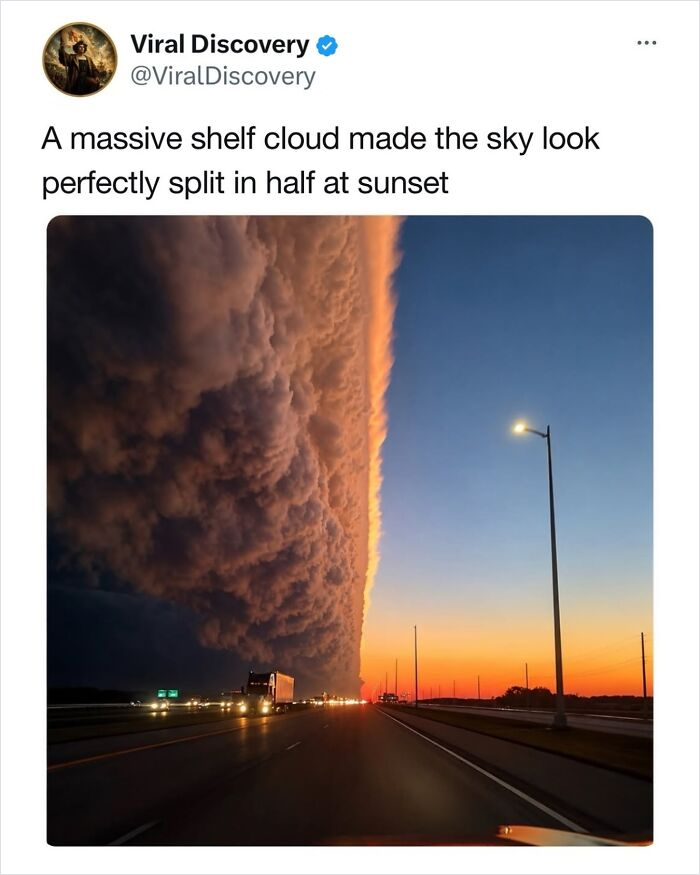
A massive shelf cloud rolled across the horizon at sunset, creating a surreal scene that made the sky look almost perfectly split in two.
Shelf clouds typically form along the leading edge of strong thunderstorms, where cooler storm air pushes underneath warmer air and creates the dramatic, low-hanging formation.
Gustavo Ramirez.
© Photo: viraldiscovery
#17
A Chinese train driver’s career has become a striking visual of how dramatically the country’s rail system changed in just a few decades.
The photos show Han Junjia 26 years apart, first alongside a coal-fired steam locomotive and later beside a Fuxing high-speed train capable of reaching around 350 km/h. During that span, he reportedly retrained across multiple generations of locomotives as China built the world’s largest high-speed rail network.

© Photo: viraldiscovery
#18
This isn’t a train station. It’s a storage yard in Lianyungang, Jiangsu, where rows of China’s high-speed trains are parked before heading out to serve passengers. The photo was taken in the early morning on June 30, 2026.
The scale is a glimpse of just how massive China’s high-speed rail system has become. When China adjusted its railway schedule on July 1, it added 106 passenger train services, bringing the nationwide schedule to 12,174 passenger trains.

© Photo: viraldiscovery
Even though we have more information than ever, there is still much we haven't discovered. The ocean is a good example. Explorers have seen less than 0.001% of the deep ocean floor. Many underwater landscapes are still hidden from us, even after centuries of exploration and big advances in technology.
Scientists also believe there are many marine species we haven't found yet. Some estimates say there could be between 700,000 and one million marine species, and about two-thirds of them are still waiting to be discovered or described. Even after generations of studying our world, nature keeps showing us how much we still have to learn.
The more we learn about the world, the more we realize how many fascinating stories are still waiting to be discovered. And sometimes, all it takes is a closer look to see history in a whole new light.
Which of these discoveries surprised you the most? Leave your thoughts in the comments!
#19
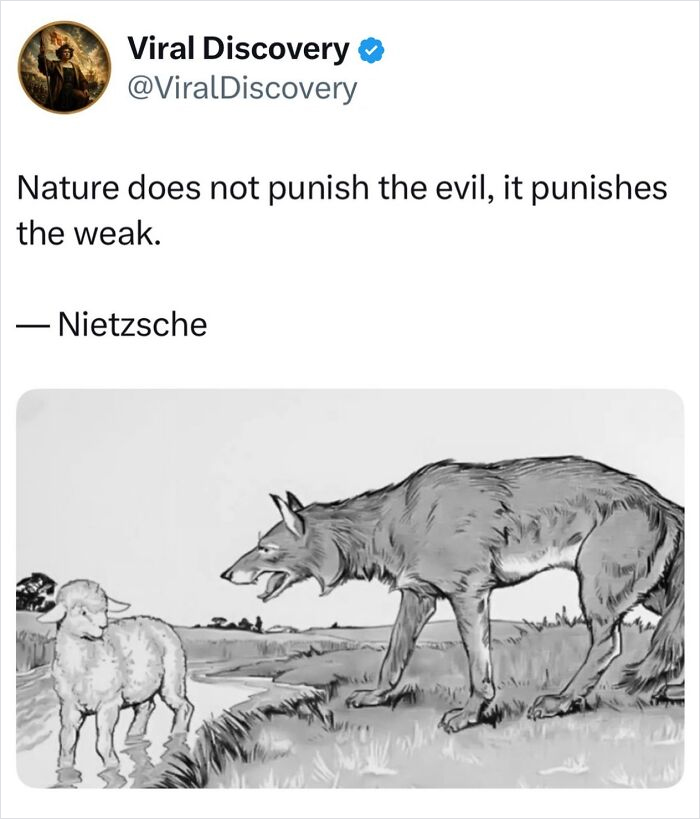
Friedrich Nietzsche argued that nature operates entirely outside of human moral categories. In his view, concepts like good and evil are artificial human inventions rather than universal laws governing reality. The natural world does not care about ethical merit, so it never delivers cosmic justice to bad actors.
Instead, natural forces like disease, environmental changes, and predators solely test a living being’s physical capacity, resilience, and adaptability. This means that survival belongs to the strong and the flexible, while the weak and the unadaptable perish regardless of how morally pure they might be.
© Photo: viraldiscovery
#20
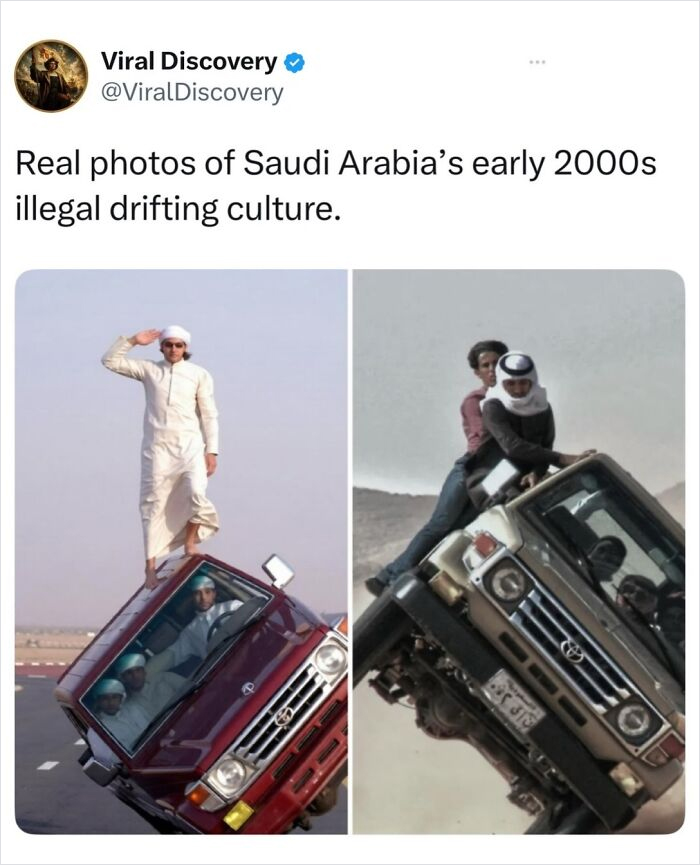
In the early 2000s, Saudi Arabia’s highways hosted a dangerous, illegal drifting subculture known as hajwalah. Drivers modified everyday sedans and SUVs to perform high-speed stunts like balancing vehicles on two wheels while passengers hung out of the windows. Harsh penalties and police crackdowns eventually suppressed the underground scene.
© Photo: viraldiscovery
#21
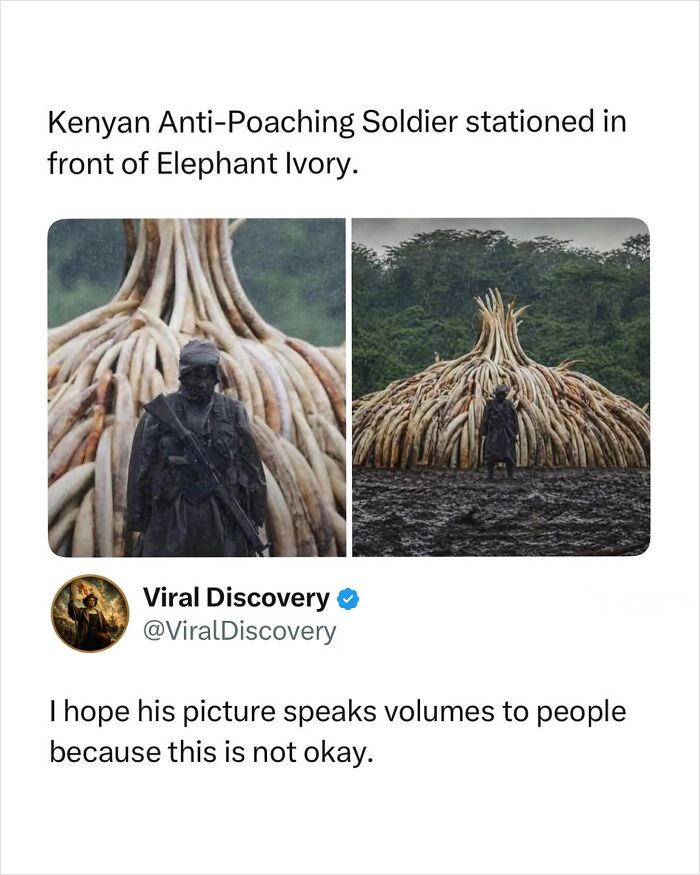
I thought we were over hunting for tusks?!!
“Tusk hunting” usually refers to the pursuit of elephants, walruses, or wild boars specifically for their tusks — prized for ivory, status symbols, weapons, or trade. In the 19th and early 20th centuries, ivory hunters traveled deep into African forests and savannas, facing dangerous wildlife, disease, and harsh terrain in search of massive elephant tusks that could weigh over 100 pounds each.
The hunt became one of the most controversial wildlife practices in history because the global ivory trade devastated elephant populations. Today, many countries ban ivory trading, and conservation groups work to protect elephants from poaching. Modern discussions about tusk hunting often center on wildlife conservation, ethics, and the balance between human traditions and endangered species protection.
© Photo: viraldiscovery
#22
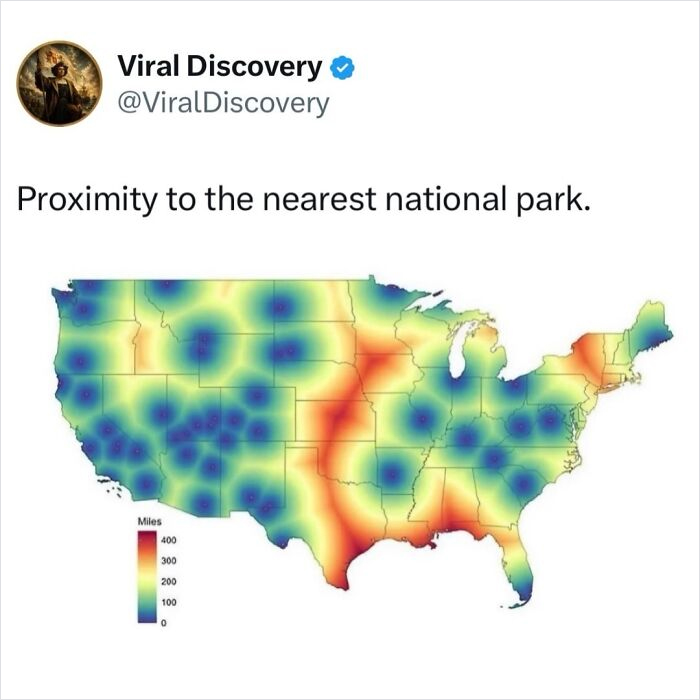
The United States has 63 designated national parks, but the broader National Park Service system includes more than 400 sites, ranging from national monuments and battlefields to historic parks, seashores, rivers, and recreation areas.
The map measures distance in miles, as shown in the key. Dark blue and purple indicate areas closest to a national park, while yellow, orange, and red represent greater distances. The biggest takeaway is how much easier national park access is in the western United States. The West contains dense clusters of some of the country’s most famous parks, including Yosemite, Yellowstone, Grand Canyon, Zion, Glacier, Olympic, and Rocky Mountain. California, Utah, Arizona, Washington, and parts of Colorado are particularly well covered.
By contrast, the orange and red areas highlight regions where residents may be hundreds of miles from the nearest designated national park. Much of the Great Plains, along with parts of Texas, Louisiana, Mississippi, Alabama, and the upper Northeast, have larger gaps in access. That does not mean these regions lack protected or scenic public lands. National forests, state parks, wildlife refuges, historic sites, and national monuments may still be nearby. They are simply farther from a site that falls specifically into the “national park” category.
© Photo: viraldiscovery
#23
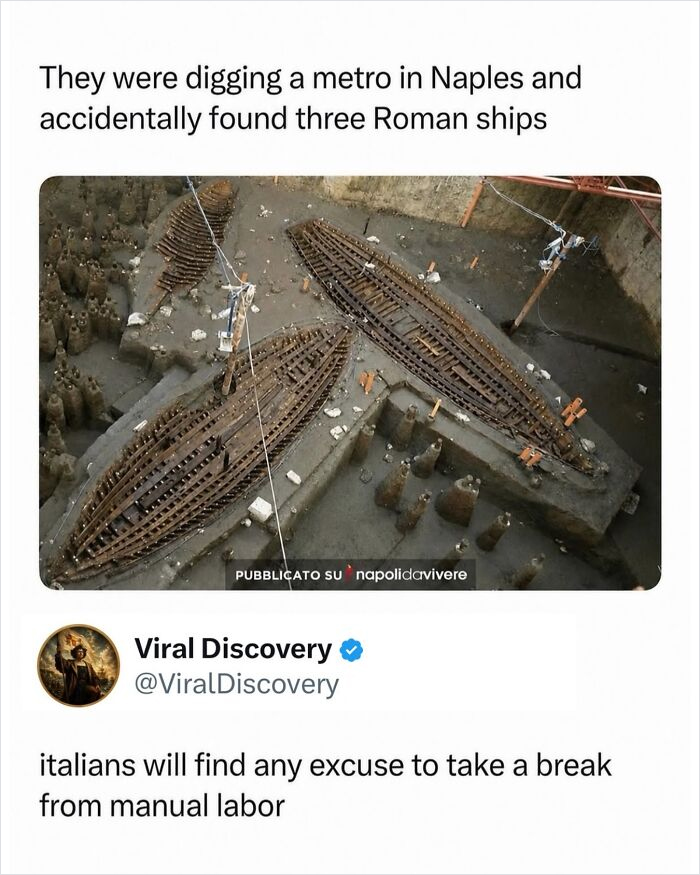
During construction of Naples’ Metro Line 1 in the early 2000s, archaeologists made one of Italy’s most remarkable urban discoveries by uncovering several ancient Roman ships buried beneath Piazza Municipio. Dating back nearly 2,000 years, the vessels were part of a thriving Roman harbor, alongside preserved docks, warehouses, tools, and everyday artifacts that offered a rare glimpse into life during the height of the Roman Empire.
The excavation transformed the construction project into a major archaeological effort, with experts spending years carefully preserving the finds before work on the metro resumed. Today, the discovery is considered one of the most significant archaeological finds in modern Italy, highlighting how layers of history can remain hidden beneath some of the world’s busiest cities.
© Photo: viraldiscovery
#24
After learning that three of their four children were gradually losing their vision, Quebec parents Edith Lemay and Sébastien Pelletier decided to give them something unforgettable: a year traveling the world.
Their children Mia, Colin and Laurent were diagnosed with retinitis pigmentosa, a rare inherited condition that progressively damages the retina. Their brother Léo does not have the condition. The family traveled through countries across Africa, Asia and beyond, filling the kids’ “visual memory” with wildlife, landscapes and new cultures while their eyesight was still strong.
Their journey later became the National Geographic documentary Blink, which follows the family as they focus on experiencing as much of the world as possible instead of letting the diagnosis define their lives.

© Photo: viraldiscovery
#25
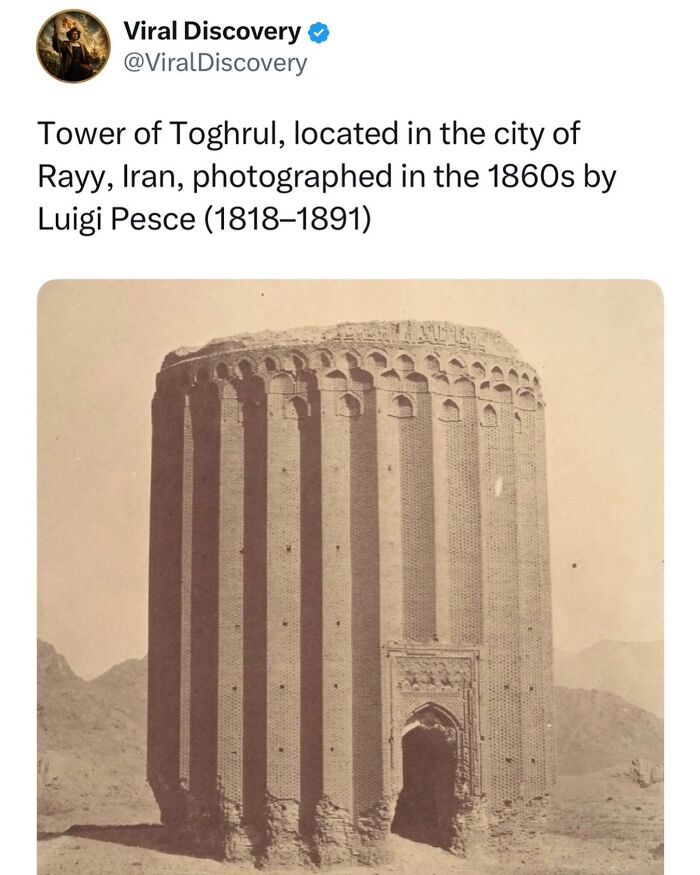
The Tower of Toghrul is a striking 12th-century monument located in the ancient city of Rayy, Iran, that stands as a prime example of Seljuk architecture. Built in 1139, the brick tomb tower rises roughly 20 meters high and features 24 pointed outer flanges designed to function as a giant sundial to track the passing hours.
The historic 1860s photograph by Italian colonel Luigi Pesce captures the structure in its weathered, pre-restoration state before its original conical dome collapsed. This image belongs to one of the earliest comprehensive photographic surveys of Persian heritage, documenting the monument long before modern preservation efforts altered its surrounding landscape.
© Photo: viraldiscovery
#26
Moss are surprisingly efficient at absorbing carbon dioxide, with studies suggesting they can take up to four times more CO₂ per unit area or biomass than trees. This is because mosses lack bark and other protective outer layers, allowing their entire surface to participate directly in gas exchange and photosynthesis. However, despite this efficiency, trees still dominate long-term carbon storage due to their enormous size, wood density, and ability to accumulate carbon over decades or even centuries. Overall, mosses may account for roughly 6% of global biological carbon uptake, making them a small but meaningful part of the carbon cycle.
Beyond carbon absorption, mosses are remarkable for their ability to grow without soil, thriving on rocks, roofs, walls, and tree surfaces by absorbing water and nutrients directly from the air. This adaptability allows them to survive in harsh and urban environments where other plants struggle. In cities, moss can help reduce heat by providing evaporative cooling and shading, which contributes to lowering the urban heat island effect. Because of these benefits, moss is increasingly being explored in green infrastructure such as vertical gardens and biofilters, highlighting its value as a low-maintenance and environmentally useful organism.

© Photo: viraldiscovery
#27
When Bill Withers recorded “Ain’t No Sunshine,” the famous section where he repeats “I know” 26 times was originally meant as a placeholder. However, the musicians loved the raw emotion it brought to the song and encouraged him to keep it in the final recording. Raised in a small West Virginia town, Withers became celebrated for his warm, soulful voice and deeply honest songwriting, often exploring love, heartbreak, and everyday life.
Throughout his career, he created timeless classics such as “Lean on Me” and “Lovely Day,” earning multiple Grammy Awards and leaving a lasting mark on soul and R&B. Though he eventually stepped away from the spotlight, Withers’ music continues to endure for its simplicity, emotional honesty, and timeless appeal.

© Photo: viraldiscovery
#28
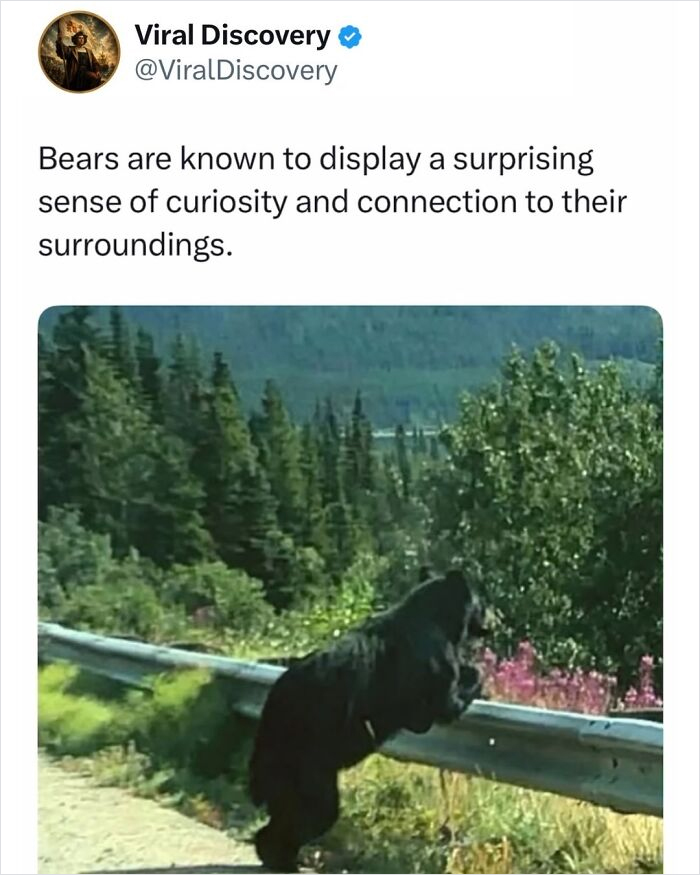
Bears display a surprising level of intelligence and emotional awareness in the way they interact with their environment. Naturalists have often described them sitting quietly for long stretches, seemingly watching sunsets or taking in mountain landscapes, behavior that suggests they may experience moments of reflection beyond simple survival.
Their curiosity leads them to investigate every part of their habitat, relying on exceptional problem solving abilities and an extraordinary sense of smell to make sense of the world around them. Whether choosing scenic places to rest or engaging in playful behavior, bears exhibit a thoughtful, sentient side that highlights a peaceful connection with nature and challenges the stereotype of them as nothing more than fierce predators.
© Photo: viraldiscovery
#29
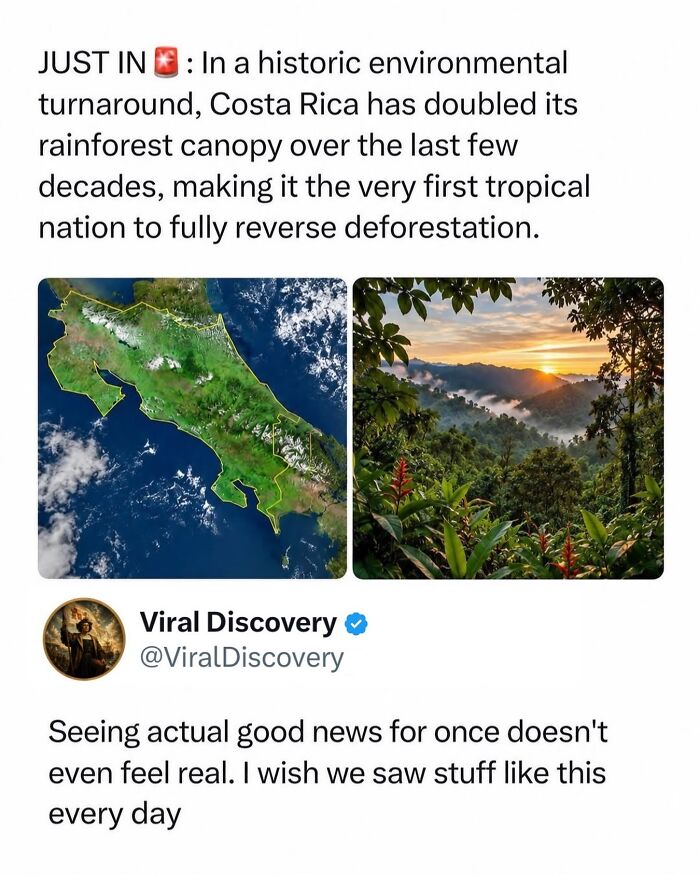
Costa Rica chose the reverse button
Costa Rica is one of the world’s most frequently cited examples of large-scale forest recovery. During much of the 20th century, the country lost enormous areas of forest as land was cleared for cattle ranching and agriculture. By the 1980s, forest cover had fallen dramatically from historical levels.
Then the trend changed.
Costa Rica expanded protected areas and introduced policies that gave landowners financial incentives to conserve and restore forests. Its Payment for Environmental Services program, launched in the 1990s, compensates participating landowners for environmental benefits associated with forests, including carbon storage, biodiversity protection and watershed conservation.
Today, forests cover more than half of Costa Rica’s territory, representing a major recovery from the country’s low point. Tourism also changed the economics of conservation. Rainforests, volcanoes and wildlife became valuable attractions, helping make intact ecosystems economically important rather than simply land waiting to be cleared.
Costa Rica is also extraordinarily biodiverse for its size, containing hundreds of thousands of documented species and ecosystems ranging from cloud forests to tropical beaches.
Turns out forests can make a comeback when protecting them becomes the plan.
© Photo: viraldiscovery
#30
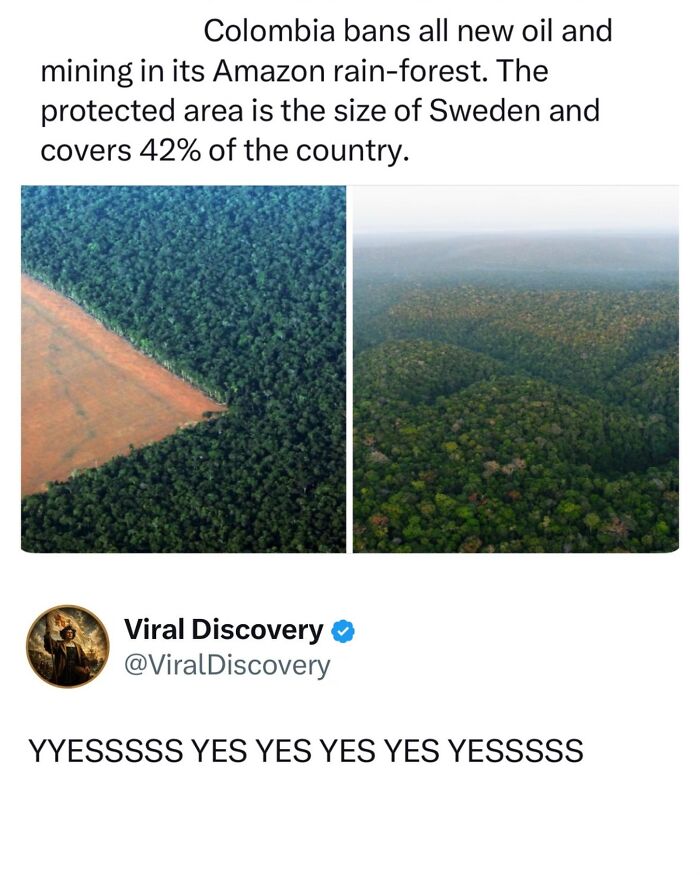
Colombia has passed a landmark environmental law banning all new oil extraction and mining operations across its entire Amazon rainforest territory — a protected area equivalent in size to the entire country of Sweden, covering 42% of Colombia’s total landmass. The move makes Colombia one of the most aggressive nations in the world in terms of formal legal protection for its rainforest and sets a precedent that environmental groups are hoping other Amazon nations will follow.
The significance cannot be overstated. The Amazon is frequently described as the lungs of the Earth — a carbon sink so vast that its destruction directly accelerates global warming at a scale that affects every country on the planet. While deforestation continues at devastating rates across the broader Amazon basin, Colombia’s decision to draw a legal line across nearly half its territory is the kind of policy shift that will be studied and referenced for decades.
© Photo: viraldiscovery
#31
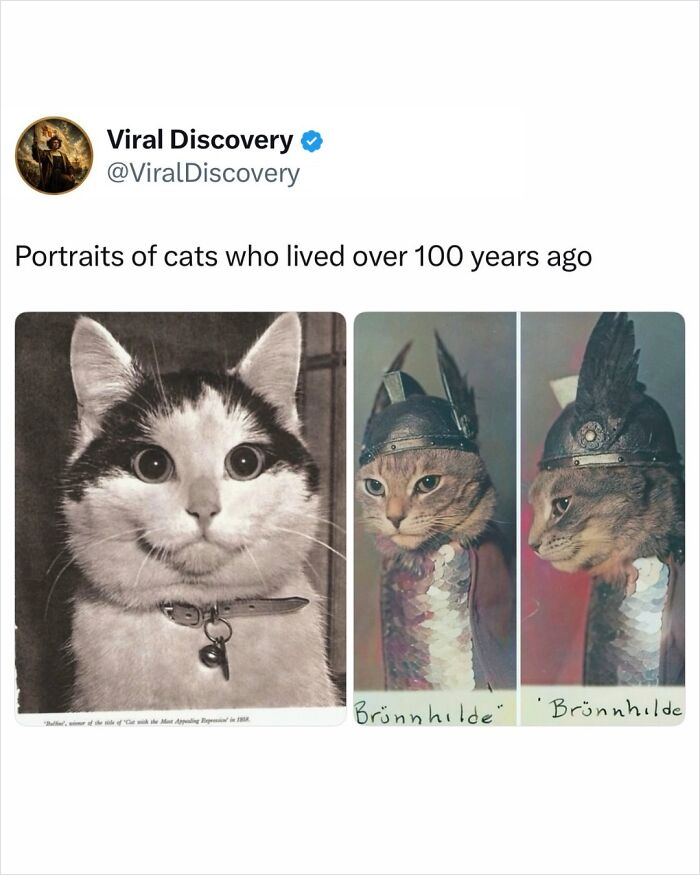
By the late nineteenth and early twentieth centuries, cats had become surprisingly frequent subjects of photography, appearing in everything from formal studio portraits to humorous staged scenes. Early photographers posed them with ribbons, costumes and miniature props much as they did human sitters, while advances in photographic technology gradually made candid pet photography easier. Several surviving examples have entered museum collections: the Science Museum Group preserves an early albumen cabinet card titled The Old Batchelor, showing a cat posed on a barrel beside a bottle and glass, while photographs from 1936 show a remarkably patient cat named Brünnhilde dressed as the Valkyrie from Wagner’s Ring cycle.
These portraits also document how long cats have occupied a familiar place within domestic life and popular culture. By the twentieth century they were appearing in newspapers, advertisements, competitions and elaborately staged novelty photographs, often given the same individual names and personalities that characterize pet culture today. Brünnhilde’s portraits, photographed by Adolph E. Weidhaas, are now preserved by the Library of Congress, nearly ninety years after they were made. Together with the older Victorian-era portraits that survive in photographic collections, they offer a small but unusually relatable record of everyday affection for animals across generations.
© Photo: viraldiscovery
#32
Japanese scientists at ATR Computational Neuroscience Labs have developed a “dream recorder,” but it doesn’t play smooth movies yet. By combining fMRI brain scans with AI, the system matches sleeping neural patterns against a trained visual database. It currently reconstructs rough, blurry, 60% accurate flashes of shapes and objects the dreamer can recognize upon waking.

© Photo: viraldiscovery
#33
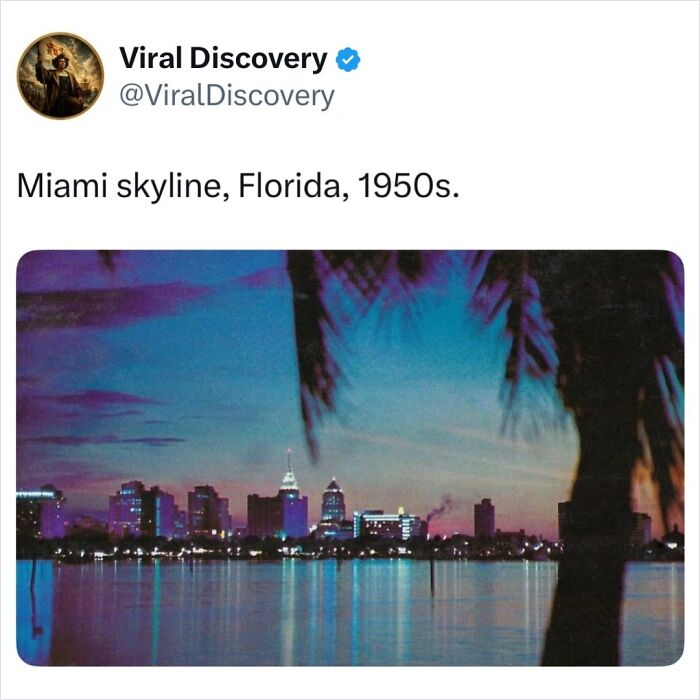
In the 1950s, Miami transformed into a sparkling winter playground defined by postwar optimism and a booming tourism industry. As dusk fell over Biscayne Bay, the modest downtown skyline illuminated with brilliant neon hues of purple and turquoise blue, reflecting smoothly across the calm coastal waters. Palm trees swayed along the shorelines, framing a city that balanced mid-century modern architectural ambition with a relaxed tropical atmosphere.
Visitors and residents alike embraced a lifestyle of leisure, cruising along the wide waterfront boulevards in stylish automobiles and enjoying the vibrant nightlife that put South Florida on the global map. This era captured the essence of the Magic City at a unique crossroads, standing as a tranquil yet energetic coastal oasis just before the dramatic high-rise development of later decades.
© Photo: viraldiscovery
#34
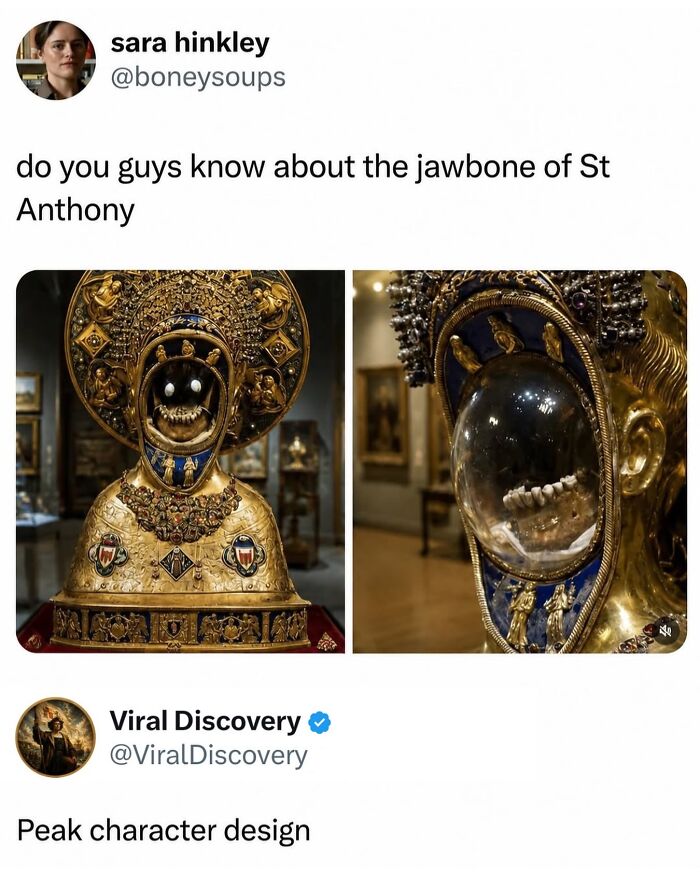
Crazy
Medieval Christian relic culture produced some of the most elaborate devotional objects in Europe, and the reliquary of St. Anthony of Padua’s jawbone is one of the most striking examples. Housed in the Basilica of Saint Anthony in Padua, Italy, the relic contains what is believed to be the saint’s mandible, displayed behind a crystal window and set within an ornate gilded bust crafted in the 14th century. Relics like this were created to honor saints whose teachings or miracles had shaped entire communities, and the craftsmanship surrounding them was often intended to reflect the saint’s spiritual importance.
St. Anthony died in 1231, and when his remains were exhumed in 1263, witnesses reported that his tongue and jawbone were unusually well-preserved—an event interpreted as a sign of his preaching and teaching. Over the centuries, these relics became central to pilgrimage traditions, drawing visitors from across Europe. While the reliquary may look dramatic or otherworldly to moder.
© Photo: viraldiscovery
#35
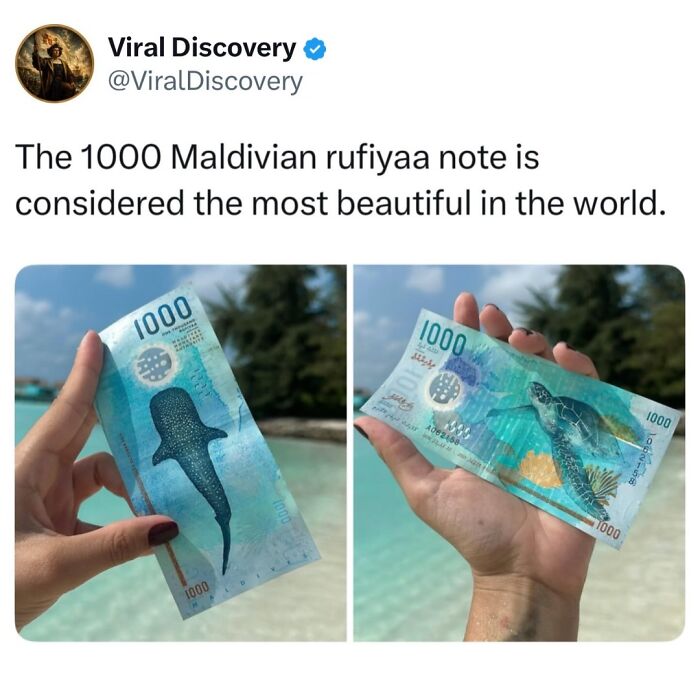
This viral sentiment is highly accurate and backed by international design recognition. While designating any currency as the absolute “most beautiful” involves personal taste, the Maldivian 1,000 rufiyaa polymer note is widely celebrated globally by collectors and design experts as a masterpiece. Issued as part of the [“Ran Dhihafaheh” (Golden Fifty) series] to commemorate 50 years of independence, the note officially achieved elite design status when it was named a top finalist and secured second place globally in the International Bank Note Society’s (IBNS) prestigious Banknote of the Year competition.
Titled [“The Beauty in Our Surrounding, “] the ocean-blue currency explicitly treats the country’s vibrant marine ecosystem as a work of art rather than a standard background element. The front features an intricate underprint patterned after whale shark skin alongside a swimming green sea turtle, while the reverse prominently showcases a majestic whale shark gliding through deep blue and gold waters. Because it is printed on a durable, waterproof polymer material, the note seamlessly incorporates transparent security windows and holographic features, prompting millions of travelers to routinely keep it as a prized vacation souvenir instead of spending it.
© Photo: viraldiscovery
#36
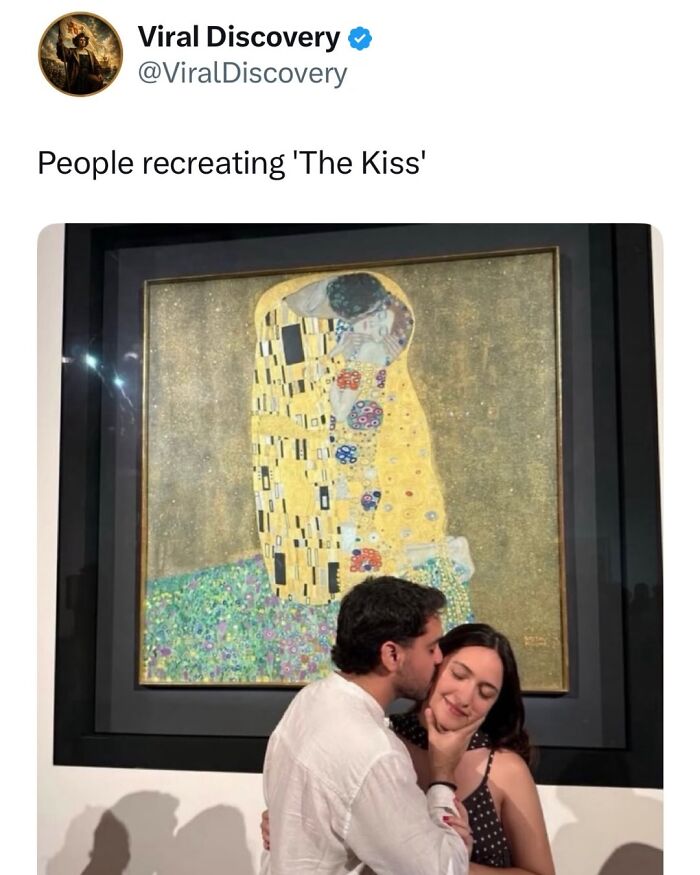
Gustav Klimt’s 1908 painting remains one of the most frequently parodied and celebrated images in art history. Modern creators bring the symbolist masterpiece to life by meticulously designing gold-patterned clothing, matching the intimate, kneeling pose of the lovers, and using metallic backdrops to capture the essence of the Golden Period.
These striking tributes span across photography, elaborate cosplay, and digital illustrations, allowing contemporary couples and artists to step directly into the romance of the original canvas.
© Photo: viraldiscovery
#37
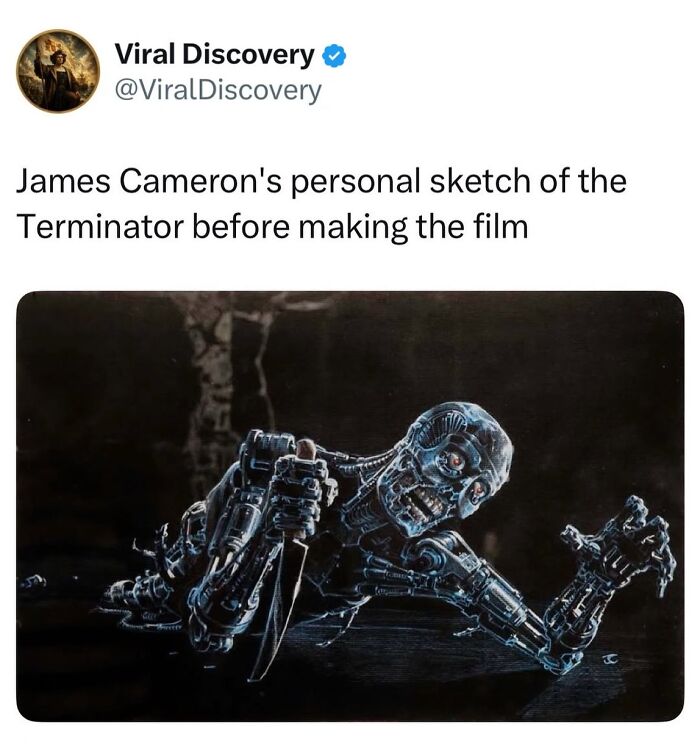
James Cameron famously sketched the initial concept of the Terminator in 1981 after waking from a vivid, fever-induced nightmare in Rome. In his dream, he saw a metallic, chrome endoskeleton holding a kitchen knife as it dragged its mangled torso out of an explosion. He immediately put pen to paper to capture the terrifying image, and that exact sketch later became the direct inspiration for the movie’s climactic final sequence.
Because he was an unknown director at the time, Cameron relied heavily on these highly detailed personal illustrations and storyboards to pitch his vision to skeptical film studios and secure the financial backing needed to bring the legendary sci-fi character to life.
© Photo: viraldiscovery
#38
In the early moments of the 9/11 attacks, many bystanders in New York City took photographs because they initially believed the first plane crash was a tragic aviation accident. Without smartphones, social media, or instant news alerts, people had little real-time information to understand that a coordinated terrorist attack was unfolding.
Tourists and locals reacted with shock and curiosity, photographing the burning towers, with some even smiling for pictures because they had not yet grasped the severity of what was happening. The lack of information created a surreal contrast between ordinary life and the catastrophe unfolding around them.
Today, these photographs serve as haunting historical records, capturing a moment of disbelief before the full scale of the tragedy became clear to the world.

© Photo: viraldiscovery
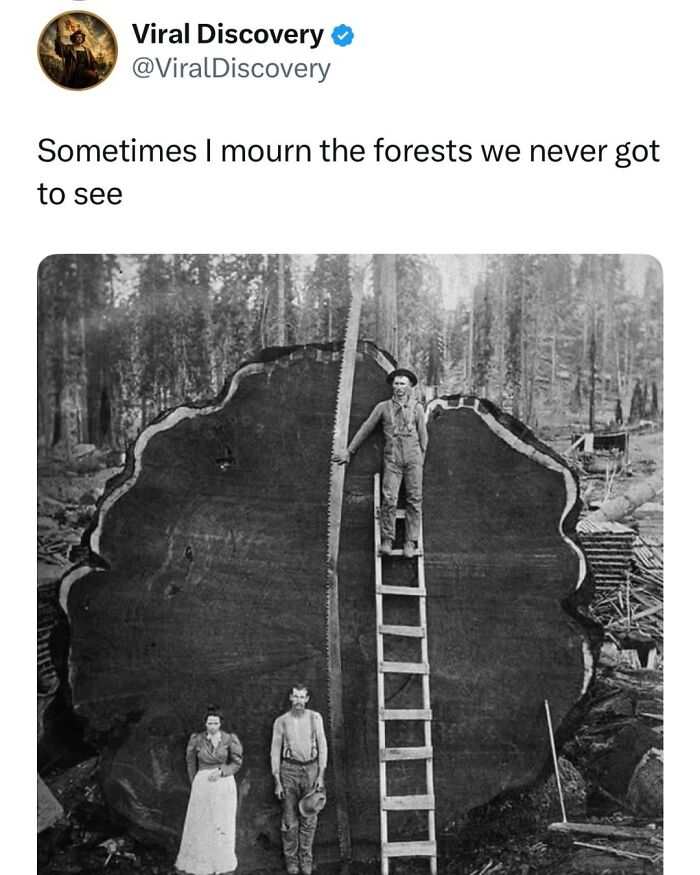
#39
The year 1891 marked a massive turning point for industrial logging because the passage of the Forest Reserve Act triggered an aggressive rush by timber companies to clear public lands before federal protections could take effect.
This expansion introduced steam-powered machinery that allowed humanity to systematically erase ancient ecosystems, particularly the millennia-old Coast Redwoods and Giant Sequoias of the American West. These ecological giants were rapidly reduced to raw lumber for railroads and housing, destroying complex habitats before scientists could even fully understand their biological value. The staggering scale of deforestation during this era represents a profound, permanent environmental sacrifice that stands as a haunting testament to the majestic wilderness lost to modern progress.
© Photo: viraldiscovery
#40
Born in Japan on January 2, 1903, Kane Tanaka became the world’s second-oldest validated person in history, living an extraordinary 119 years and 107 days before her passing in April 2022. Spanning three different centuries, her life served as a living timeline for modern history; she was just 11 years old when World War I began, 36 at the start of World War II, 74 when the original Star Wars premiered, and 117 during the global COVID-19 pandemic. She lived through the reigns of five different Japanese emperors, anchoring a personal history that witnessed the dawn of aviation, the rise of the digital age, and the turn of two millennia.
Tanaka spent her final years in a Fukuoka nursing home, where her sharp mind and vibrant personality continually amazed medical staff. She attributed her immense longevity to a deep faith, a passion for writing poetry, and a daily routine of solving mathematical puzzles to keep her brain active. She was also famously celebrated for her lifelong sweet tooth, routinely drinking three cans of Coca-Cola a day and eating large amounts of chocolate. In 2019, she was officially recognized by Guinness World Records as the world’s oldest living person, cementing her legacy as a global symbol of vitality and resilience.

© Photo: viraldiscovery
#41
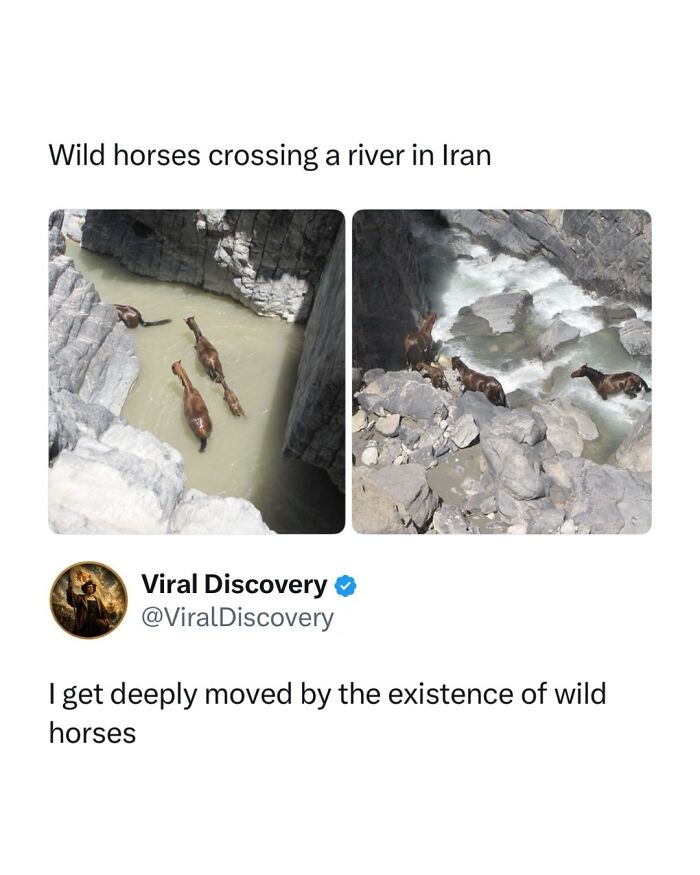
I forgot they can be wild…
These striking images of horses navigating a rocky river in Iran have circulated online for years and are credited to Iranian photographer Eydi Heydari. Versions of the photographs were already being shared online by at least 2022.
Free-roaming horses can still be found in parts of Iran, including mountainous and river regions. Similar herds have been documented around Taleghan, Damavand and northern Iran.
Eydi Heydari.
© Photo: viraldiscovery
#42
In 2022, Senator Bernie Sanders sat by himself on the U.S. Capitol steps after the Senate voted 99 to 1 against his amendment to slash Medicare prices in half.

© Photo: viraldiscovery
#43
Sylvia Plath was an American poet and writer whose work became known for its emotional intensity and striking imagery. She was born in Massachusetts in 1932 and began writing poetry at a young age. Plath published her first poetry collection, The Colossus, in 1960.
Her novel The Bell Jar, published in 1963, drew heavily from experiences in her own life. Her poetry often explored identity, relationships, nature, and the complexities of the inner self. Although her life was tragically short, Plath became one of the most influential American poets of the 20th century.

© Photo: viraldiscovery
#44
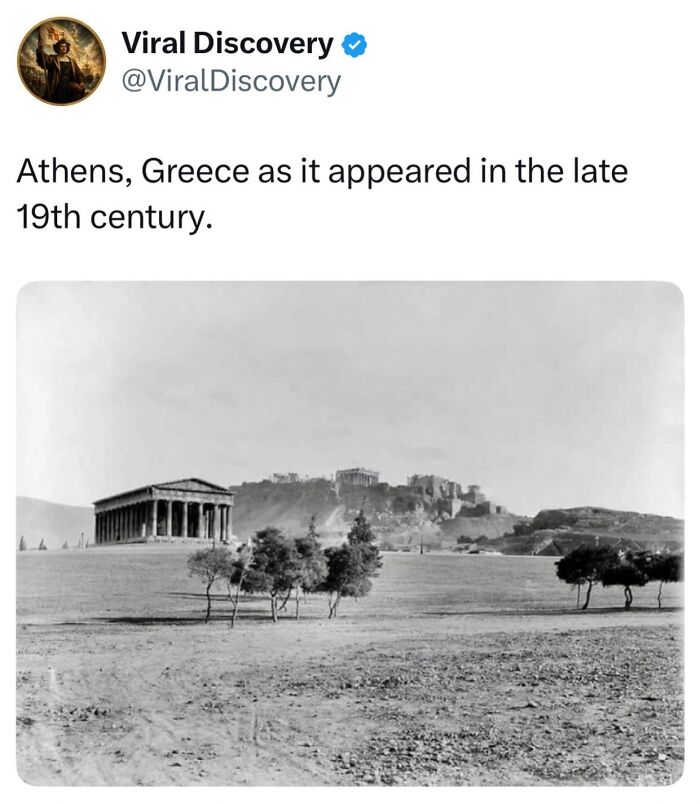
This historic late-19th-century photograph captures the Temple of Hephaestus standing on the Agoraios Kolonos hill in Athens during an era before extensive archaeological excavation. In the background, the Acropolis rises above the barren landscape to showcase the Parthenon and its surrounding classical ruins.
The image highlights a largely open and undeveloped terrain where sparse trees dot the ground, offering a rare look at the ancient monuments prior to the major modern urban expansion and archaeological digs that transformed the surrounding city.
© Photo: viraldiscovery
#45
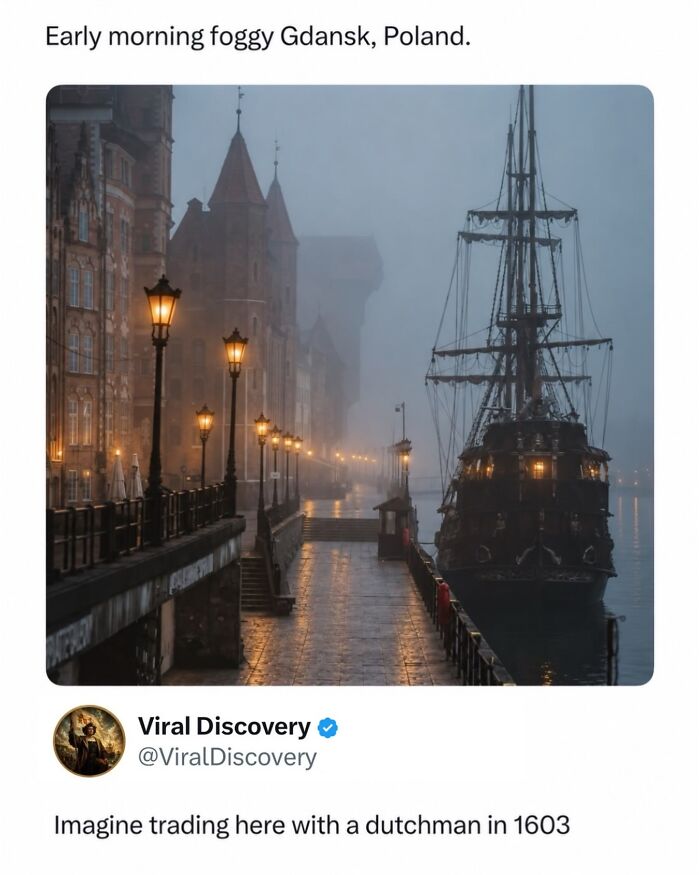
This looks straight out of another century
Early morning fog completely transforms Gdańsk, Poland, turning its historic waterfront into a scene that feels like it belongs hundreds of years in the past. The combination of old European architecture, glowing street lamps, wet cobblestones, a tall sailing ship and thick mist over the Motława River makes it surprisingly easy to imagine what this important port city might have felt like during the height of European maritime trade.
Gdańsk has centuries of history tied to shipping, merchants and international commerce. Its position on the Baltic Sea helped make the city an important trading center, connecting Poland and the wider Baltic region with merchants from across Europe. Ships carrying grain, timber and other valuable goods regularly moved through its harbor, while traders from different countries arrived to negotiate deals and build commercial relationships.
And that makes the comment about trading with a Dutchman in 1603 even better. Dutch merchants played a major role in Baltic trade during this period, with enormous quantities of grain and other commodities moving from the Baltic region toward the Netherlands and Western Europe. Gdańsk was one of the major ports involved in that commercial network.
Now imagine arriving before sunrise four centuries ago. The harbor covered in fog, wooden sailing ships sitting silently along the waterfront, merchants preparing their cargo, lanterns glowing through the mist and negotiations beginning before another ship departed across the Baltic.
Modern Gdańsk might have changed dramatically, but on mornings like this, the atmosphere makes centuries of history suddenly feel incredibly close.
Imagine pulling up here for a business meeting in 1603.
© Photo: viraldiscovery
#46
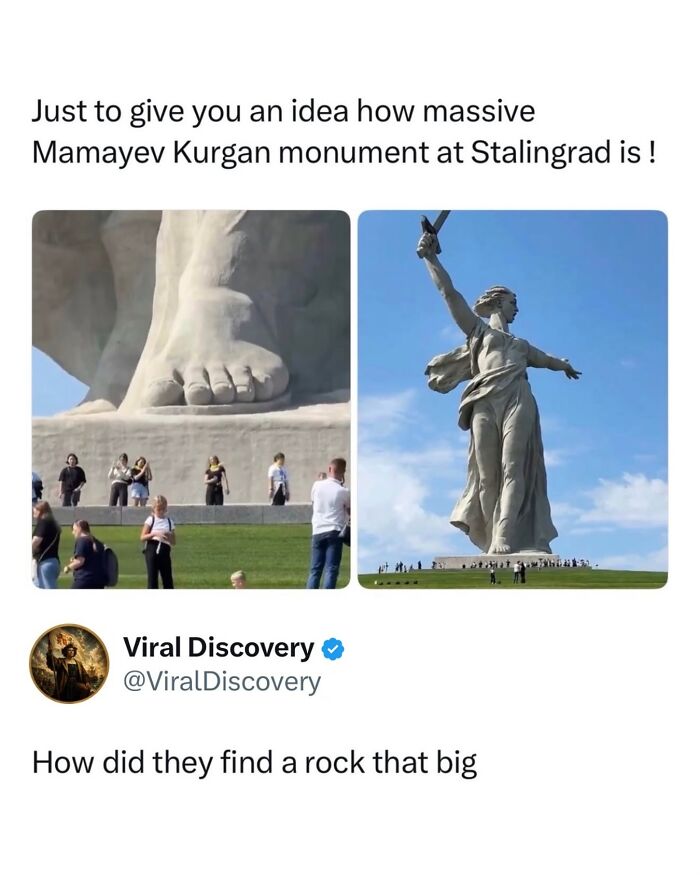
The scale of this thing is hard to comprehend
The Motherland Calls in Volgograd, Russia, stands around 85 meters tall from its base to the tip of its sword. Despite looking like it could have been carved from some enormous piece of stone, it was actually built from thousands of tonnes of reinforced concrete between 1959 and 1967.
The inside is hollow too, with a network of chambers and steel cables helping support the enormous structure. The sword alone stretches roughly 33 meters, which gives you some idea of just how massive the whole thing really is.
© Photo: viraldiscovery
#47
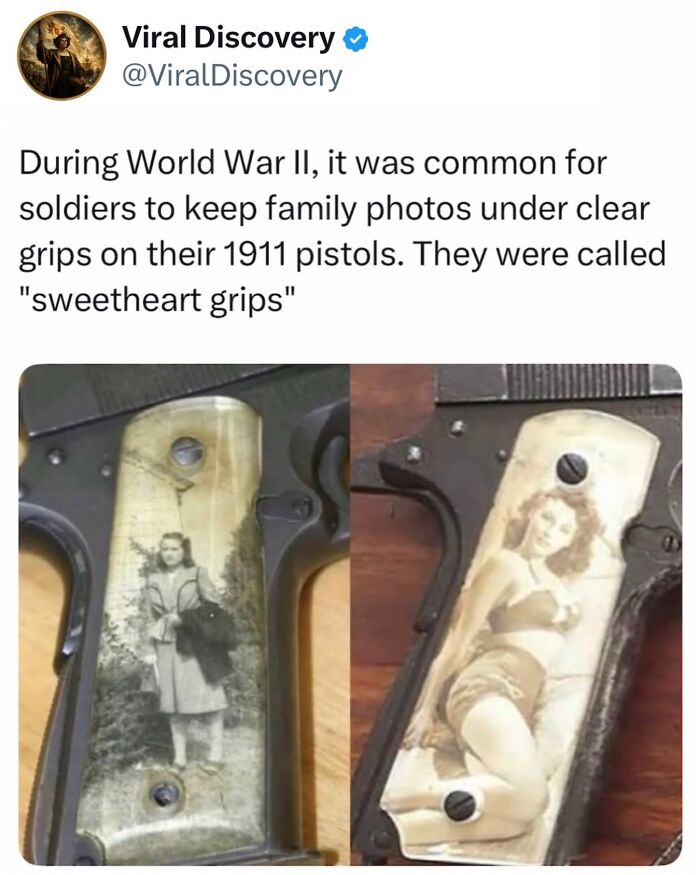
While some grips were professionally crafted by skilled artisans, many were homemade creations made possible by the introduction of a new material: Plexiglass. Soldiers would salvage pieces of clear acrylic from the shattered canopies and windows of downed Allied and enemy aircraft, including planes such as the B-17 and P-51 Mustang.
With basic tools, they carefully sanded and polished the plastic until it was clear and shaped to fit their Colt M1911A1 service pistols. The standard checkered walnut or plastic grips could then be replaced with transparent panels, allowing soldiers to slip photographs of their wives, girlfriends, parents, or other loved ones underneath.
These grips were more than just a unique modification. Amid the chaos of the Pacific and European theaters, carrying a physical reminder of the people waiting for them back home could provide a powerful boost to morale. The modification transformed a utilitarian weapon into something deeply personal, connecting the soldier to the people and life he was fighting to return to.
© Photo: viraldiscovery
#48
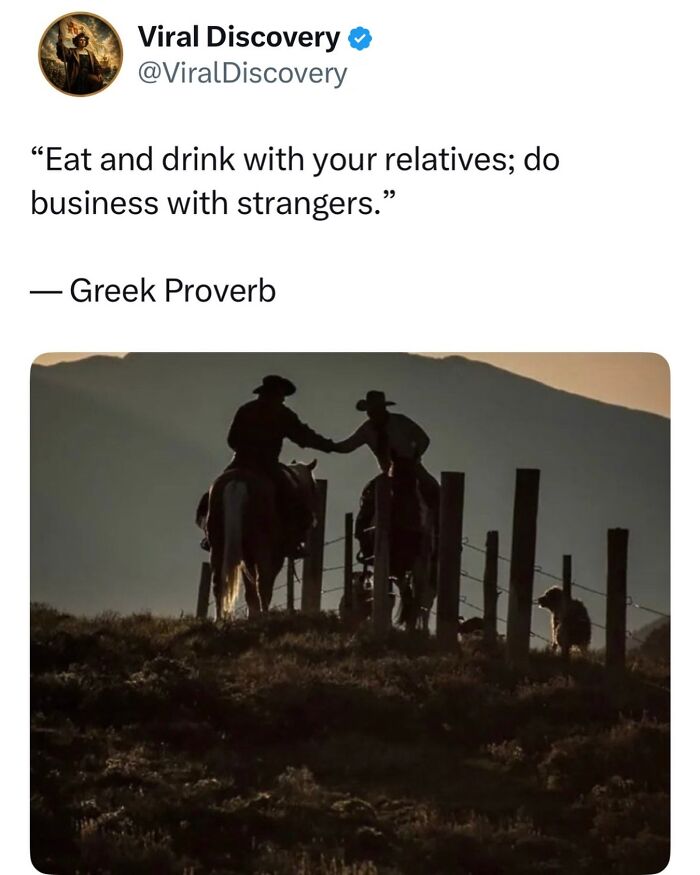
This classic Greek proverb highlights the importance of keeping personal relationships and financial dealings completely separate. It suggests that family settings should be reserved for warmth, bonding, and shared experiences, while commerce is best conducted with outside parties where objective rules apply.
When money and business mix with family, disagreements over debts or responsibilities can deeply fracture personal relationships. By dealing with strangers instead, you can establish clear boundaries and neutral accountability, protecting both your professional interests and your family peace.
© Photo: viraldiscovery
#49
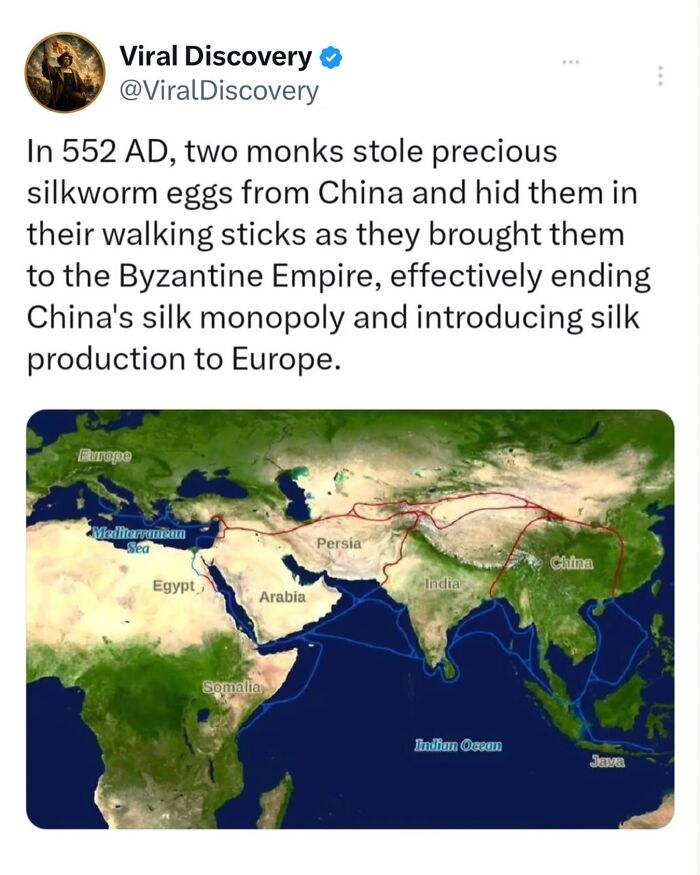
In 552 AD, two monks are said to have secretly smuggled silkworm eggs out of China by hiding them inside their hollow walking sticks. They delivered them to the Byzantine Empire, which had been eager to break China’s long-held control over silk production. This clever act of espionage allowed the Byzantines to finally begin producing silk locally rather than relying entirely on imports.
As a result, China’s monopoly on silk was effectively weakened, and silk manufacturing spread into Europe. The Byzantines developed their own silk industry, turning it into a valuable economic and cultural asset. This moment marked a major shift in global trade, showing how a single act of ingenuity could reshape industries and influence economies across continents.
© Photo: viraldiscovery
#50
A satellite comparison of Miami between 2012 and 2025 reveals a dramatic shift from a warm orange yellow glow to a crisp and highly defined urban grid. In 2012, traditional sodium vapor lamps dominated the metropolitan footprint, casting a uniform amber hue that blurred finer street details from orbit.
By 2025, the widespread transition to multi-colored and white LED lighting caused the city streets, buildings, and vehicles to pop with unprecedented clarity. This modern view features distinct color variations across neighborhoods, though it also includes unique faint blue and purple tinges caused by degrading LED phosphor coatings that expose the underlying raw blue diodes.

© Photo: viraldiscovery
#51
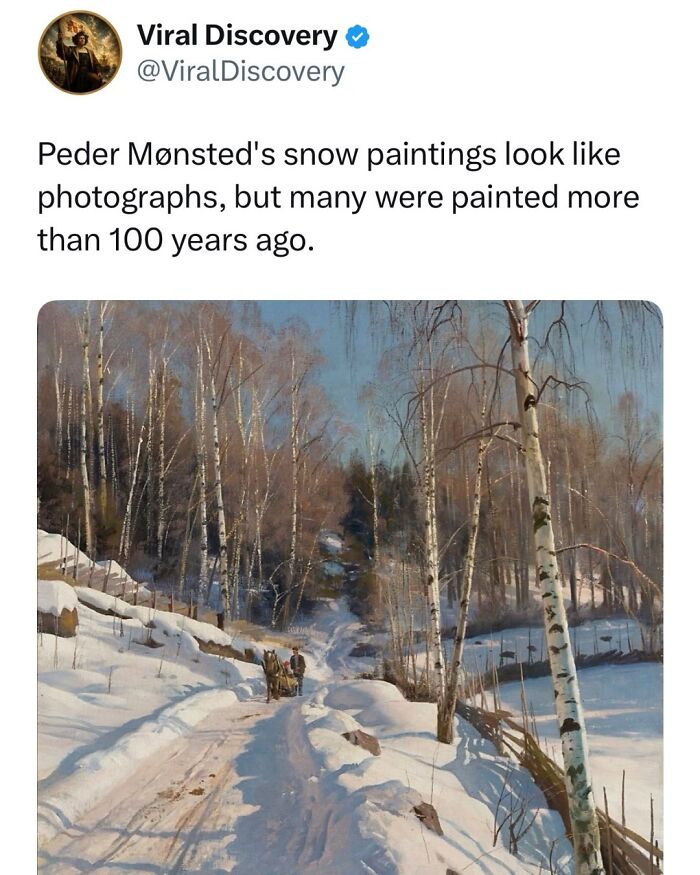
Peder Mønsted’s snow paintings can look remarkably like photographs, even though many were created more than a century ago.
The Danish painter became renowned for his winter landscapes, capturing intricate details such as sunlight glinting off snow, frozen paths, bare trees, and tiny figures making their way through the countryside. His scenes of winter around Lillehammer, Norway, became especially popular, with several displayed in Copenhagen during the 1910s and 1920s.
Yet Mønsted’s life was much more adventurous than his tranquil paintings might suggest. In 1882, he traveled to Capri, where he became ill before recovering and continuing through Switzerland to Paris. He later journeyed through Algeria, Egypt, and Spain. In 1892, King George I invited him to Greece, where Mønsted stayed with the royal family and painted their portraits.
© Photo: viraldiscovery
#52
A couple went viral after holding an Alaskan glacier wedding, sharing the photos with the caption that it was a ceremony “no one could copy.” While they meant it as a nod to the stunning, unique landscape, the internet added a dark twist: commenters joked that no one will replicate it because global warming will melt the venue. Alaska’s glaciers declined 13% between 1985 and 2020.

© Photo: viraldiscovery
#53
In Senador Canedo, Brazil, 5-year-old Gabriel went to the military police to report that his uncle pushed him. When Officer Guilherme Toledo investigated, the suspect turned out to be another 5-year-old—Gabriel’s uncle Rafael, born two months before him. Rafael admitted to the push because Gabriel walked too slowly. The officer staged a playful mock trial, ending the feud with a hug.

© Photo: viraldiscovery
#54
In 1988, Israel Kamakawiwoʻole arrived at a Honolulu recording studio in the middle of the night for an impromptu session that would eventually produce his most famous recording. Engineer Milan Bertosa recalled that a client called around 3 a.m. asking to bring Kamakawiwoʻole in; after initially saying the studio was closing, Bertosa relented when Israel personally pleaded, “Please, can I come in? I have an idea.” Given 15 minutes to get there, Kamakawiwoʻole arrived, sat down with his ukulele, and performed “Over the Rainbow” in a single take.
The recording remained largely unheard for years. In 1993, while Kamakawiwoʻole was making his solo album Facing Future, Bertosa remembered the old tape and played it for producer Jon de Mello, who decided to include it on the album as part of the medley “Somewhere Over the Rainbow/What a Wonderful World.” The recording went on to become synonymous with Kamakawiwoʻole internationally, appearing extensively in film and television and, in 2020, being selected for preservation in the U.S. National Recording Registry as a recording deemed culturally, historically or aesthetically significant.

© Photo: viraldiscovery
#55
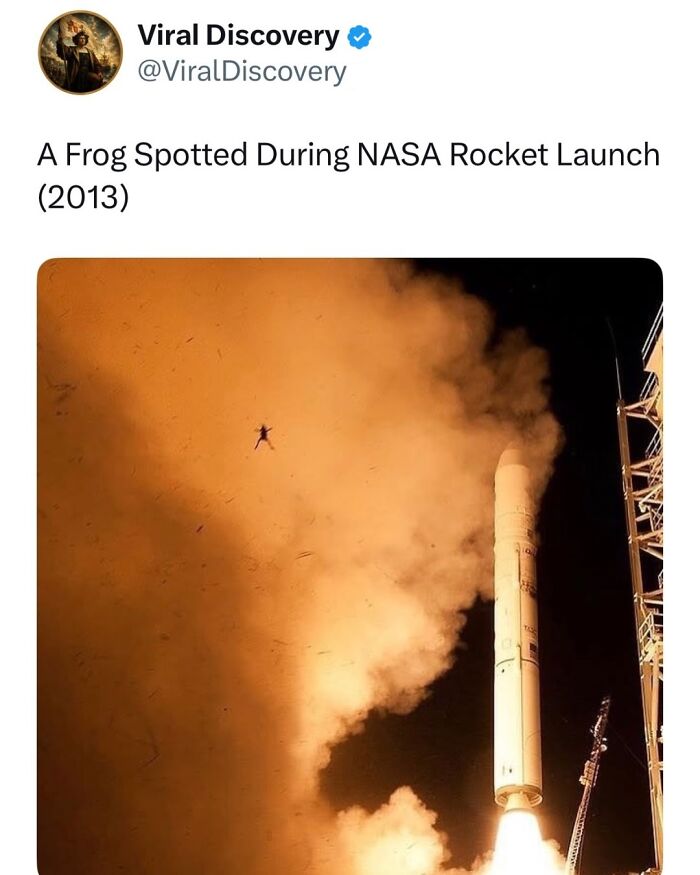
On September 7, 2013, a remote camera at NASA’s Wallops Flight Facility captured a photo of a frog airborne during the launch of the LADEE spacecraft. The frog, likely startled from a nearby water-deluge pool by the Minotaur V rocket, appears silhouetted against the exhaust in the image but likely did not survive the launch.
© Photo: viraldiscovery
#56
This famous optical illusion by psychologist Akiyoshi Kitaoka works due to color constancy, a brain feature that forces you to see red strawberries despite the image only containing gray and cyan pixels.
Your brain recognizes the object as a strawberry and automatically subtracts the heavy cyan tint. This cognitive correction tricks your perception into filling in the missing red hue.

© Photo: viraldiscovery
#57
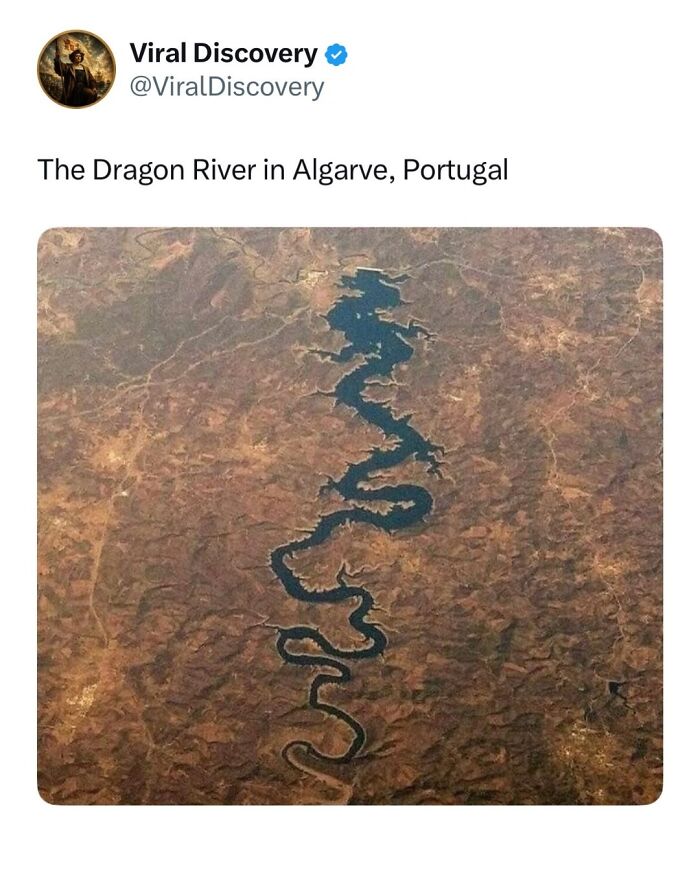
The Dragon River is the popular nickname for the Odeleite River, a tributary of the Guadiana that rises in the Serra do Caldeirão mountains and flows through the Algarve region of southern Portugal, near the municipality of Castro Marim. Its fame comes from an aerial view of the Odeleite Dam reservoir, whose sinuous curves make it look strikingly like a blue dragon when seen from above. A photograph taken by a traveller on a flight over the Algarve went viral in 2015 and eventually spread across Chinese social media and television, where the dragon symbolizes power, strength, and good luck, earning the spot the affectionate name River of the Blue Dragon. Today its deep blue waters and quiet, rugged surroundings draw photographers and kayakers looking for one of the region’s most unusual natural sights.
© Photo: viraldiscovery
#58
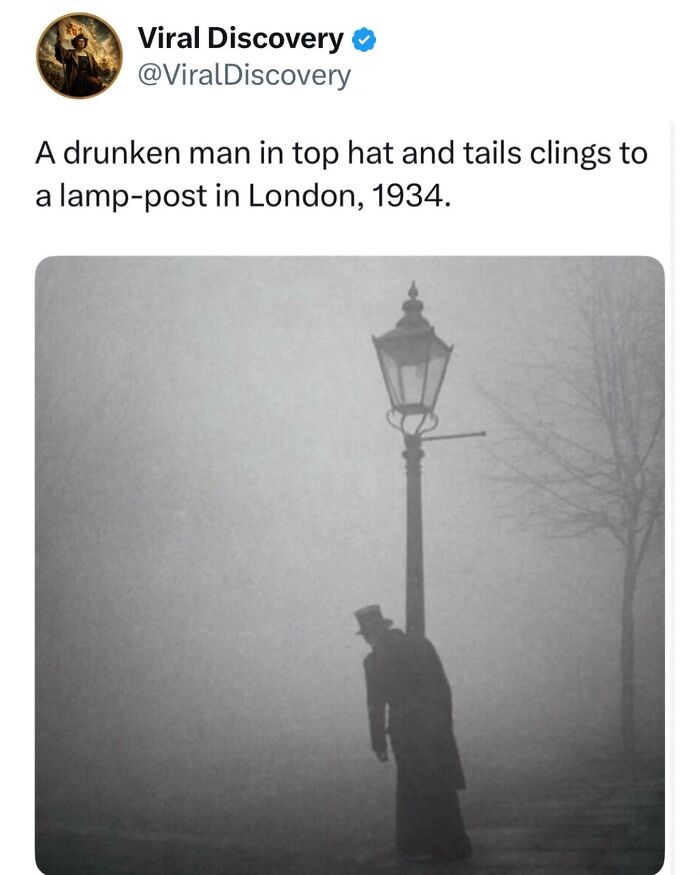
This 1934 black and white photograph by Bill Brandt captures a solitary man dressed in a top hat and formal evening wear leaning against a traditional street lamp. Set against a thick and obscuring London fog, the atmospheric image highlights the dramatic play of light and shadow characteristic of Brandt’s early documentary work.
The misty backdrop dissolves the urban environment into a haunting, surreal landscape that emphasizes the subject’s isolation. Through this striking composition, the photographer effectively captures both a specific social archetype of the era and the unique, moody essence of mid-century British city life.
© Photo: viraldiscovery
#59
In October 2018, 23-year-old Fiona Simpson went viral after using her own body as a human shield to protect her 4-month-old daughter, Clara, during a violent supercell storm in Queensland, Australia. When tennis-ball-sized hailstones shattered her car windows, Simpson dove into the back seat to cover her baby. She suffered severe, horrific body welts and deep bruising, but her infant escaped with only minor bumps.

© Photo: viraldiscovery
#60
China’s massive manufacturing output has crashed lab-grown diamond prices by roughly 90% since 2020. This extreme price drop occurred because factories in China transformed a once-exclusive jewelry alternative into an abundant, mass-market industrial product. The flood of cheap synthetic stones destroyed the artificial scarcity required to maintain high retail margins for fashion jewelry.
In response to this market collapse, De Beers permanently closed its lab-grown jewelry brand, Lightbox. However, the company did not stop producing synthetic diamonds entirely. Through its subsidiary Element Six, De Beers continues to manufacture man-made diamonds exclusively for high-tech and industrial uses, such as semiconductors and quantum computing, while refocusing its jewelry efforts on natural stones.

© Photo: viraldiscovery
#61
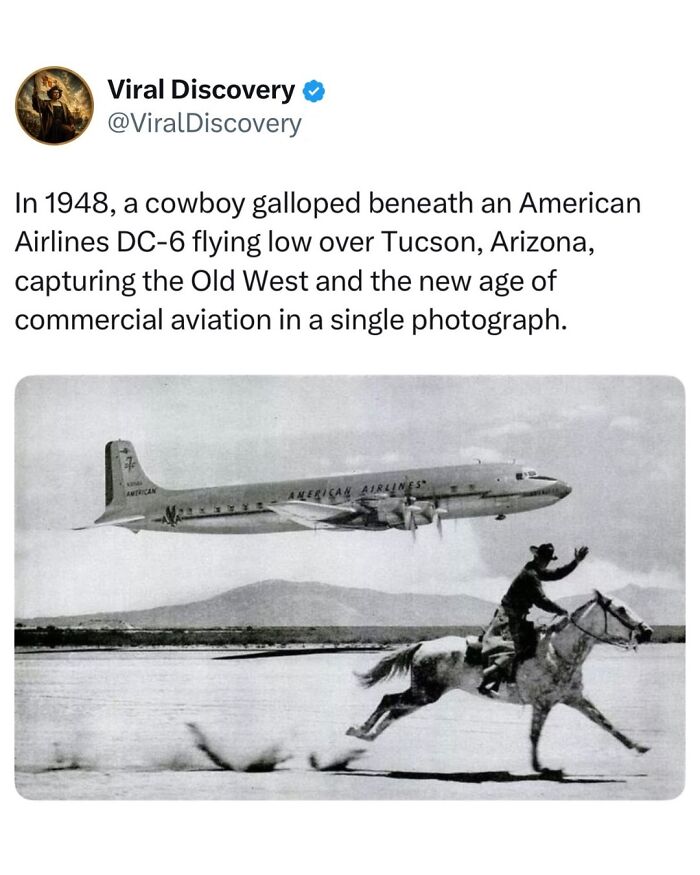
In 1948, a cowboy galloped on horseback beneath an American Airlines Douglas DC-6 over Tucson, Arizona. The photograph captured two eras of transportation side by side at a time when commercial aviation was rapidly transforming how Americans traveled. The DC-6 was one of the newest passenger aircraft of the period, having entered airline service in 1947, and offered greater range and capacity for long-distance routes across the country.
American Airlines was expanding its service across the Southwest during the postwar aviation boom, connecting cities like Tucson with its growing national network. Western imagery was commonly used to promote travel through the region, pairing Arizona’s cowboy identity with the speed and modernity of air travel. Photographs from the Tucson series combined horses, Western clothing and American Airlines aircraft to create some of the era’s most striking images of the changing American West.
© Photo: viraldiscovery
#62
NYC Mayor Zohran Mamdani released over 170,000 pages of undisclosed 9/11 documents showing that city officials deliberately withheld toxic air quality data from the public while assuring residents the air around Ground Zero was safe to breathe.

© Photo: viraldiscovery