
Against all odds, certain objects have survived thousands of years to reach our modern world. For instance, a 3,000-year-old Egyptian ring carved with playful kittens, or the Orkney Hood — the only complete piece of woven clothing to survive from medieval Scotland.
These incredible relics prove that our ancestors loved art, beauty, and comfort just as much as we do. Since we don’t have a real time machine, looking at these items is easily the next best thing — offering a rare, personal glimpse into everyday life centuries ago.
We’ve collected photos of some of the most remarkable historical objects shared by an online community that acts as a “virtual museum.” The best part is that you can admire these ancient treasures right from the comfort of your couch, and even dig deeper if something catches your eye.
#1
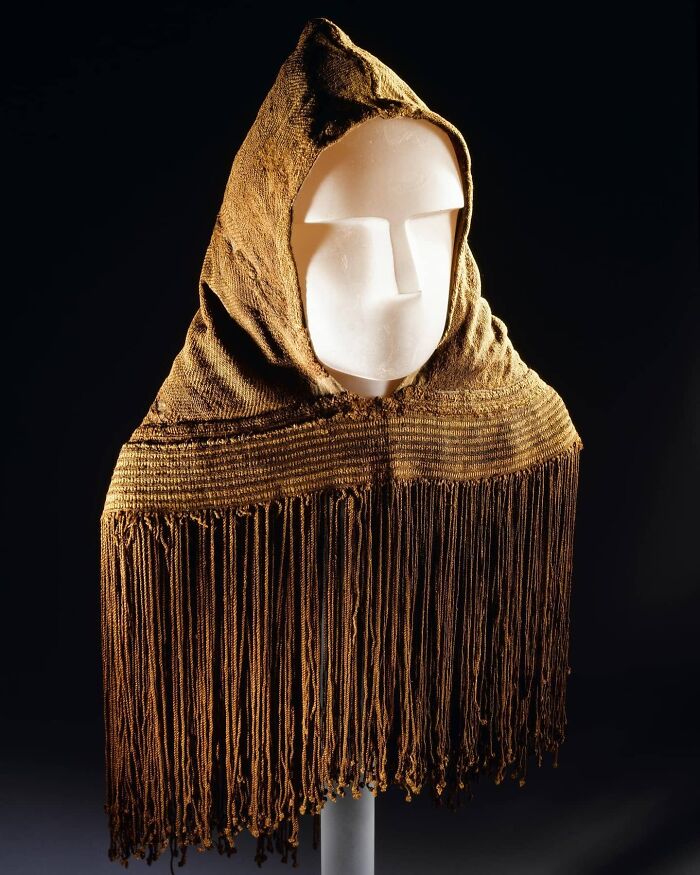
The Orkney Hood, found in a peat bog in 1867, the only complete item of fabric clothing to have survived from early medieval Scotland, 250 - 615 AD
It is rare for organic materials, such as leather, wood or cloth, to survive through the ages. In normal circumstances, they decay rapidly, over a relatively short period of time.
But thanks to the preservative qualities of peat, one of Orkney's most unique discoveries looks almost as good today as when it was created, over 1,700 years ago.
The head-covering part of the hood is shaped like an old-fashioned pixie hood, but it is joined on to a yoke that covers the wearer’s shoulders, and it has a long twisted fringe.
Further research by experimental archaeologist Jacqui Wood has revealed fascinating details. The hood is small and was probably made for a child of about eight or nine.
The main part of the fabric is a twill weave, but the diagonal line of the twill changes direction irregularly. Careful measurements showed that at each direction change, the number of threads per inch also changed.
It seems that the cloth was being woven with hand-spun yarn which varied in thickness, and the changes in direction were being used to mask these variations.
The fringe is part of a tablet-woven braid, and both the cloth and the braid must have come from other, better-made garments which must have been cut up to make this child’s hood.
One imagines that the child then left the hood in the hill – maybe they were working peats? Or would the child have been herding animals? Or maybe it blew off the washing line – maybe at Minehowe? The possibilities are endless.
Jacqui’s discoveries about the hood were published in the proceedings of the Orkney Heritage Society’s Iron Age conference ‘Sea Change’, which took place in 2001.
The original hood is in the Museum of Scotland
© Photo: historiante_
#2
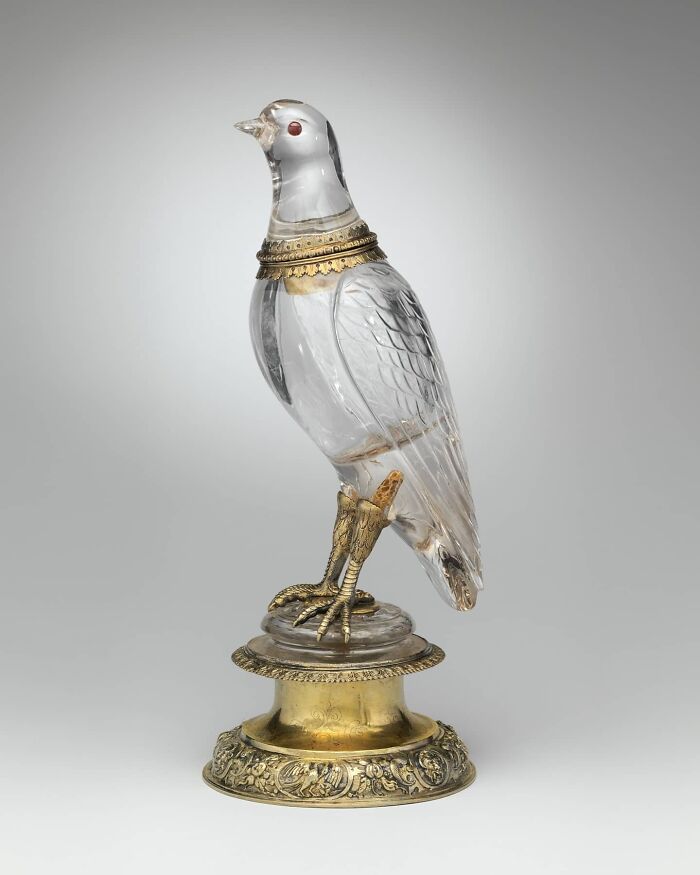
Rock crystal and silver gilt vessel in the form of a bird - Nuremberg, Germany, 1580
The coveted qualities of both natural wonder (naturalia) and fine craftsmanship (artificialia) are embodied in this hollow vessel.
In the 1500s, rock crystal was priced at its weight in gold. The material’s extreme hardness allows it to be worked—cut, carved, or drilled—without shattering, while at its finest, as here, it is luminous and transparent.
Through artistry, a pricey mass of heavy pure quartz has here been transformed into a seemingly weightless bird, complete with beady eyes of ruby and a collar and legs of gilded silver.
Now on display at the Metropolitan Museum of Art in New York
© Photo: historiante_
#3
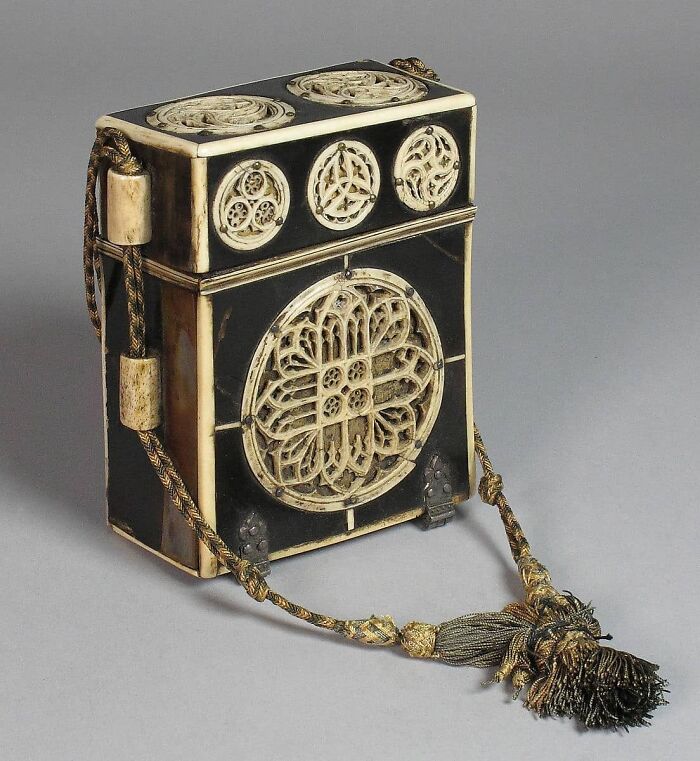
Manuscript case - France, 15th century
Medieval literature is a broad subject, encompassing essentially all written works available in Europe and beyond during the Middle Ages (that is, the one thousand years from the fall of the Western Roman Empire ca. AD 500 to the beginning of the Renaissance in the 14th, 15th or 16th century, depending on country).
The literature of this time was composed of religious writings as well as secular works. Just as in modern literature, it is a complex and rich field of study, from the utterly sacred to the exuberantly profane, touching all points in-between. Works of literature are often grouped by place of origin, language, and genre.
The medieval manuscripts were often designed to be visually appealing, and wealthy patrons commissioned leading artists to work on them.
© Photo: historiante_
Long before anyone wrote history down on paper, people left tiny clues in the things they touched, used, and carried every day. Physical objects act like a bridge across time, showing us what life was really like back then.
Books and old papers can get lost, altered, or rewritten over time. But a simple stone tool, a worn sweater, or an old clay pot can’t lie. When you look at a chipped blade or a painted dish, you can instantly picture someone sitting down to make dinner or working out in the sun hundreds of years ago.
#4
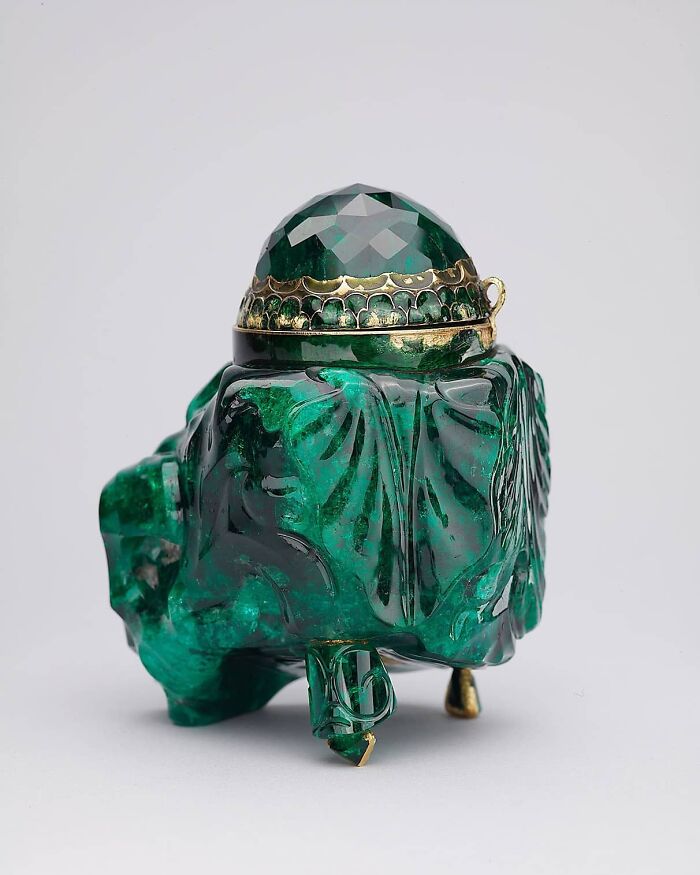
Emerald Unguentarium (vessel for ointments), 2,860 carats with gold inlay and decorations, and carved out of a single emerald in 1641 for Habsburg Emperor Ferdinand III - Imperial treasury in Vienna
The "Emerald Unguentarium" in the Imperial treasury (Schatzkammer), in Vienna, was commissioned by the Habsburg king, Emperor Ferdinand III in 1641, and was carved out of a single large emerald crystal of Colombian origin, probably over 3,000 carats in weight, perhaps the largest emerald crystal discovered in the world at that time.
The Emerald Unguentarium is shaped more like a bottle, and appears somewhat irregular in shape, as the cutter of the enormous emerald crystal was perhaps instructed by the king to reduce losses in cutting, to a minimum. The unguentarium had a lid and feet also made of emerald, probably worked from the material scooped out of the vessel.
The exact weight of the original massive crystal is not known but after the crystal was hollowed out and transformed into an ointment vessel (unguentarium) it weighed 2,860 carats. The cutter who apparently seemed to have followed the shape of the natural crystal - which was in fact a twin crystal intergrown into one another - in order to minimize losses, eventually ended up with a vessel having a rather irregular shape.
The surface of the vessel is engraved with four leaf patterns. The dome-shaped lid of the bottle has enameled gold decoration at its base where it fits on to the mouth of the vessel.
The master carver who fashioned the vessel had also created facets of different shapes on the surface of the vessel as well as the lid, which were subsequently polished to bring out the intrinsic beauty of the emerald.
The dimensions of the vessel are length-8.5 cm, breadth-7.2 cm, and height-10.9 cm
© Photo: historiante_
#5
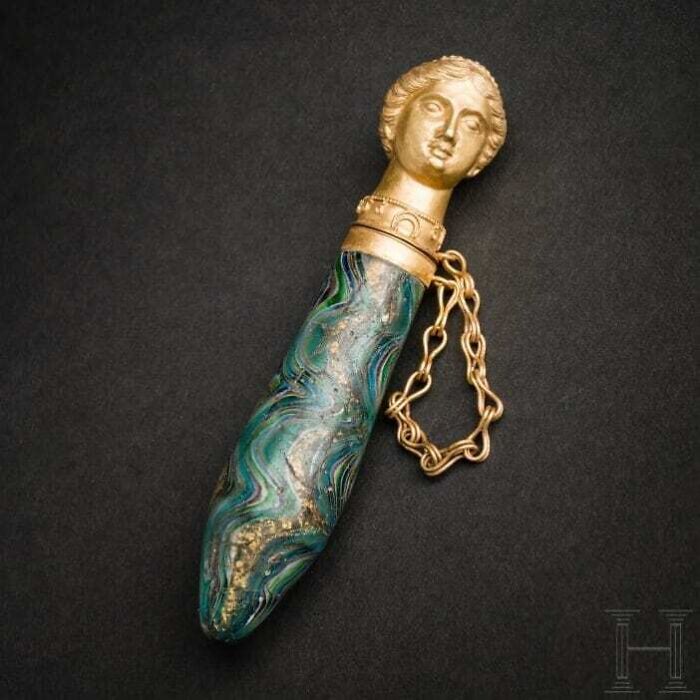
A Roman glass unguent bottle with figural gold lid - 1st century AD
Roman glass is the result of a stunning piece of historic craftsmanship dating back 2,000 years to the time of the Roman Empire. In 63 BC, the Romans conquered the Syro-Palestinian area and returned to Rome with skilled glass makers. Before then, glass was available only to the wealthy and was manufactured by core forming, casting, cutting and grinding.
With the invention of the glass blowing around 50 BC, glass instantly became available to the less wealthy public. The Roman glass industry rapidly developed over a couple of generations during the first half of the first century A.D.
Glass vessels became commonplace throughout the empire and were exported to places as far away as Scandinavia and the Far East. The people of the Roman Empire used more glass than any other ancient civilization.
Perfumes were very popular in Ancient Rome. In fact, they were so heavily used that Cicero claimed that, "The right scent for a woman is none at all." They came in liquid, solid and sticky forms and were often created in a maceration process with flowers or herbs and oil.
Today, most commercial perfumes are alcohol-based, but Roman perfumes for the skin took the form of unguents, or greasy ointments. An unguent consisted of a liquid base and a scented essence, and could also contain preservatives such as salt, and fixatives such as gums or resins – to stabilise the volatile components of the perfume.
Physical description: oblong gold ribbon glass perfume bottle, the rim of which has a gold border. The lid is designed as a delicate, graceful woman's head (with a long neck and necklace) and has a long spike on the underside with which drop by drop the precious perfume could be removed from the container. The lid and the bezel are connected by a chain. The thick glass is polychrome (turquoise, blue, white etc.) with gold threads worked into it.
Length 11.8 cm. Weight 49 g.
Provenance: Hermann Historica - the item is put up for auction. DM for more details.
© Photo: historiante_
#6
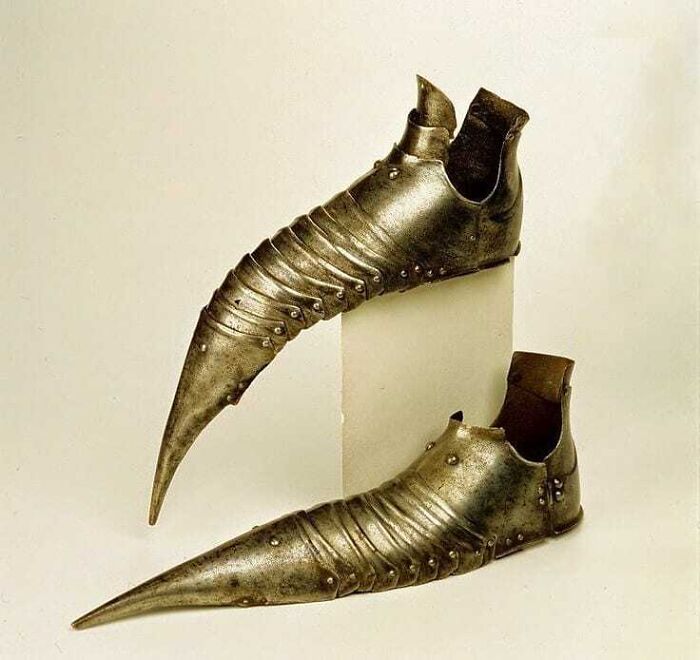
Gothic equestrian sabatons - Germany, 1490
Sabatons are armoured footwear worn as part of a complete suit of amour. In the Gothic period, the fashion for pointy-toed shoes influenced the shape of the military sabaton.
This late 15th century example would have been worn by an equestrian soldier often during parades rather than in the battlefield. It features an articulated upper made of lames, or narrow strips of metal, which would have allowed the toe to hang over the stirrup enabling the rider to secure his foot while riding.
© Photo: historiante_
By studying these everyday things, experts can see how simple ideas became major technological breakthroughs over time. We can see how whole communities grew, traded, and changed their way of life across generations.
Even old scraps of parchment, kept safe for centuries, have given historians the exact words they need to decipher ancient languages and ideas that still shape how we think today.
“Objects give us a special kind of access to the past. They allow us to touch (within careful parameters usually) something that was used by people, and thus get a physical feel for their lives. We can learn about past societies' values from what they kept, and what materials they made things from - or about daily life from such simple things as cooking utensils and furniture,” says Katy Barrett, curator of Art pre-1800 at Royal Museums Greenwich.
#7
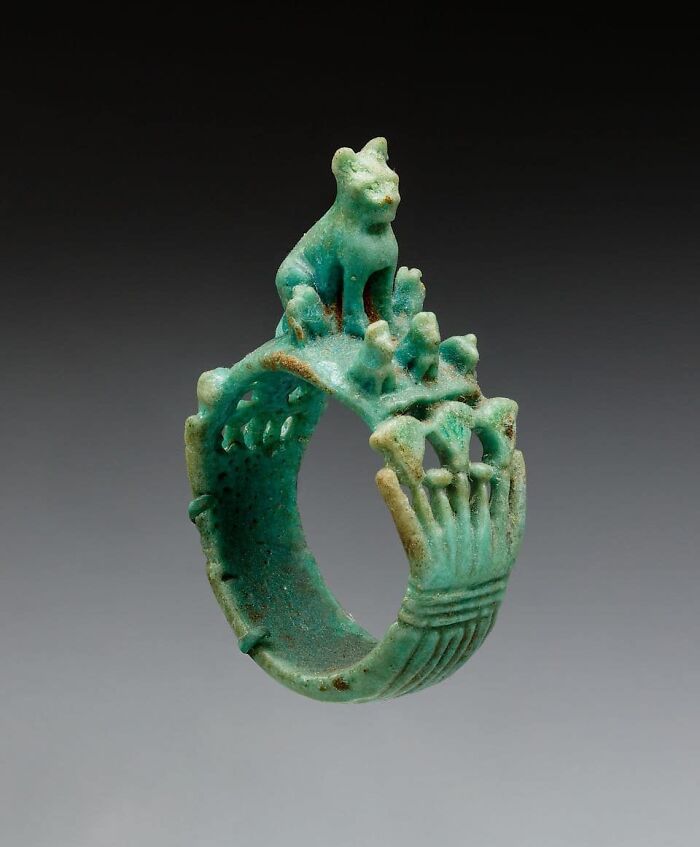
Ring with cat and kittens - Ancient Egypt
Ramesside/Third Intermediate Period - 1295–664 B.C.
This ring depicts a cat and its kittens perched above a bound bundle of flowering papyrus designed to represent a marsh. In all likelihood, these elements symbolize the myth of the "Faraway Goddess," a story in which a feline plays a prominent role as a deity that must be coaxed back to the Nile Valley after she flees into the Nubian desert.
Her desertion disrupts the ancient Egyptian world of "maat" and she must be brought back by a variety of personages so that Egypt returns to stability and order and prosperity.
Elaborately carved faience rings typically date to this period when craftsmen had total mastery of the medium faience; this one is a superb example. Such rings were most likely created to celebrate various festivals held in honor of the deities depicted on the rings.
Medium: faience
On display at the Metropolitan Museum of Art in New York
© Photo: historiante_
#8
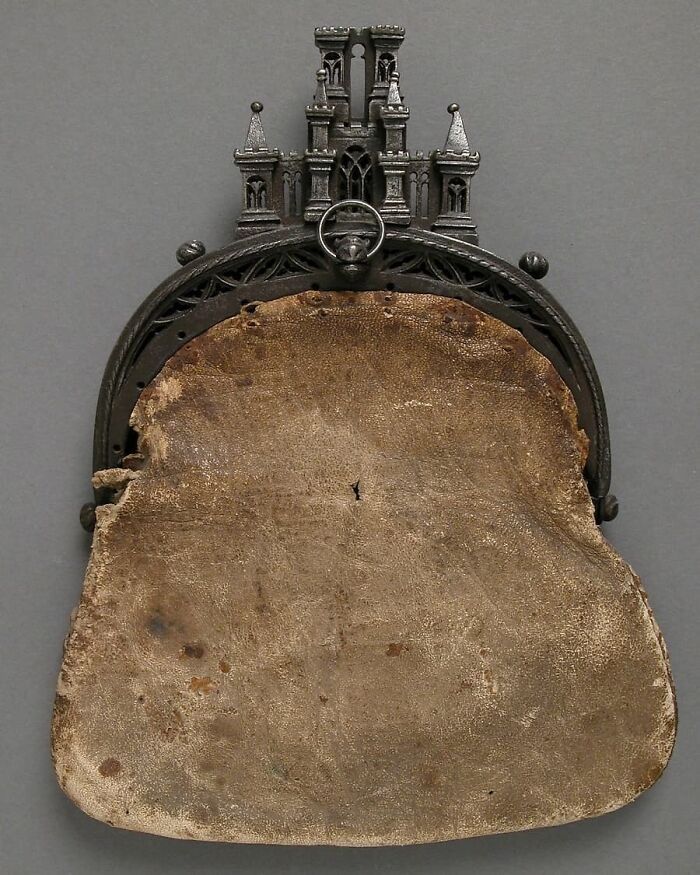
Medieval leather purse, 15th - 16th century - Europe
Purses of various shapes and sizes, carried by both men and women, were given descriptive terms in medieval inventories, such as bourse or poche à compartement.
In the fifteenth century, purses with clasps of metal and loops on the rear which could be attached directly to the belt superseded the pouches which closed with drawstrings and hung from the belt.
The clasp no doubt came into use to provide greater security for money or other valuables when the owner walked on crowed city streets.
This purse has two inside pockets and a concealed smaller section with two small openings hidden beneath the front flat.
Housed now at the Metropolitan Museum of Art in New York
Medium: Iron, leather
Dimensions:
Overall: 22.9 x 17.9 x 4.1 cm
purse clasp only: 12.7 x 15.2 x 4.1 cm
© Photo: historiante_
#9
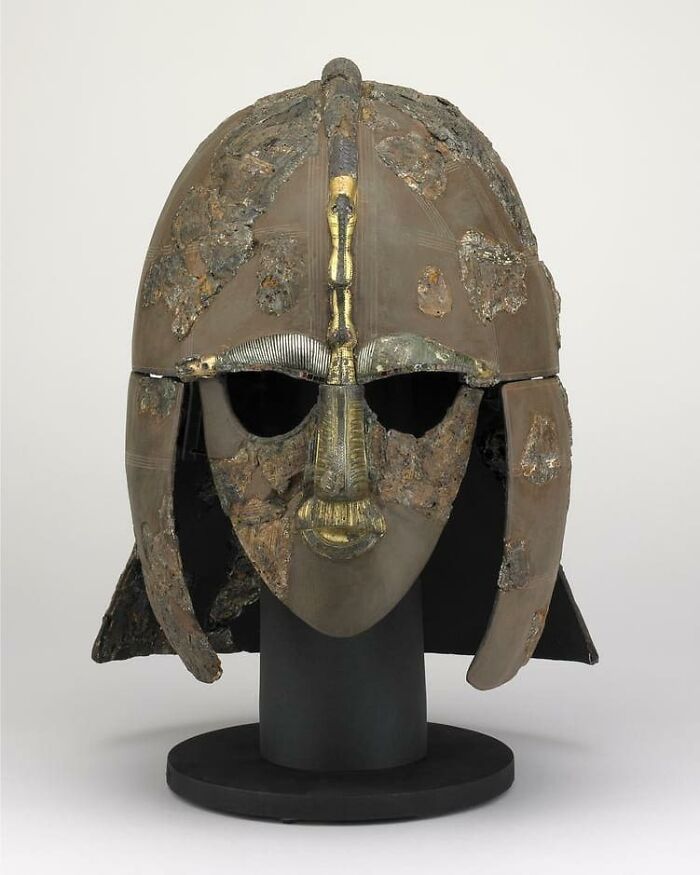
The Sutton Hoo Helmet - Anglo-Saxon, 7th century
The Sutton Hoo helmet is an ornately decorated Anglo-Saxon helmet found during a 1939 excavation of the Sutton Hoo ship-burial.
It was buried around 625 and is widely believed to have belonged to King Rædwald of East Anglia; its elaborate decoration may have given it a secondary function akin to a crown.
The helmet was both a functional piece of armour that would have offered considerable protection if ever used in warfare, and a decorative, prestigious piece of extravagant metalwork.
The visage contains eyebrows, a nose, and moustache, creating the image of a man joined by a dragon's head to become a soaring dragon with outstretched wings.
It is described as "the most iconic object" from "one of the most spectacular archaeological discoveries ever made", and perhaps the most important known Anglo-Saxon artifact.
It has become a symbol of the Early Middle Ages and "of Archaeology in general". It was excavated as hundreds of rusted fragments, and was first displayed following an initial reconstruction in 1945–46, and then in its present form after a second reconstruction in 1970–71.
The Sutton Hoo helmet, weighing an estimated 2.5 kg (5.5 lb), was made of iron and covered with decorated sheets of tinned copper alloy. The copper alloy sheets are stamped with various patterns including animal interlace, and warrior motifs depicted in two panels.
Now on display at the British Museum, in London
© Photo: historiante_
Artifacts are a goldmine for anyone trying to understand the past. Archaeologists carefully dig up ancient living sites, searching for lost objects that can tell us who these people really were. Since many early societies never wrote anything down, these physical finds are often our only clues.
Ancient Egypt is a great example. The Egyptians strongly believed in life after passing away, so they buried their loved ones with everything they might need in the next world. As a result, their tombs became incredible time capsules. The most famous, King Tut’s tomb, offers a massive window into their everyday world.
#10
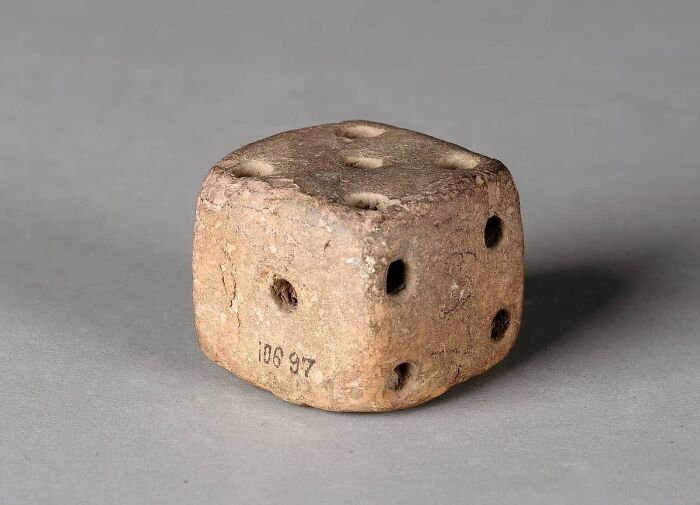
Ancient terracotta dice - Indus Valley Civilization 2500 - 1900 BC
The earliest references to board games on the subcontinent come from the Indus Valley Civilization.
Dice and counters have been found at sites like Harappa, Lothal and Mohenjo-Daro, dated to 2500 BCE. Primitive board games have also been found etched into the floors of caves and temples, going back to the early centuries of the Common Era, in places like Bhaja, Ajanta and Ellora in Maharashtra.
Elsewhere in the world, hieroglyphics in the tomb of Merknera (3300–2700 BC) in Egypt depict ancient games, and traces of board games have even been found at archaeological sites in Mesopotamia and Greece. Clearly, board games have a long history, cutting across time and geography.
These games continued to be popular in medieval times. Games that involved gambling were popular in the Mughal court.
Now on display at Lahore Museum in Pakistan
© Photo: historiante_
#11
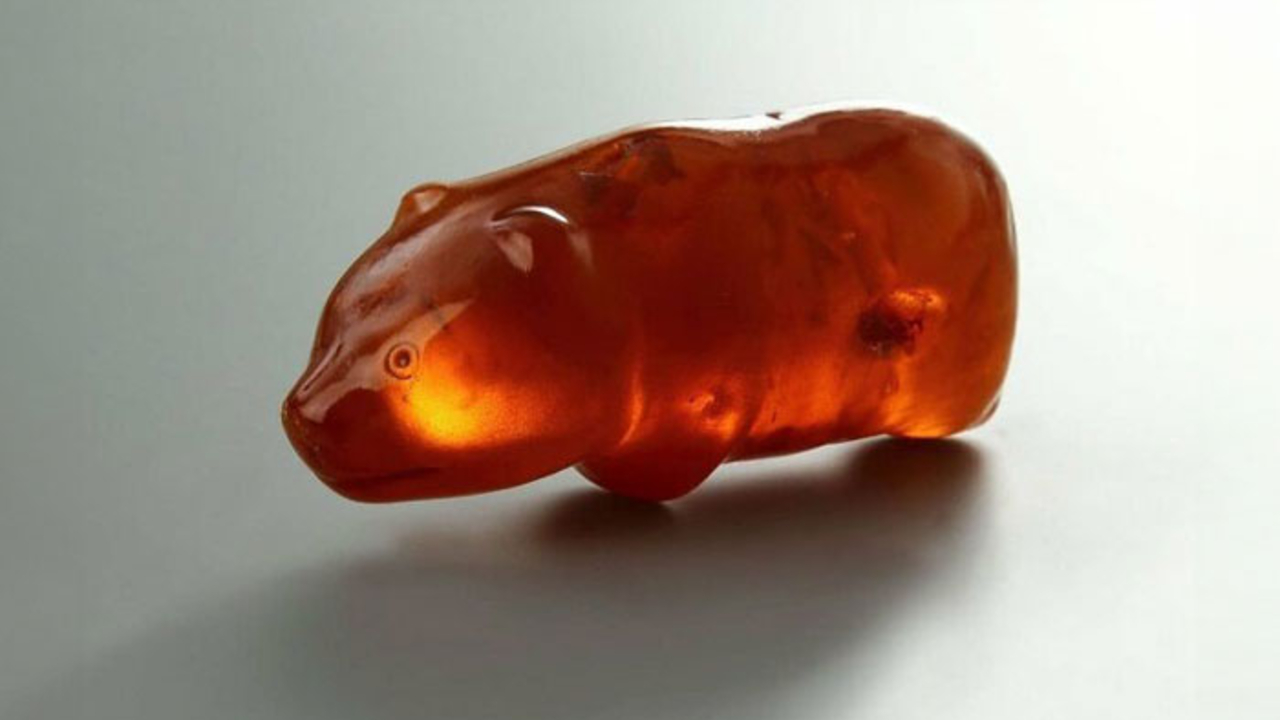
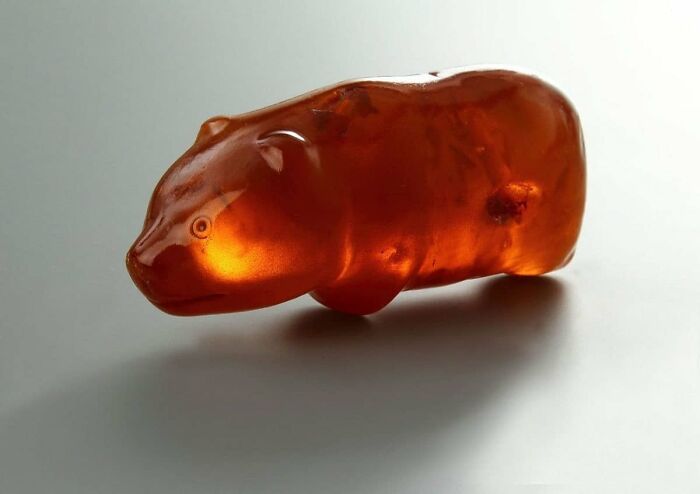
3,500-year-old Amber Bear Amulet found in Slupsk, Poland
The amber bear amulet was found in 1887 in a peat bog near Slupsk, Poland. When the figure was examined it turned out to be the amulet of a bear hunter, originating from the Neolithic period. It was dated at between 1700 B.C. and 650 B.C.
Since the researchers were not precise regarding the age of the find, we can assume this figure is over three thousand years old.
The original did not stay long in Slupsk since special protection was sought for the oldest item ever discovered in the Pomerania.
The museum in Szczecin guaranteed safety, and the amber bear was placed there - probably until 1945.
© Photo: historiante_
#12
Carved Halloween turnip Jack-o-Lantern from about 1850
A far cry from the grinning pumpkins of Halloween today, the original folklore version of Jack-o-Lanterns, named for Jack O’Lantern of the Irish myth, were actually quite terrifying. They were carved from turnips or beets rather than festive orange pumpkins and were intended to ward off unwanted visitors.
The origin of the carved turnip began with Irish folklore. The legend is about a man they called Jack O’Lantern who was condemned to roam the earth for eternity after playing tricks on the devil. He carried with him a carved-out turnip with a burning coal inside to light his way.
In Ireland and Scotland, people began to make their own versions of Jack’s lanterns by carving scary faces into turnips or potatoes and placing them into windows or near doors to frighten away Stingy Jack and other wandering evil spirits. In England, large beets are used. Immigrants from these countries brought the jack-o’-lantern tradition with them when they came to the United States. They soon found that pumpkins, a fruit native to America, make perfect jack-o’-lanterns.
Kept now at the National Museum of Ireland
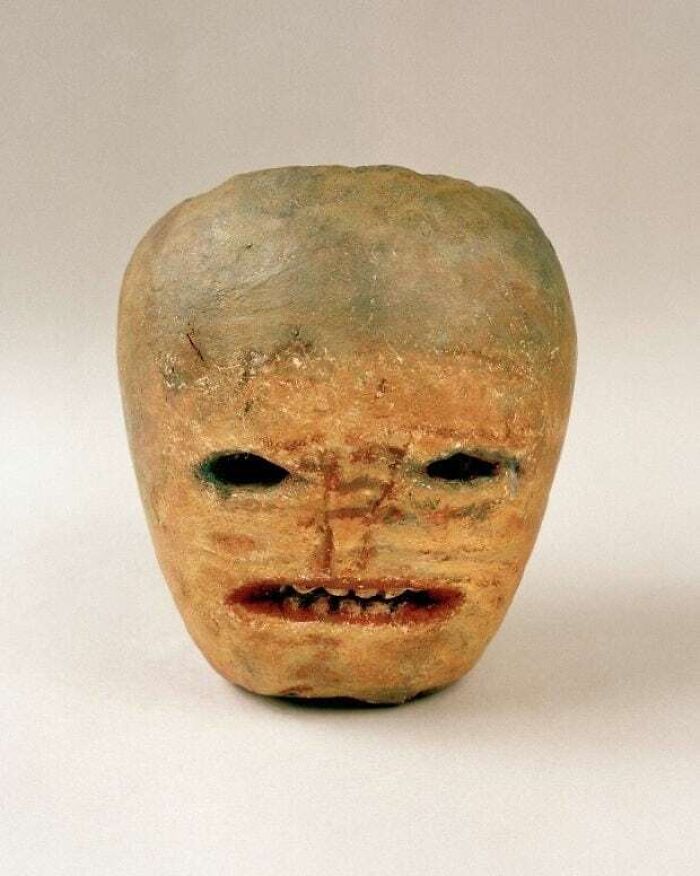
© Photo: historiante_
The most exciting thing about historical objects is that the search is far from over. Archaeologists — and often everyday folks — are constantly stumbling upon new finds that completely change how we see the past.
Recently, a 13-year-old schoolboy picked up a tiny coin in a field near Berlin. When experts examined it, they were stunned. The bronze coin was minted in the 3rd century B.C.E. in Troy, located in modern-day Turkey. It turned out to be the first ancient Greek artifact ever unearthed in Germany's capital. How it made the long journey from Troy to Berlin remains a fascinating mystery.
#13
3,400 year old painter's palette inscribed with the name of Amenhotep III
New Kingdom 1390–1352 B.C.
This painter's palette was carved from a single piece of ivory. Six oval wells contain cakes of pigments including blue, green, brown, yellow, red, and black.
The oval cartouche at one end encircles the throne name of Amenhotep III, Nebmaatre, and the epithet "beloved of Re."
Now on display at the Metropolitan Museum of Art in New York
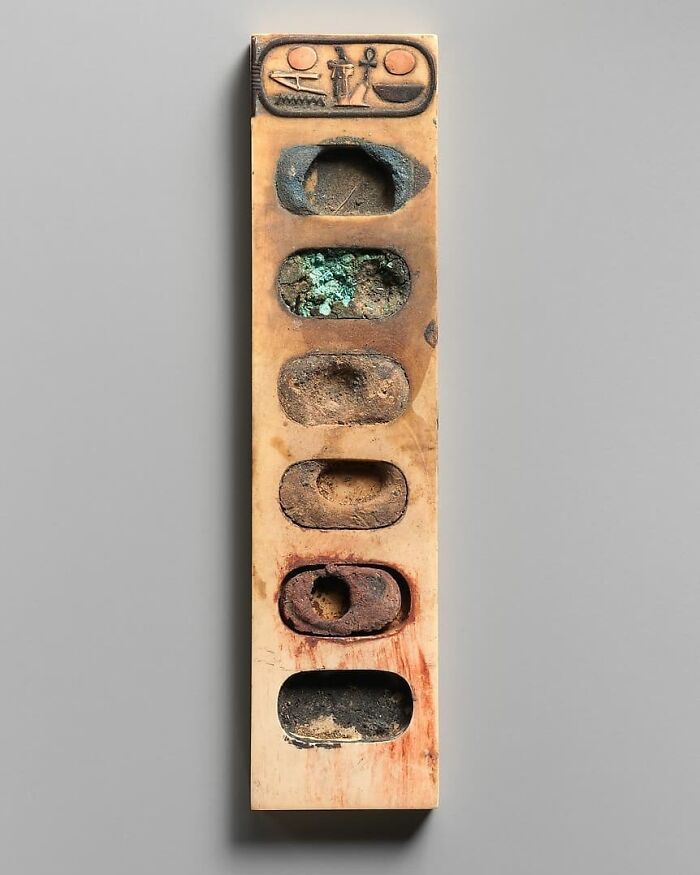
© Photo: historiante_
#14
The world’s oldest woven garment, called the Tarkhan Dress, probably fell past the knees originally. At 5,100 to 5,500 years old, it dates to the dawn of the kingdom of Egypt.
The dress was discovered in an ancient Egyptian cemetery, about 30 miles from Cairo. Dating from the First Dynasty or Old Kingdom period, the dress is made of linen (therefore featuring the earliest known textile fabric used for clothing), and features tightly pleated sleeves and a yoke stitched to a skirt.
Initially found in 1913, the significance of the find wasn’t understood until 1977 – the tunic was part of a linen pile that had been excavated, but wasn’t cleaned or properly examined for more than 60 years. Conservators at the Victoria and Albert Museum in London mounted the garment on a backing of fine silk to allow it to be displayed as it would have been worn in life.
Researchers say the garment was clearly worn in life, as it showed distinct creasing at the elbows and armpits. It was also discovered inside out, although some believe it was deliberately placed in the tomb that way as a form of funerary significance.
The garment is a find of surpassing rarity. Few pieces of early clothing, which was made from plant fibers or animal skins, escaped disintegration. Textiles recovered from archaeological sites are generally no older than 2,000 years.
A handful of garments of similar age have survived to the present day, but those were simply wrapped or draped around the body.
Such fine detail could only have been turned out by a specialized craftsperson. And such people arise only in a prosperous and hierarchical society, such as the ancient Egypt of 5,000 years ago, a time when the kingdom was first united under a single ruler.
It now resides at the Museum of Egyptian Archaeology, at University College of London.
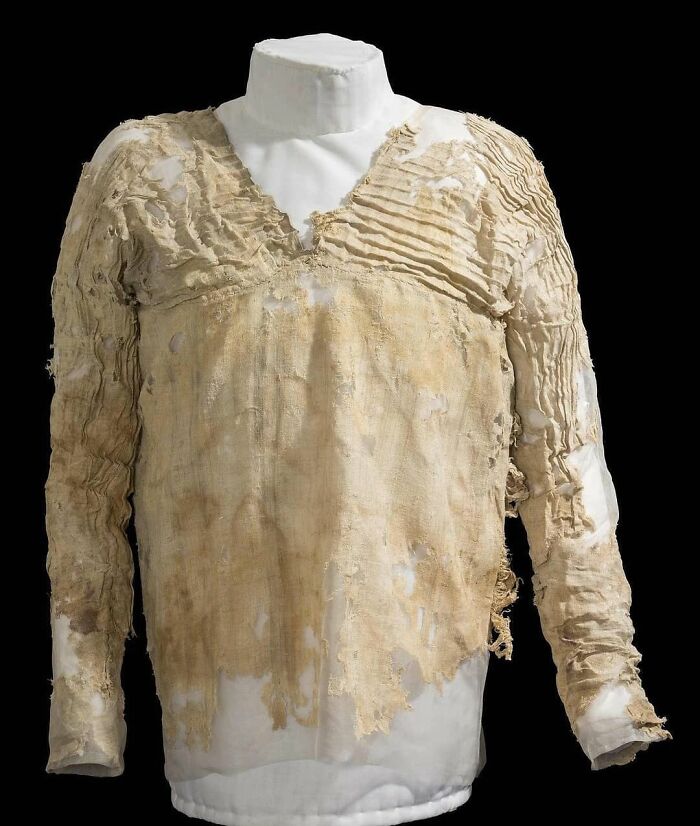
© Photo: historiante_
#15
Ivory amulet representing an otter - Inuit culture, 1870
There are rare occasions when a carved object has no other function but to represent a hunted animal, as a sculpture.
This is one such example, of a charm figure, which would have been placed in a Kayak when seeking otters. It should be noted, however, that even though this charm does not appear to double as a practical tool, its significance is powerful.
This is a communicating figure, shown swimming on its back, with front paws delicately touching its face, as if eating or calling out.
Arctic native hunters have described using amulets like this precisely to assist them in guiding animals to them, which this otter seems to be doing. Like the circular joint markings depicted in many other animal representations, these express the mortal and spiritual transformation of the animal.
The circular marks and dots represent passages through transformational states, and in the shamanic universe of native Alaskans, animals, people, fish and birds may be seen traveling through concentric circles much like the stacked planes that the Buddhist universe is conceived to be.
As one passes through one circle, he becomes another creature, in order to navigate the particularities of the next sphere.
The fact that there are seven drilled dots along the spinal decoration of this otter, and three triangulating dots encumbering his belly, is additionally significant, perhaps in the expression of the hunter, that his success depends upon the continual support of his charm, repeatedly, throughout his life.
Courtesy of: The Steven Michigan Collection of North American Tribal Art
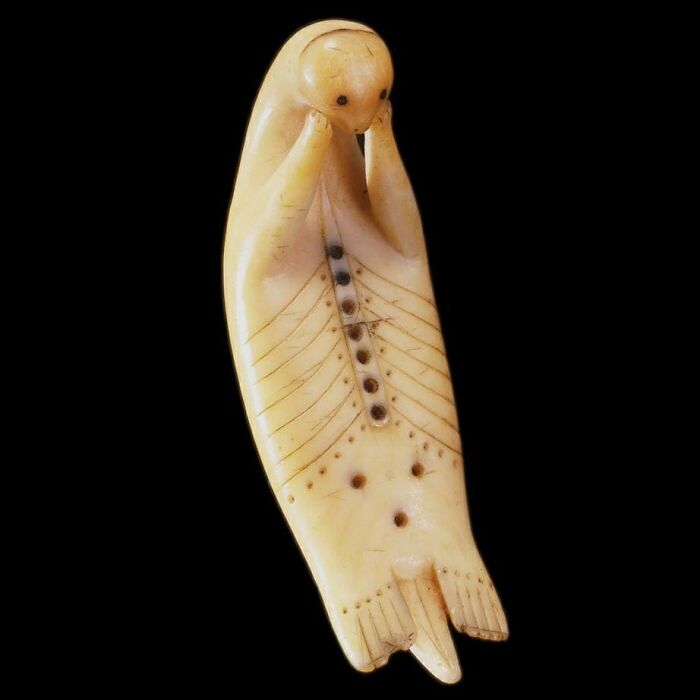
© Photo: historiante_
Technology has made museums easier to visit than ever. If you cannot go in person, you can now explore collections online. Virtual reality, digital guides, apps, and virtual trails bring history straight to your screen.
Even so, stepping inside a real museum changes how your brain works. A study found that people find artwork far more stimulating, positive, and memorable when they view it in a physical gallery rather than on a computer screen.
Standing in an actual museum space deeply engages our minds — partly because the physical layout helps us remember surrounding pieces.
#16
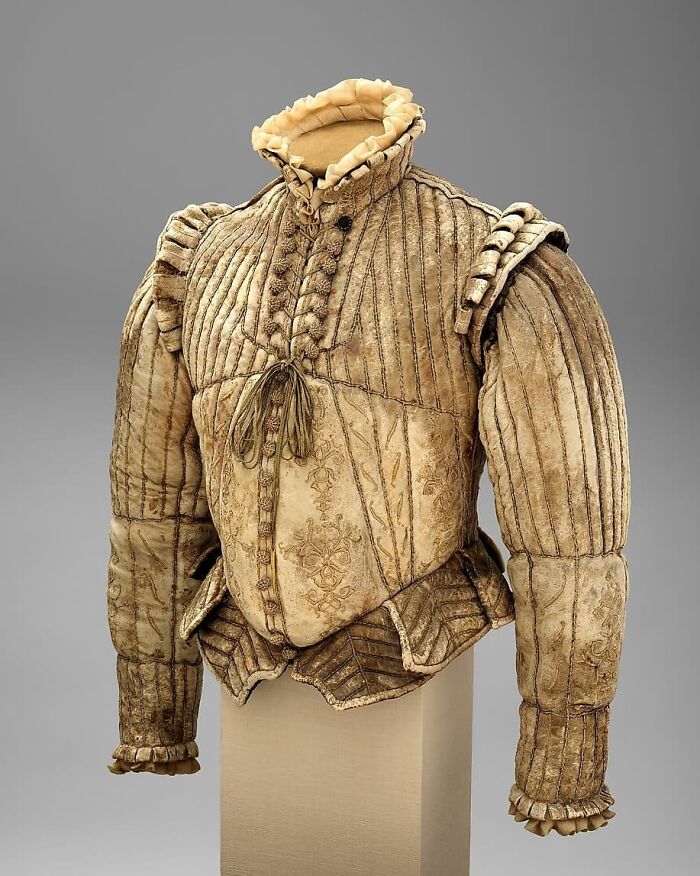
Fencing Doublet (leather, linnen, silk, cotton) - Western European, 1580
This doublet is a rare example of sixteenth-century male clothing, very little of which has survived. The cut of the doublet, particularly the protruding "peascod" waist, is typical of fashionable costume of the 1570s and 1580s.
The delicate silk embroidery and the use of gold and silver metallic yarns are additional indicators of its high quality. The padded ribs on the chest, back, and sleeves suggest that the doublet was also intended as a protective garment.
It was probably made for wear during fencing practice, which was at the time an essential part of every gentleman's education.
Now on display at the Metropolitan Museum of Art in New York
© Photo: historiante_
#17
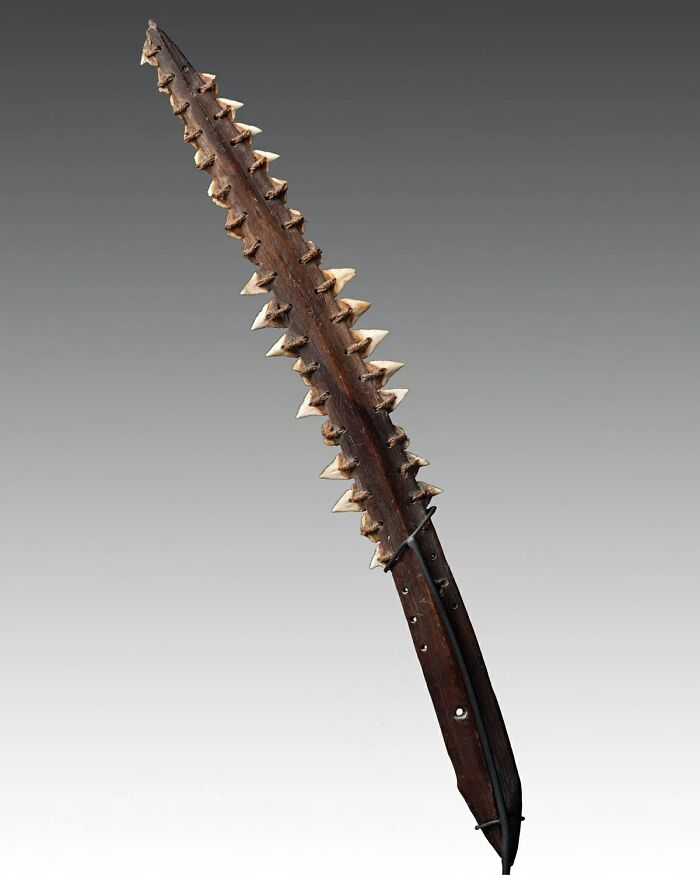
Shark tooth dagger - Kiribati, late 19th century
The islands of Kiribati were once divided by feuding local clans. Fighters used formidable weapons edged with shark teeth, drilled and bound to the edges of palmwood staves.
This weapon was one of a range of pikes, swords and daggers in the Kiribati armoury. It involved a special technique. The teeth were removed from the sharks and then the dagger was made in a socketing technique.
Small grooves were carved into the wood and the teeth were further stabilized with fiber cord. The technique involved drilling small holes through the teeth themselves. Two thicker sections of palm fiber are then used to stabilize the teeth, and a more complex binding is used to ensure that the entire array of teeth is locked in place.
For protection, fighters wore strong but cumbersome armour of coconut fibre, including a helmet, a cuirass with a high backplate, and sleeves and leggings, which it would be hard even for these sharp sawlike weapons to cut through.
© Photo: historiante_
#18
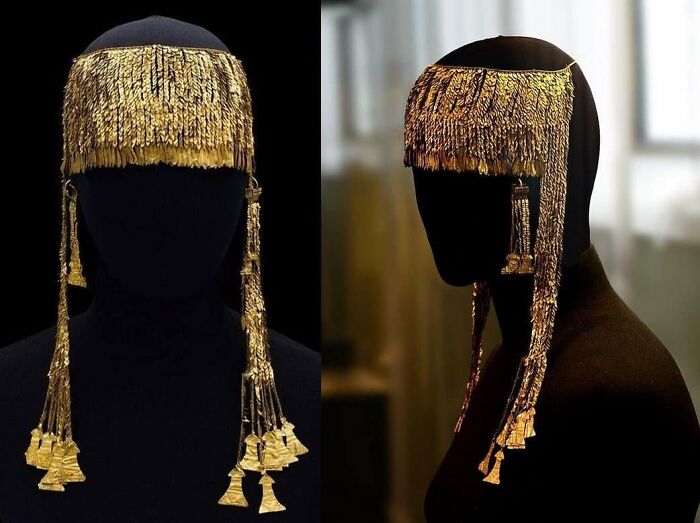
The large gold diadem with idol-shaped pendants from "Priam's treasure" - Ancient Troy, 2400 - 2300 BC
During Heinrich Schliemann's excavations at Hisarlik, he discovered 270 artifacts buried where Priam's palace supposedly stood. He called these artifacts 'Priam's Treasure'. If Priam's belongings are at Hisarlik then this is evidence for Troy being at this location.
Schliemann thought that Priam must have hidden his valuable treasure somewhere in the city. The King wouldn't have wanted Trojan treasures to fall into Greek hands if the city was captured.
Finding this hidden treasure was of great importance to Schliemann, not only for its value but also as evidence that Hisarlik was, indeed, the site of Troy.
On 31st May 1873, at Troy II, Schliemann found what he was looking for. The artifacts were all closely packed together, probably having been initially buried in a chest.
These 270 items included gold jewellery, headdresses, silver ingots, bronze weapons, a copper cauldron and many other treasures.
Schliemann actually published a photo of his wife Sophia wearing the gold jewellery and diadem found in this treasure cache, to show off his findings to the public.
The treasure was certainly extensive enough and valuable enough to have belonged to royalty.
Schliemann got into trouble with the Ottoman authorities by smuggling the treasure out of Ottoman territory. Some say that his wife, Sophia, hid some of the treasure in her underwear.
Eventually, Schliemann was sued by the Ottoman authorities, but the artifacts were later displayed in various museums including Pushkin State Museum of Fine Arts
Neues Museum, Troy Museum.
© Photo: historiante_
So, why take the time to scroll through a list of old relics?
Because exploring these rare treasures does more than fill a quick break — it can spark deeper curiosity and lead you down unexpected rabbit holes into ancient history and forgotten cultures.
Who knows, it might even inspire your next big weekend adventure and compel you to book a ticket to a world-class museum and see these wonders with your own eyes.
#19
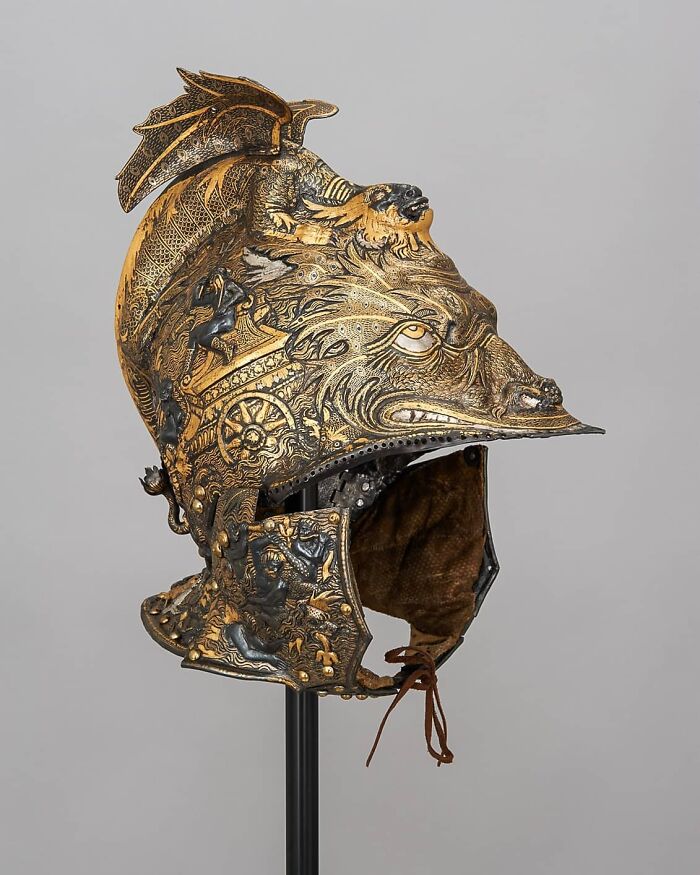
Italian-made circa-1560 helmet belonging to Archduke Ferdinand II of Tyrol
Ferdinand II's balaclava is above all an object of fantasy. The parasol of this helmet is designed as a grotesque wolf's head, which turns into a lurking dragon lying on the ridge.
The helmet bell is occupied by triumphal chariots driven, drawn by dolphins and driven by putti, on which Neptune and Amphitrite sail across the sea. Tritons fighting and blowing their horns cavort on the cheek flaps and the neck guard.
Medium: Iron, forged, chased, partly burnished, partly inlaid with silver and gold. Textile (silk, filling material). Interior embossed with leather
Exhibited now at Kunsthistorisches Museum in Austria
© Photo: historiante_
#20
A Medieval Leather Shoe from 1300s, England
During the medieval period children's shoes were similar to those worn by adolescents and adults.
The only exceptions were the exaggerated, long, pointed 'poulaines', which were worn only by adults.This right foot child's ankle-shoe dates to the late 1300s and has a slightly pointed toe.
The tip of the toe is worn.It is fastened at the front with a leather thong. It is complete, including the rand, the strip of leather inserted between the upper and the sole.
It was found at Baynard's Castle Dock, near Blackfriars, London.
Now on display at the Museum of London
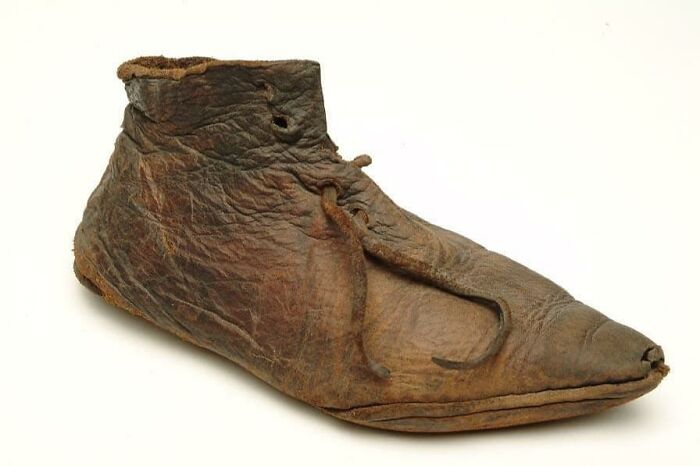
© Photo: historiante_
#21
Vajracharya Priest’s Crown - Nepal, 13th–early 14th
Medium: Gilt-copper alloy inlaid with semiprecious stones, lapis lazuli, and turquoise
Elaborate crowns such as this were worn by Vajracarya priests, the highest rank in the Nepalese Buddhist community.The conical crown is unique to Newari Buddhism and embodies a memory of older and now lost Indian Buddhist practices.
The term Vajracarya denotes both a caste and a family name, and the designation entitles its holders to perform reserved priestly functions, analogous to the privileges held by Brahmans in Hinduism.
This crown is exceptional in its complexity: It is dominated by a series of diadem plaques depicting emanations of the wisdom bodhisattva Manjushri, benign and wrathful.
All is surmounted by a five-pronged thunderbolt scepter, or vajra. This unique iconography points to the crown being designed for enacting rites dedicated to invoking Manjushri.
Housed now at the Metropolitan Museum of Art in New York
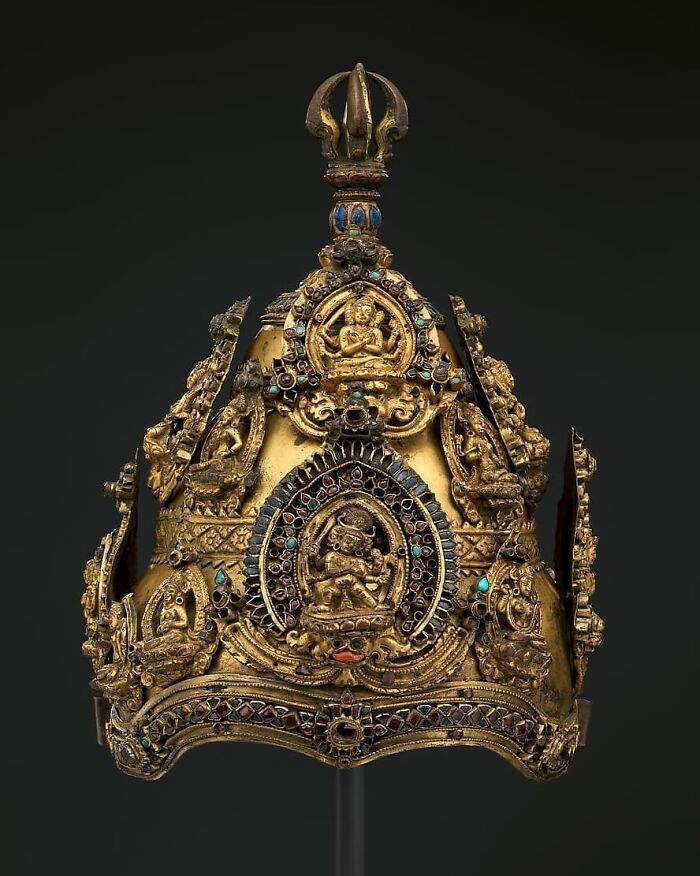
© Photo: historiante_
#22
Gold belt buckle from the ship burial at Sutton Hoo - AD 650
In early Anglo-Saxon England, buckles used to fasten waist belts were a means of expressing a man's wealth and status. The type of metal used and the finesess of decoration were key factors. This spectacular gold buckle from the Sutton Hoo ship burial shows that the person commemorated there was of great importance.
Weighing more than 400 grams, the buckle is actually a hollow box that opens at the back on a hinge beneath the loop. A locking system, involving a complex system of sliders and internal rods which fit into slotted fixings, enables it to close securely.
Similarly-made buckles from Frankish and Burgundian parts of the Continent appear to have contained Christian relics, but we do not know for certain whether the Sutton Hoo buckle was used for this purpose.
No fewer than thirteen creatures decorate the buckle's surfaces. The plate and round tongue shield feature writhing snakes and intertwining four-legged beasts. Their bodies are highlighted with punched ornament filled with black niello.
Stylised snakes biting their own bodies slither on the loop, while at the tip of the buckle, two animals grip a small, dog-loke creature in their jaws. These together with the two fierce birds' heads on the buckle's shoulders, make this extraordinary object one of the most powerful images from early Anglo-Saxon England.
Photos courtesy: British Museum
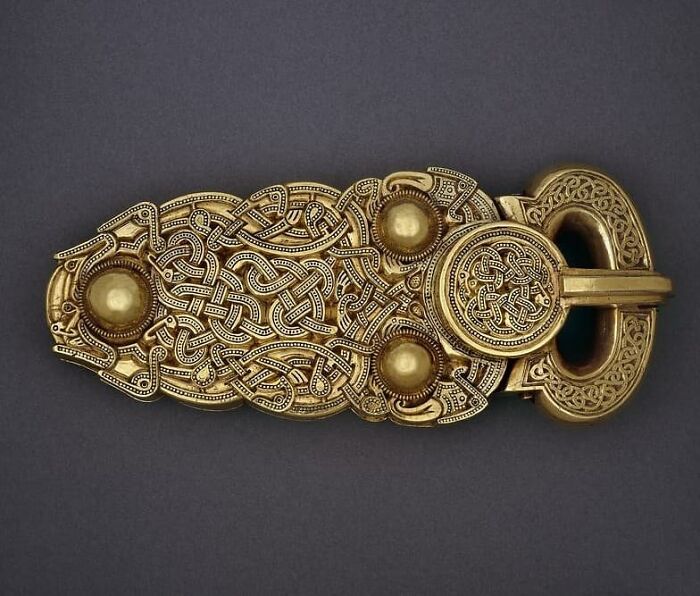
© Photo: historiante_
#23
Shell cosmetic container - Phoenicia, 7th century BC
This shell, from a clam (Tridacna squamosa) was used as a container for cosmetics. The umbo has been carved in the form of a woman's head, while the natural form of the shell gives the impression of a windblown cloak draped over her head.
The border is carved with sphinxes and lotus flowers in a design which can be seen on textiles depicted in Assyrian carved reliefs. Other decoration on the outside of the shell is very worn and now hard to make out.
There are around ninety examples of this type of shell container, but this one has particularly fine decoration. They all seem to have been produced within a short period, possibly in the Syro-Palestinian area, where they are found in concentration, though they also occur in Mesopotamia, Egypt, Cyrene, the coast of Asia Minor, the Aegean islands and Greece.
The head is extremely like those carved on the handles of albaster and stone cosmetic palettes found in Jordan. Exotic imports like this frequently occur in the Orientalizing period in Etruria(seventh century BC), when flourishing trade with cultures around the eastern Mediterranean supplied the keen demand for foreign luxury goods.
Tridacna squamosa shell has its origins in the Red Sea and the Indian Ocean.
Dimensions: width - 21cm, height - 13cm
On display at the British Museum in London
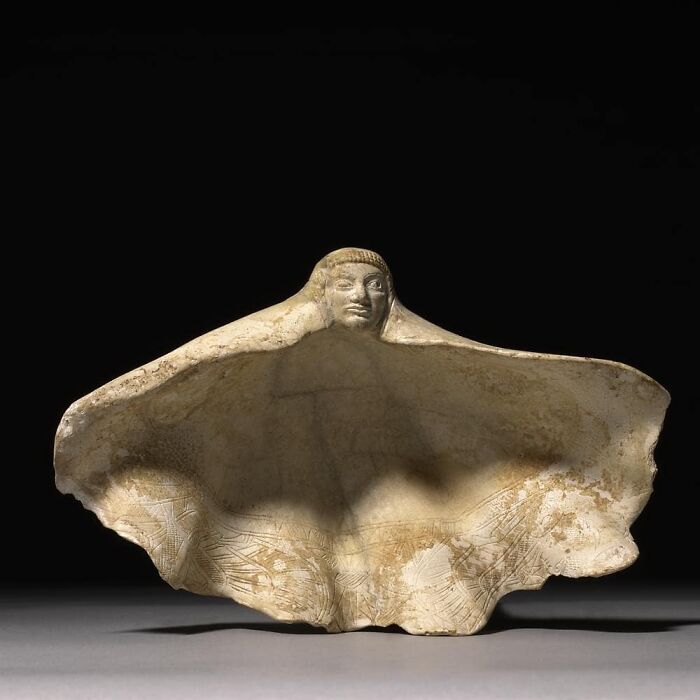
© Photo: historiante_
#24
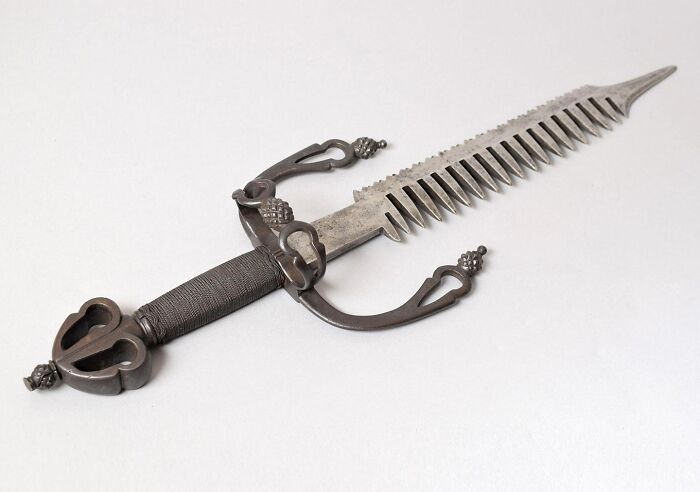
Parrying dagger with serrated toothed blade - Spain, Habsburg period, 1590
A system of fencing which used a dagger defensively held in the left hand was introduced in the first half of the 16th century. It remained popular in Spain and Italy throughout the 17th century.
The blade of a 'main gauche' or 'left hand' dagger was usually straight and double edged, frequently with prongs or serrations designed to catch an opponent's blade.
The counterguard of Spanish daggers was often triangular and the guard was usually decorated en suite with the rapier.
It is now kept at the Victoria & Albert Museum in London
Medium: blackened iron
Length: 45.7cm
© Photo: historiante_
#25
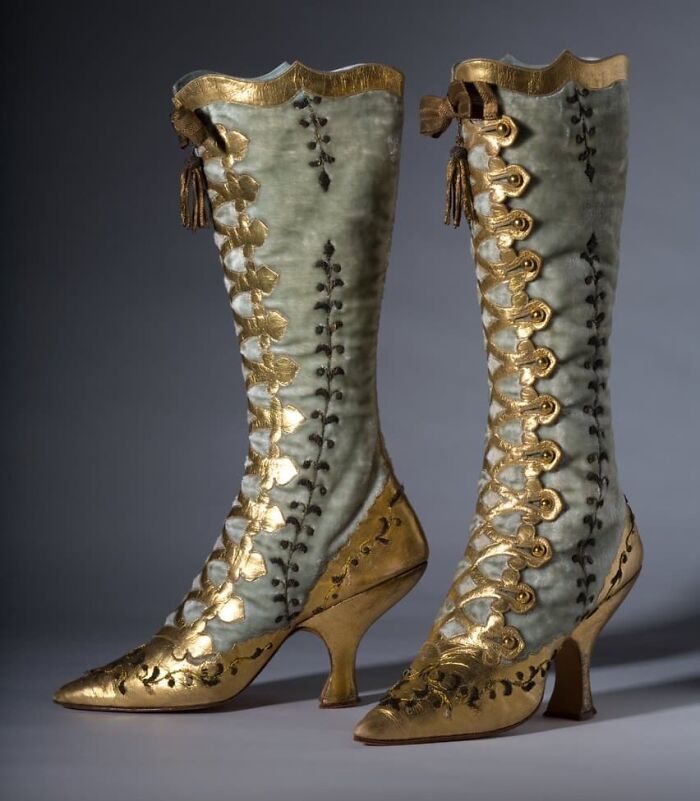
Victorian leather and velvet boots - Swedish or German, 1890s
This pair of handmade, bespoke button boots reflects the infusion of erotically charged references in women’s dress that emerged at the end of the 19th century.
The level of artisanry, the luxury of the materials and the whimsy found in the overall design, is exceptional. The gold kid leather appliqué and velvet are 'erotically charged' and they resemble a stockinged leg. Even a glimpse beneath a skirt would have been tantalizing.
These boots may have been commissioned by a specific client or perhaps more likely, as a ‘show off’ piece meant for display at an exposition.
The pair is kept now at the Bata Shoe Museum in Toronto
© Photo: historiante_
#26
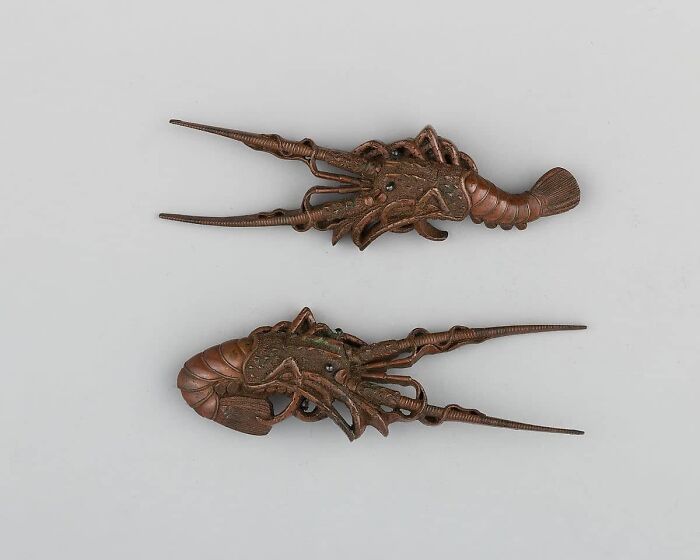
The Menuki - Parts of a japanese katana - 18th century
The menuki are the decorative metal ornaments the are woven under the tsuka-ito (handle wrapping).
These ornaments were originally made to hide the mekugi pins that secure the tsuka to the tang of the blade. They are normally positioned forward on one side and back on the other.
On unique tsuka wrappings such as katate-maki or battle wrap the menuki may be woven into the centre as a decorative ornament.
Some are very elaborate pieces made by talented jewellers and artisans that will compliment or become the centre piece of the katana's
Medium: Copper, copper-gold alloy
© Photo: historiante_
#27
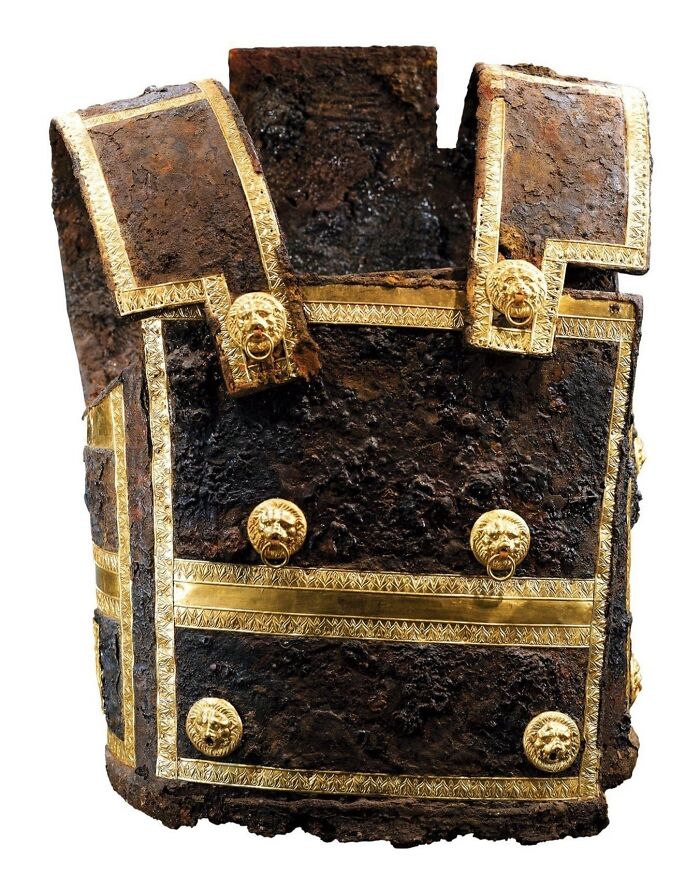
The iron and gold cuirass of king Philip II of Macedon, father of Alexander the Great - 4th century BC
Before the reign of Alexander the Great, his father, Phillip II of Macedonia, ruled the Macedonian state and became one of the ancient world’s most accomplished generals.
Philip II of Macedon was born in 382 B.C.E. in Aegae. He was the son of King Amyntas III. He was the 18th king of Macedonia and ruled from 359 to 336 B.C.E.
Macedon was unstable during Philip II’s youth. During an invasion by the Greek city-state of Thebes, Philip himself was even taken hostage. He remained in Thebes for three years and learned military strategies from Epaminondas, the great Theban general. Upon returning to Macedon, Philip was able to help his brother, Perdiccas III, rule and succeeded him as king after Perdicass died.
King Philip II is credited with restoring internal peace to his country. Philip used his military knowledge to strengthen the Macedonian army. His soldiers were trained to fight as a phalanx. A phalanx was a large group of foot soldiers armed with shields and spears. Soldiers moved closely together in a rectangular formation as if they were one giant soldier. One phalanx could contain 265 soldiers.
King Philip’s military battles and diplomatic tactics resulted in the expansion of his empire and domination over all of Greece. After he conquered Greece, he planned to conquer the Persian Empire, but he would never achieve this goal.
Philip II was assassinated in 336 B.C.E., and was succeeded by his son, Alexander III, later known as Alexander the Great. While Philip II did not fulfill his plans to expand his empire through Persian territory, he is often credited with paving the way for his son to be one of the greatest military leaders in history.
Now on display at the Museum of Royal Tombs of Aigai in Vergina, Greece
© Photo: historiante_
#28
The crown of Stephen Bocksai, Prince of Transylvania(now part of Romania), 1557 - 1606. Made from gold, rubies, spinels, emeralds, turquoises, pearls and silk
The Crown of Stephen Bocskai is a crown given by the Ottoman sultan to Stephen Bocskai, Prince of Hungary and Transylvania, in the early 17th century.
To save the independence of Transylvania, Bocskay assisted the Turks. In 1605, as a reward for his part in driving Basta out of Transylvania, the Hungarian Diet assembled at Medgyes/Mediasch (Mediaş) elected him Prince of Transylvania; in response the Ottoman sultan Ahmed I sent a special envoy to greet Bocskay and presented him with a splendid jewelled crown made in Persia. Bocskay refused the royal dignity, but made skillful use of the Turkish alliance.
Medium: height 0,235 m, weight 1,88 kg
The crown is today displayed in the Kaiserliche Schatzkammer (Imperial Treasury) at the Hofburg in Vienna.
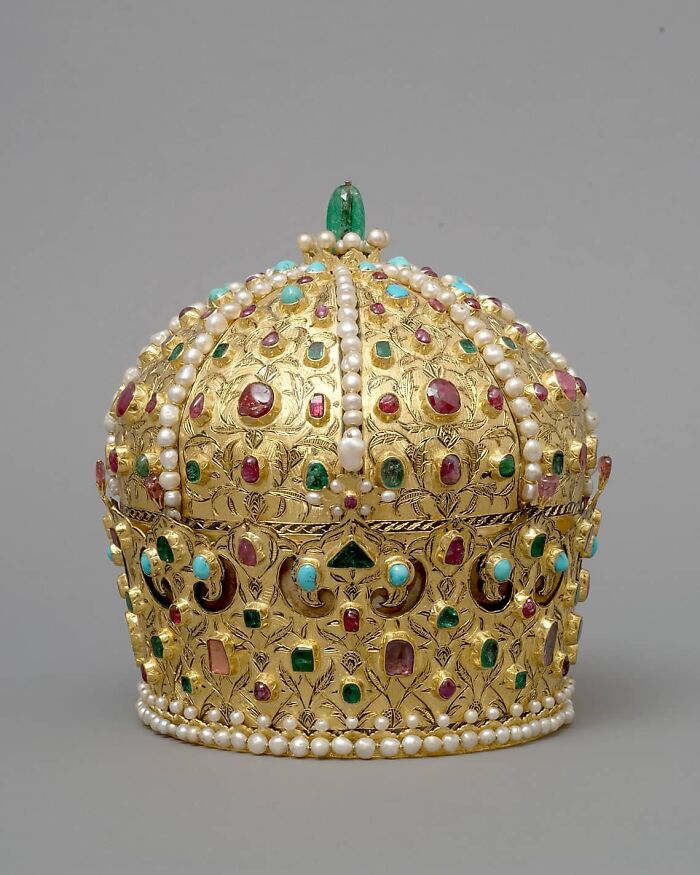
© Photo: historiante_
#29
Ceremonial helmet in the shape of a wolf’s head, Etruscan - dating back to the 6th-5th centuries BCE
The top components of the nose and the hemispherical dome have areas of rough, raised green corrosion products and brown burial accretions. Numerous large losses are the result of corrosion and breaks in the brittle, mineralized metal.
There are numerous ancient repairs, including the flaps of metal folded and riveted around cracks on the lower edge of the hemispherical dome and the irregular shapes of metal riveted to the dome where it meets the lower jaw on both sides.
The cast teeth are modern additions. They are not life casts and were irregularly modeled directly in wax to fit the shapes of the sheet metal assembly that form the jaw and top portions of the mouth.
A modern sheet-copper framework in the top and bottom sections of the mouth and a patinated but modern ridged palette-shape on the top of the mouth both help to support weight of these teeth.
Many of the rivets are ancient, but some have been replaced with modern copper pins or brass screws.
Kept now at the Harvard Museum in U.S.A.
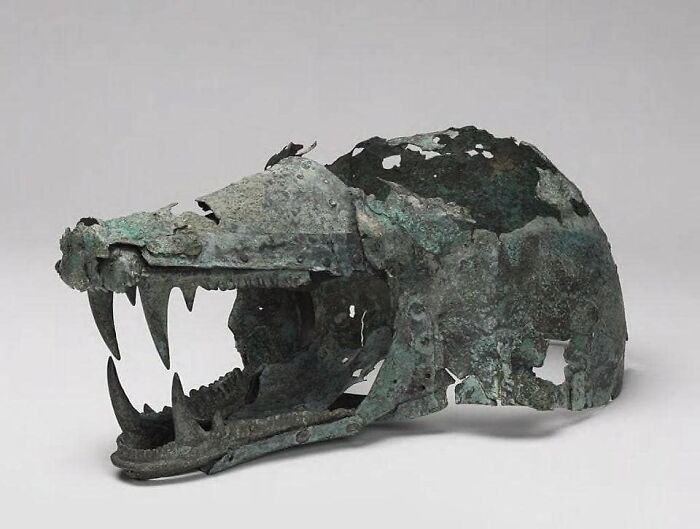
© Photo: historiante_
#30
Ancient Roman amethyst intaglio showing Pan, the pastoral god, playing pipes under a crescent moon and a leaning tree, with a goat observing. Dated between the 1st and 2nd centuries AD. The gold ring setting is of a later date.
Kept now at a private collection
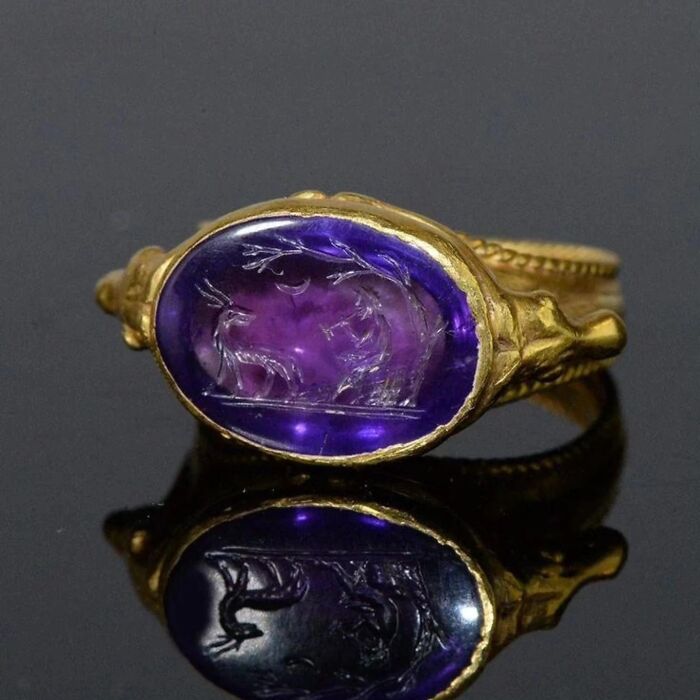
© Photo: historiante_
#31
Parrying dagger - Italy, 1550–75
Designed to be used together with a rapier, this dagger is fitted with a side ring, recurved quillons, and a depression at the base of one side of the blade to accommodate the thumb and facilitate a firmer grip.
The waves in the blade may be intended to act like "speed bumps" in breaking the impact of a blow from an opponent's blade. The piercing of the fullers (grooves) is a decorative motif.
It is now on display at the Metropolitan Museum of Art in New
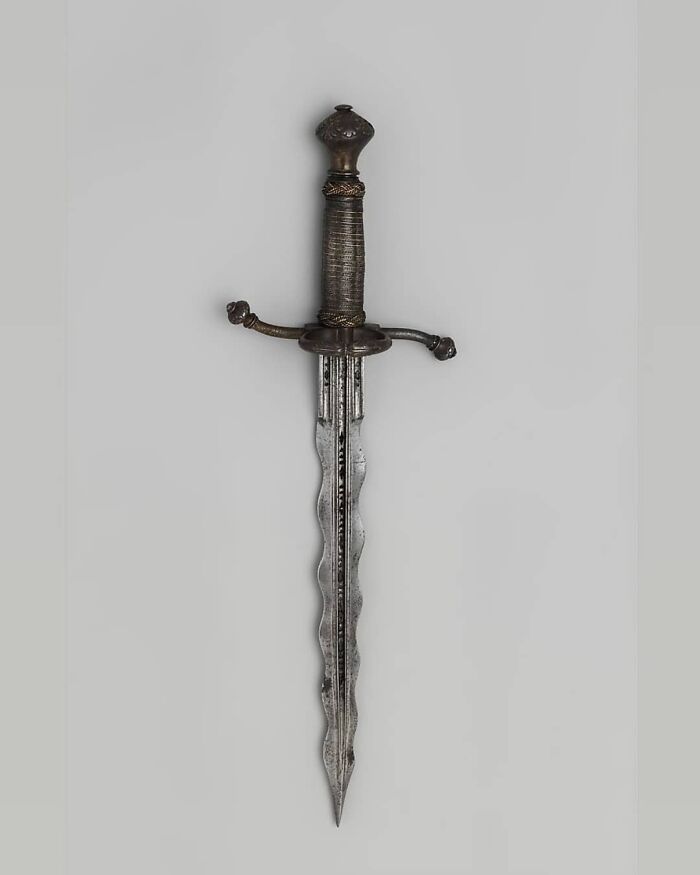
© Photo: historiante_
#32
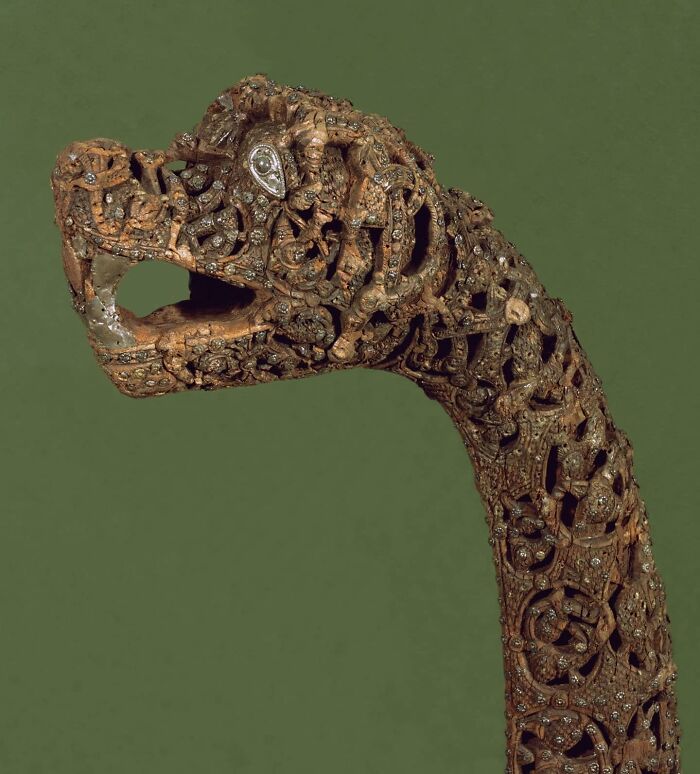
Skillfully carved dragon head - Vikings, 10th century
Dragonships were large longships that had carved heads of dragons and other magical beings mounted on their stem. They were ships for chieftains and kings.
The dragonhead should scare away enemies. It also had magical functions: It would provide protection for ships and crew – and it should ward off evil spirits both on land and sea.
The Icelandic law code Grágás says that the dragonhead should be taken off the ship when the Vikings returned to their homestead, not to intimidate the spirits of their native land. (Grágás was used from about 930 and written down about 1117)
The dragonhead made it easy to recognize a certain ship. It clearly shows who the leader is and where the leader is in battle.
The symbolic function of the dragonhead is enhanced by the fact that ships often were named after the magical animal that graced it’s prow.
The dragon, also called serpent, was a primary motive for the royal longships, but also other magical beings could be used as dragonheads on some ships.
When Christianity was introduced, Christian symbols and ship names eventually replaced the magical role former played by old Norse beings.
Sagas and skaldic poems tell many stories of dragonships with beautifully carved fabled animals in the stem and a tail at the stern. Some ships had dragonheads both on stem and stern. There are also old depictions of dragonheads.
Photo courtesy: Museum of Cultural History, University of Oslo, Norway
© Photo: historiante_
#33
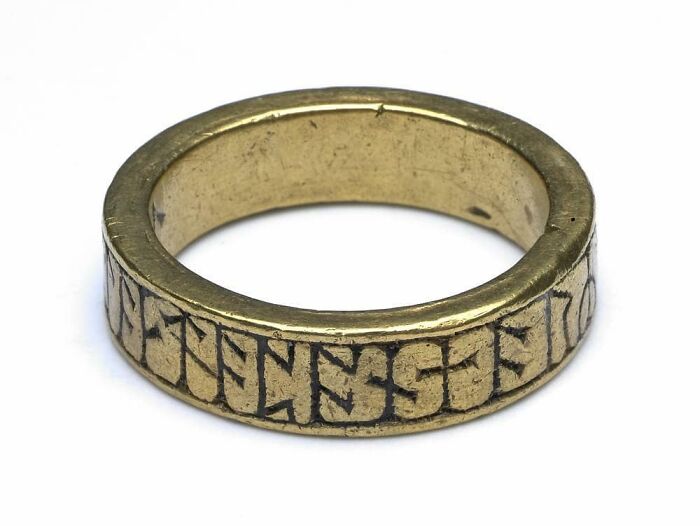
Anglo-Saxon ring engraved with a runic inscription - 8th century
The Anglo-Saxon period in Britain spans approximately the six centuries from 410-1066AD.
The period used to be known as the Dark Ages, mainly because written sources for the early years of Saxon invasion are scarce. However, most historians now prefer the terms 'early middle ages' or 'early medieval period'.
It was a time of war, of the breaking up of Roman Britannia into several separate kingdoms, of religious conversion and, after the 790s, of continual battles against a new set of invaders: the Vikings.
Jewellery was worn by both Anglo-Saxon women and men. Gemstones such as amethyst and amber and glass beads were used to make simple bracelets and necklaces. Women fastened their dresses at the shoulder with a pair of brooches. Men fastened cloaks with brooches and had elaborate belt buckles.
This gold ring was found by a young man near Greymoor Hill, in the hamlet of Kingmoor. It was given to the museum in 1823
Transliteration is: ÆRKRIUFLTKRIURIÞONGLÆSTÆPONTOL. As it cannot be interpreted it must be assumed that the inscription is meaningless and of magical import.
Photos courtesy: British Museum
© Photo: historiante_
#34
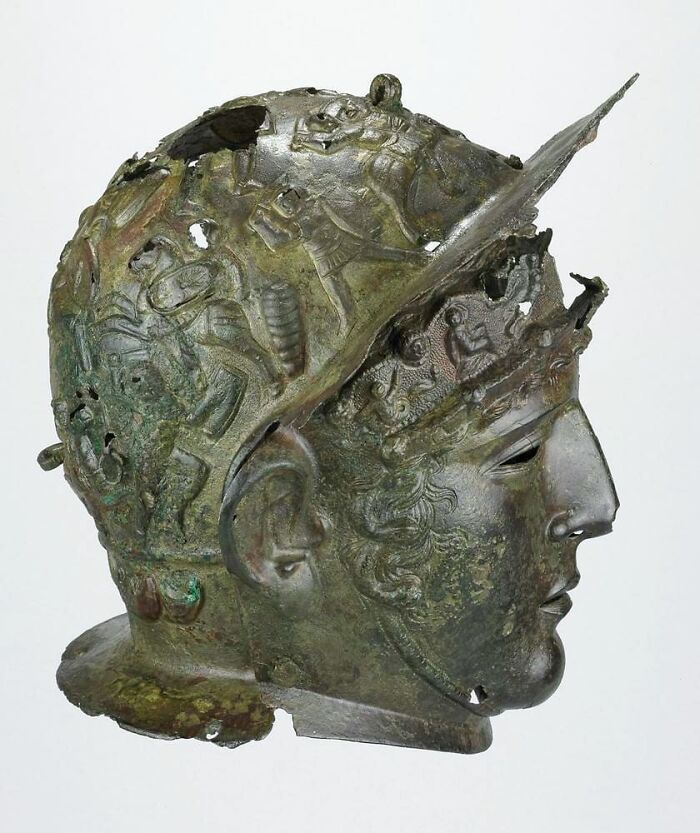
The Ribchester Helmet - A Roman cavalry sports helmet with face mask, cca. 1st-2nd century AD
In 1796 a clogmaker's son, playing behind his father's house in Ribchester, Lancashire, discovered a mass of corroded metalwork. This proved to be a hoard of Roman military equipment and military awards.
Cavalry sports (hippika gymnasia) were flamboyant displays of military horsemanship and weapons drill. They served both as training sessions and to entertain the troopers.
The most colourful events were mock battles among the elite riders of the unit, often in the guise of Greeks and Amazons. Both men and horses wore elaborate suites of equipment on these occasions.
The helmet, decorated with a scene of a skirmish between infantry and cavalry, is the most spectacular piece. When used, the head-piece and face mask of embossed bronze would be held together by a leather strap. A crest-box and a pair of trailing streamers or 'manes' would have been attached to the head-piece.
On display at the British Museum in London
© Photo: historiante_
#35
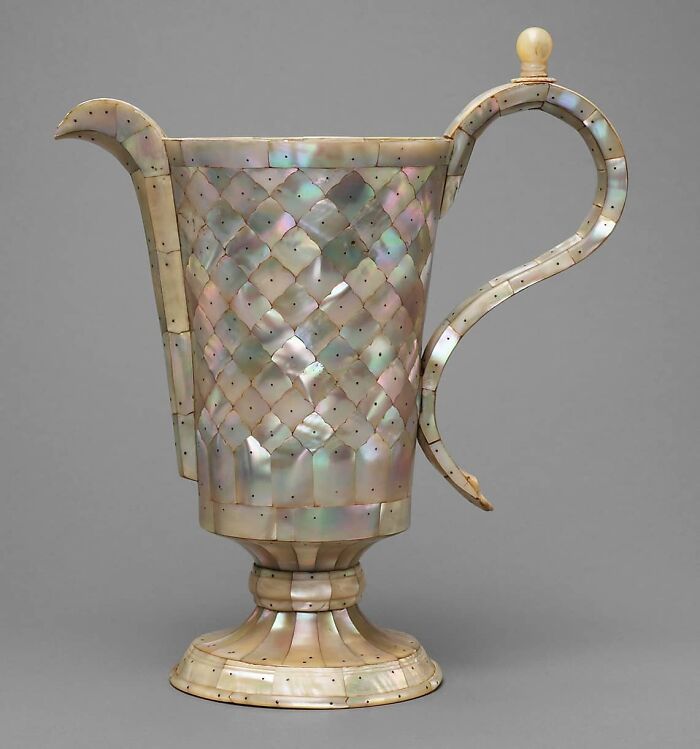
Mother-of-pearl Ewer from Gujarat, India - 1596
A ewer is an older word for pitchers or jugs of any type, though tending to be used for a vase-shaped pitcher, often decorated, with a base and a flaring spout.
This ewer and the set it belongs to are Indian in origin. They were made in Gujarat. However when the V&A acquired the set in 1857, curators thought these pieces were Italian. This was because the set had a European shape.
Another reason was that from about 1590 to 1700 European goldsmiths deliberately copied Gujarati mother-of-pearl work for both familiar and new forms.
This created problems of identification for future scholars that still exist today
Cabinet of Curiosities of Ferdinand II, Archduke of Austria. Originally at Ambras Castle. Height: 25cm
© Photo: historiante_
#36
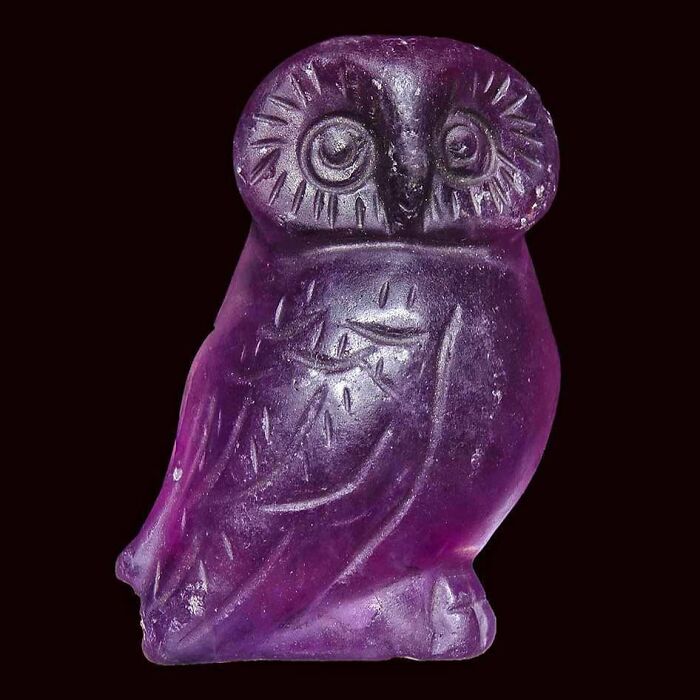
Tiny Greek owl carved in purple fluorite, 4th-3rd century BC
The tridimensional sculpture is depicting the famous owl of Athens or Athens Noctua. The mythological animal is characterized by an horizontal elongated head with big rounded open-eyes.
The head feathers and the pupils are deeply carved. The face is frontal meanwhile the body is turned to the left. The wings, and some other feathers are represented by the same carved-lines.
The posture of the bird and the general appearance are referring to the mythological owl of the goddess Athena, symbol of the city of Athens.
This sculpture can be seen as a votive idol or a very precious protective amulet empowered by the image linked to the goddess of wisdom and strategy. This ancient micro-sculpture is carved in an extraordinary deep purple bicolor fluorite.
During the Antiquity, the amulets, sculpted figures and vessels productions in fluorite are attested in ancient Greece and Rome as a precious stone. Wellknown for the crystals wonderful colors and the perfect cleavage.
Courtesy of ArsValue. com
© Photo: historiante_
#37
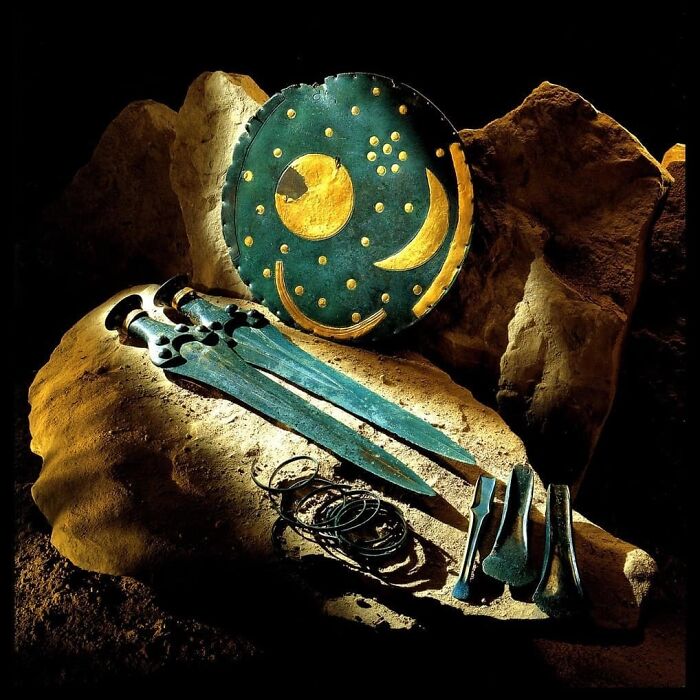
The 'Nebra Sky Disk' with two bronze swords and axe heads uncovered from Saxon-Anhalt, Germany and dated to 1600 BC. This incredible discovery of the oldest depiction of the universe was almost lost to the black market.
Dated to 1600 BCE, this bronze disk has a diameter of 32cm (about the size of a vinyl LP) and weighs around 2 kg. It is patinated blue-green and embossed with gold leaf symbols which appear to represent a crescent moon, the sun (or perhaps a full moon), stars, a curved gold band, interpreted as a sun boat, and a further gold band on the edge of the disk which probably represent one of the horizons.
Many researchers believe it is the oldest known realistic representation of the cosmos yet found, perhaps a kind of astronomical calculational tool to determine planting and harvest times. used as an advanced astronomical clock.
For thousands of years all across northern Europe, monuments were aligned to mark the summer and winter solstices; Stonehenge in Wiltshire, England and Newgrange in Irelandare the most famous examples.
As Bronze Age people were an agricultural society, a method for finding out the time of year, and thus the correct times for planting and harvesting crops, was obviously vital. One way of doing this was to identify the position of the sun at sunrise and sunset.
Researchers have pointed to the presence of the Pleiades star cluster on the disk as further evidence of Bronze Age astronomical knowledge.
The Pleiades was an important constellation for many ancient civilisations, including those of Mesopotamia and Greece. The constellation would have appeared in their skies in the autumn, showing that it was time to start bringing in the harvest, and disappeared in the spring, indicating the time for planting crops.
© Photo: historiante_
#38
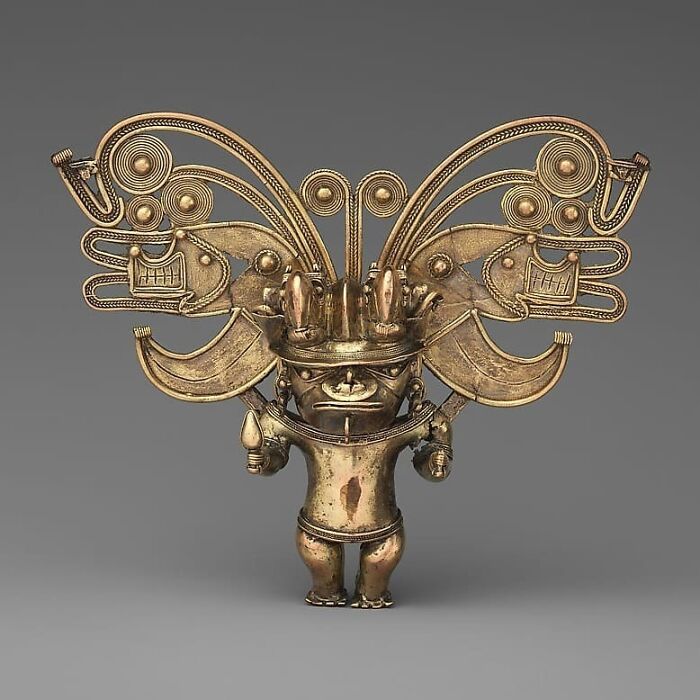
Gold Pendant - Tairona civilization, Northern Colombia, 10th–16th century
Works in gold made by the Tairona people of the Sierra Nevada de Santa Marta in north Colombia emphasize volume and three-dimensional form.
The figure shown here is part of a small group called caciques ("chieftains") because of their flamboyant, awe-inspiring appearance. Caciques range from about one to six inches in height and are among the most spectacular and detailed Precolumbian gold castings. They are hollow, having been cast by the lost-wax method in tumbaga to achieve remarkable detail. Loops in back indicate that they were worn as pendants.
There are two types of cacique: one is fully human (shown here); the other is similar but has the head of a bat or crocodile. Both wear enormous headdresses, sometimes as tall as the figures, with two large birds on the front and elaborate sidepieces.
The human-headed pendant also has a visor or diadem, a kidney-shaped nose ornament, a labret in the lower lip, disk-headed rods and crescent-shaped dangles through the earlobes, a necklace, a belt, and armbands.The tiny ornaments display minute details and are comparable to full-size examples found in Tairona tombs.
Whether a portrait of a ruler, a rendering of a supernatural ancestor, or a depiction of a shaman in the state of symbolic and spiritual transformation (assuming the features of a helping animal spirit), such a powerful image could only have been worn by individuals who were themselves powerful in Tairona society.
Now on display at the Metropolitan Museum of Art in New York
© Photo: historiante_
#39
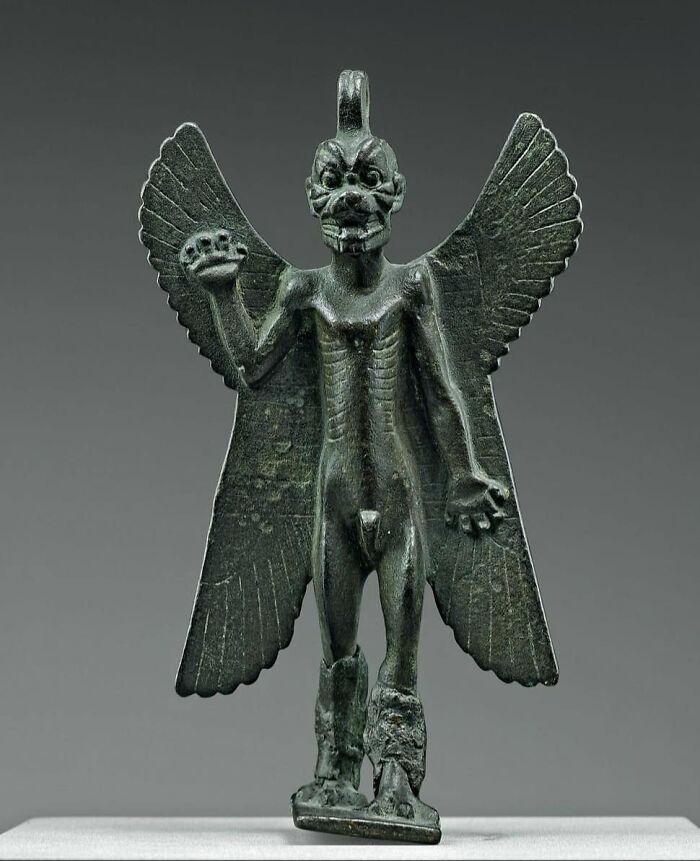
Statuette of the demon Pazuzu - Mesopotamia, first millennium BC
Pazuzu first appeared in the 1st millennium BC in hybrid form, with the body of a man and the head of a scowling dragon-snake which also has both canine and feline features.
He is represented as a spirit with two pairs of wings and talons like those of birds of prey. He also has a scorpion’s tail and his body is usually depicted covered in scales.
The demon Pazuzu was associated with ill winds, particularly the west wind which brought the plague.
His terrifying, scowling face and his scaly body repel the forces of evil, which meant that in certain circumstances the figure was considered a protective spirit.
This bronze statuette is one of the finest representations of the figure.
It is now on display at the Louvre Museum in Paris
© Photo: historiante_
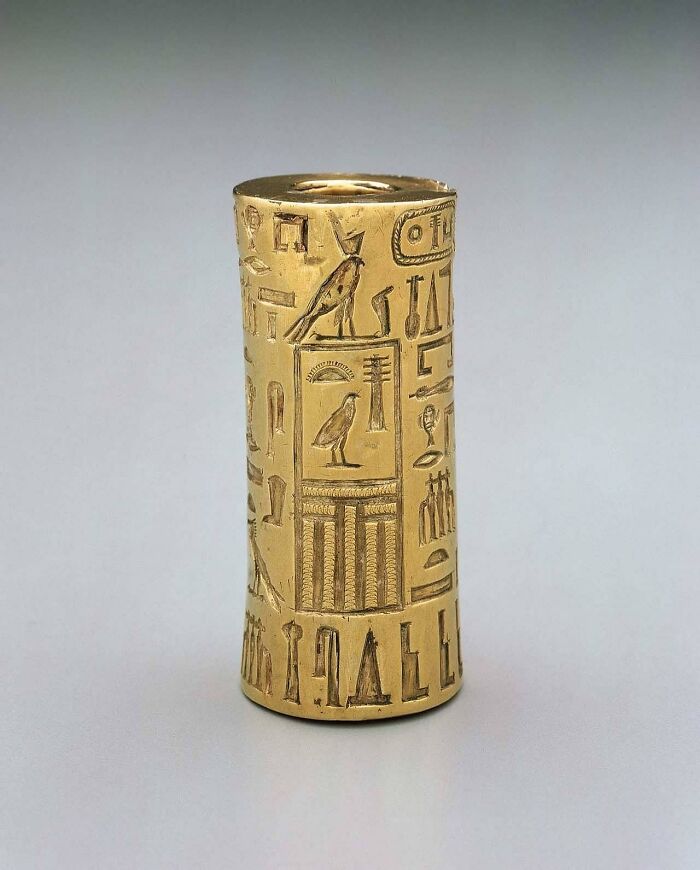
#40
Gold cylinder seal from the Old Kingdom of Egypt, 2381 - 2353 BC
The ancient Egyptians used hieroglyphs not only to create individual cartouches to represent the names of their Pharaohs, Royals and Gods, but are known to have marked their ownership by branding their livestock using these pictorial devices too.
At the same time, around 3500BC, cylinder seals were used as a form of signature or administrative tool by the Mesopotamians. These highly stylised and individual devices were typically about one inch in length, engraved with written characters or figurative scenes – or both – and rolled into a two-dimensional surface such as wet clay to leave a distinctive and identifiable mark.
In this, they can be likened to other forms of impression seal, such as the stamp or finger ring seal that we see wielded many centuries later by Kings and Lords, to authenticate and seal important documents.
The cylinder seal dates back from the reigns of Menkawhor 2497-2489 and Djedkare Isesy 2489-2450
Now on display at Museum of Fine Arts in Boston
© Photo: historiante_
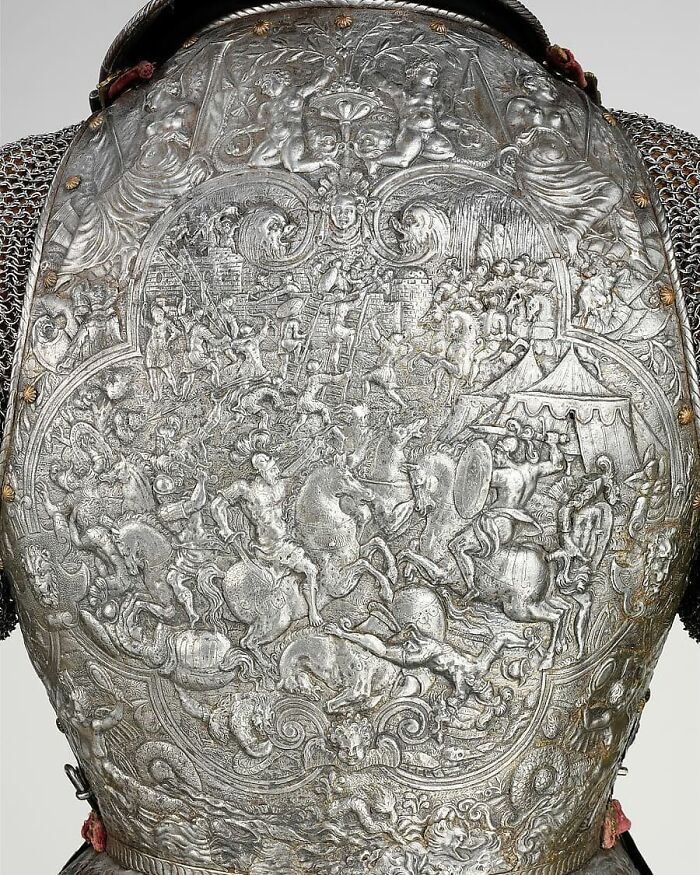
#41
Portions of a ceremonial armor - France, 1575–80
This armor was severely damaged by fire in the 1870s, destroying its gorget (collar) and arm defenses and melting off the gilding that originally covered all its exterior surfaces.
Despite this damage, the remaining parts are important as examples of French ceremonial armor from the period of Henri III (reigned 1574–89).
The embossed decoration consists of battle scenes of soldiers wearing Classical armor.
On display at the Metropolitan Museum of Art in New York
© Photo: historiante_
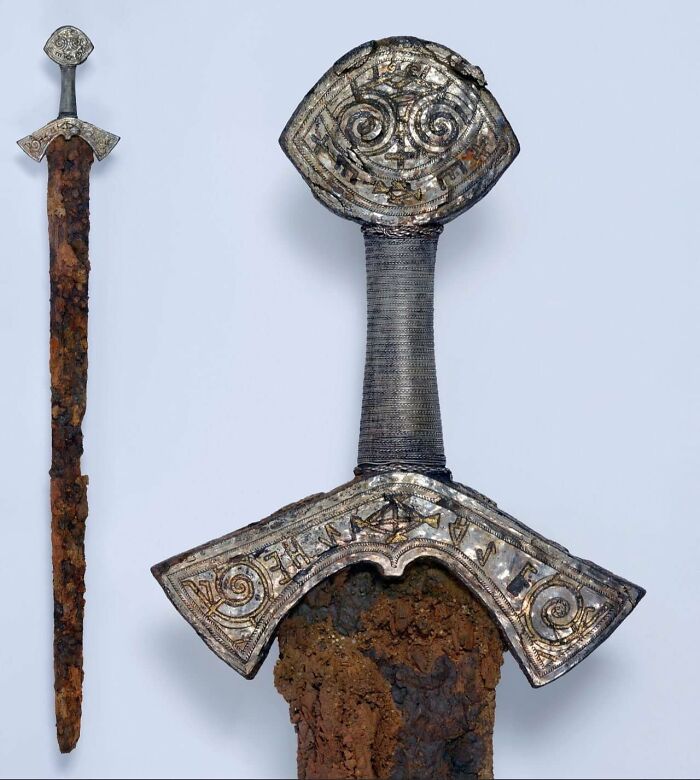
#42
Viking Era Sword with a well preserved engraved silver hilt, bearing runes - dated back to 1030 CE
The sword, dating back to the late Viking Age, was recovered from a site near the village of Langeid in Norway's Bygland municipality. It was found inside a Viking grave, lying next to a coffin.
When they cleaned it, however, the researchers found that the rust was hiding gold embellishments, stunning ornamentations, and even inscriptions. Hence, the team concluded that it once belonged to a wealthy man.
More so given the fact that, when compared to other graves discovered in the area, the one that produced this sword, built sometime around the year 1030, was quite big and, therefore, fit for a person of status.
This Viking Age sword measures 94 centimeters (37 inches) in length. Rust has eaten away at its iron blade, but its handle and the ornamentations on it are pretty much intact.
The inscriptions on the sword were written using the Latin alphabet. However, the researchers have not yet managed to figure out what they could possibly mean. Mind you, they are starting to think they are magical runes
© Photo: historiante_
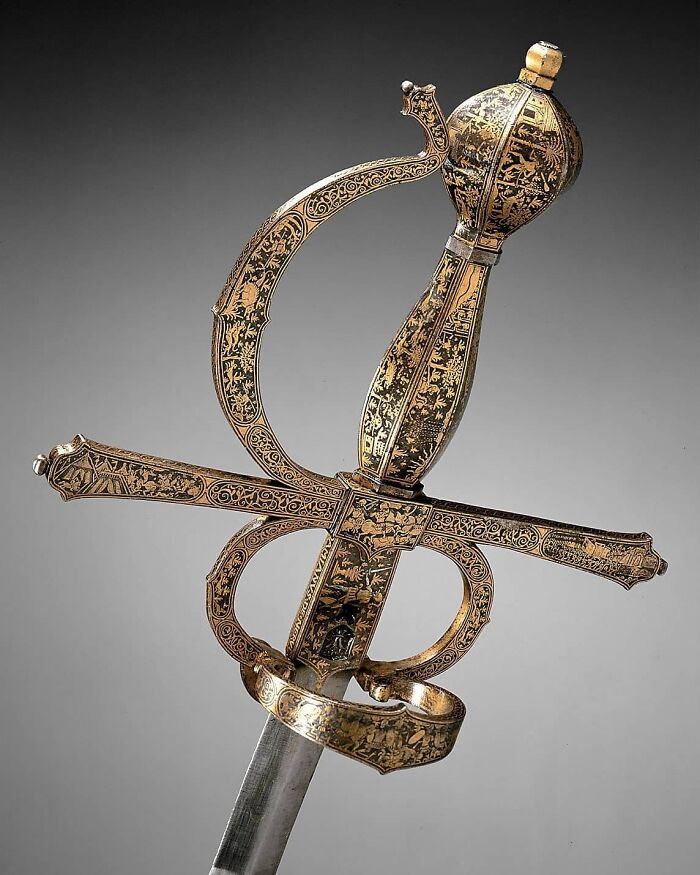
#43
Rapier sword - 1555, Italy
From the early sixteenth century onward, the practice of wearing a sword or rapier with civilian dress made duels between unarmored opponents more common. Lacking the armor or shield worn in battle, combatants had to block or parry an attack by other means. Methods of defense included the use of a dagger or a buckler held in the left hand and an increased reliance on parries made with the rapier itself.
During the sixteenth and seventeenth centuries, distinct schools of fencing developed rapidly in Italy, France, Germany, and Spain. Instruction in the art and science of fencing became an indispensable part of a nobleman’s education.
Consequently, accomplished fencing masters were hired to teach at the principal courts and universities of Europe. From about 1525 to about 1625, the rapier was regularly worn in tandem with a parrying dagger. They were sometimes made and decorated as a set.
By the mid-seventeenth century, however, parrying with the rapier blade alone had become the preferred style as a result of the development of refined fencing techniques and lighter, smaller rapiers. Most forms of left-hand parries were abandoned, except in southern Italy and Spain, where parrying daggers remained popular well into the eighteenth century.
This particular rapier was made by Damiano da Nervi. He engraved the entire surface of the hilt with gold and silver. The rich design depicts wavy tendrils, cityscapes, hunting or war scenes as well as ancient scenes such as the capture of Cerberus by Hercules or the heroic deed of Mucius Scaevola. His signature "DAMIANVS DE NERVE ME FECIT" can be found on the inner side.
Dimensions: L. (110.2 cm); L. of blade (97.2 cm)
On display at the Kunsthistorisches Museum in Vienna
© Photo: historiante_
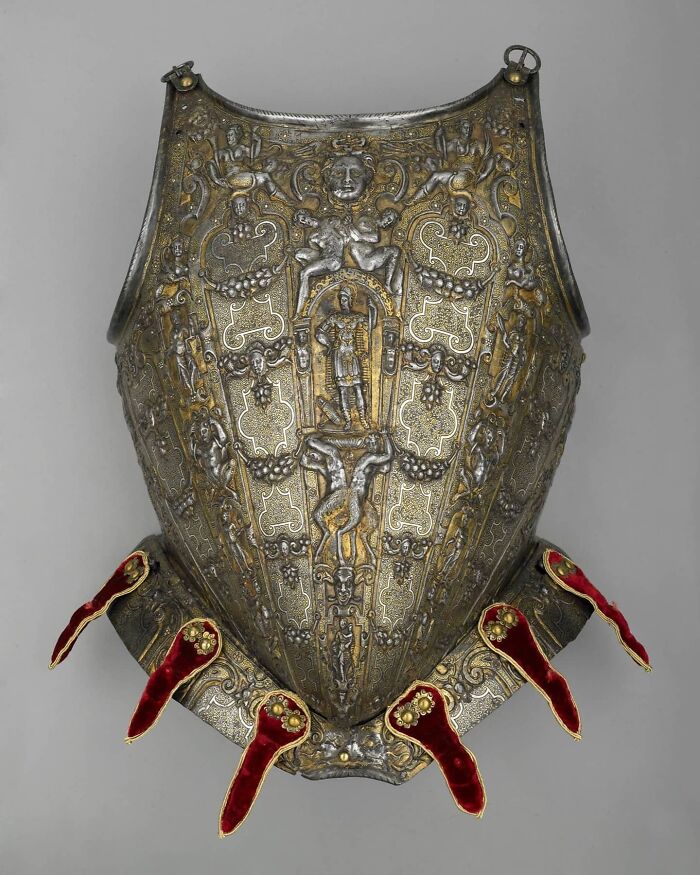
#44
Ceremonial armour belonging to Alfonso II d'Este, Duke of Ferrara from 1559 to 1597
Alfonso II d'Este was the elder son of Ercole II d'Este and Renée de France, the daughter of Louis XII of France and Anne of Brittany and was the fifth and last Duke of Ferrara.
As a young man, he fought in the service of Henry II of France against the Habsburgs. Soon after his accession, he was forced by Pope Pius IV to send back his mother to France due to her Calvinist creed.
The 1570 Ferrara earthquake fell into his reign. In 1583 he allied with Emperor Rudolf II in the war against the Turks in Hungary.
His armour employs essentially every decorative technique possible, typical of those of the Renaissance period, as well as inlay and overlay in silver and gold. This armour therefore is entirely appropriate; its luxurious forms have been rendered in very thin, soft iron, which provide almost no protection against attack.
To create richer visual effects, embossed, chased and/or etched decoration could then be covered in precious metal through the process of mercury- or fire-gilding and -silvering. After the iron or steel had been given a thin coating of copper, a mixture or amalgam of gold (or silver) and mercury was applied to the surface of the work, which was then heated up, causing the mercury to boil or fume away, leaving the gold (or silver) chemically bonded to the metal.
Alfonso II raised the glory of Ferrara to its highest point, and was the patron of Torquato Tasso, Giovanni Battista Guarini, and Cesare Cremonini—favouring the arts, sciences, and literature.
Now part of the Wallace collection in London
© Photo: historiante_
#45
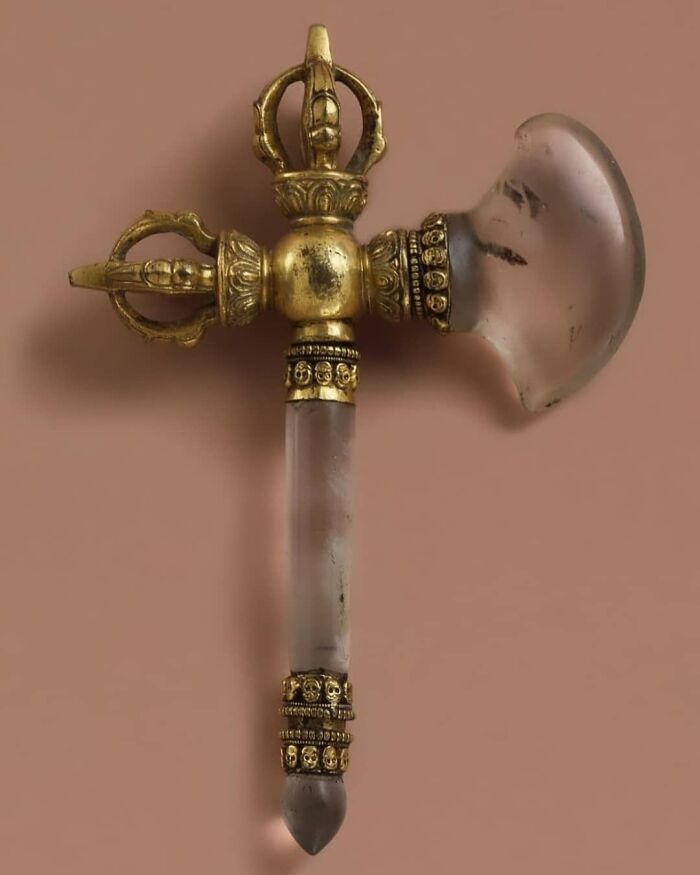
Utensils for use in Buddhist rituals(axe, flaying knife and dagger) - Eastern Tibet, Kham region - 1635
Ritual utensils are the essential tools of Tibetan Vajrayana Buddhism practice, used to drive away the delusions that act as impediments to enlightenment.
Tibetan Buddhism was practiced at the Chinese court throughout the 17th century. The gilded coppered utensils would have been used in Buddhist rituals to quell demons, which are symbolic of obstacles that must be overcome to reach enlightenment
Buddhism was more successful than any of the other missionary religions in making peace with the indigenous spirits it confronted in its progress through Asia. Monastics either turned a blind eye to existent demon-deity cults (as in Southeast Asia), allowing them to flourish in tandem with Buddhism, or (as in Tibet) Buddhist miracle workers like Padmasambhava forcefully tamed the demons and turned them into dharma protectors and fierce guardians of the new faith of Buddhism.
Those who are found lacking in these attributes have far more to fear from demons than those who, like the Buddha in his triumph over the ultimate demon Māra, have pacified their own inner demons of greed, aversion, and ignorance.
Since there is no notion of absolute evil in Buddhism (or indeed in any Asian religion), and all classes of beings, including beings of the lower realms such as demons, animals, and ghosts, may improve their karmic lot by attaining a higher birth in the human or divine realms, demons are not always and forever demons. They are troublesome but not catastrophic. They are obstacles to be overcome through ritual action, offerings of appeasement, and meditative detachment.
As representations of natural bounty, mystery, and fertility, demons threaten to exceed and overturn the human order. They must be controlled, and yet they must be respected, since they are an inevitable feature of that oscillating order
Held now at the Los Angeles County Museum of Art in U.S.A (not on public view).
© Photo: historiante_
#46
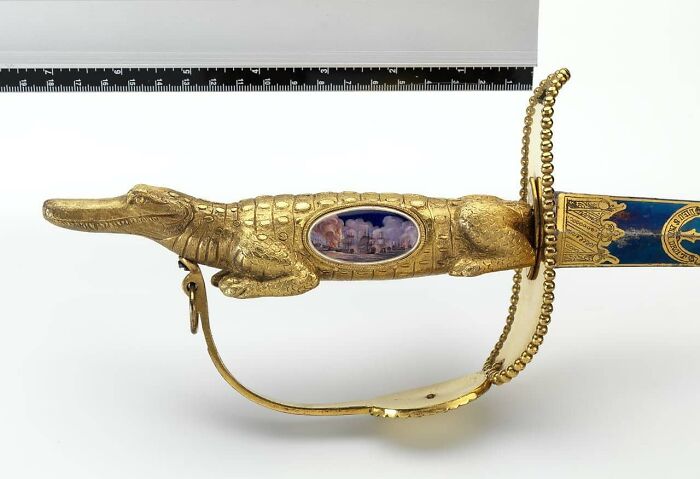
Presentation sword made for Vice-Admiral Horatio Nelson by the Captains of the Fleet after the Victory of the Nile on the 1st August 1798.
The hilt of the sword consists of a gilt crocodile forming the pommel and grip, along with a gilt knuckle-bow. There is a ring on the pommel in order to accommodate a sword knot.
There is a nearly flat, single shell and an oval shield on the knuckle-bow, which are now plain, any original enamel or engraving having been rubbed away. On the obverse and in the centre of the grip there is an oval shield decorated with coloured enamel depicting ships of the line in action.
The panel on the reverse of the shield is engraved with the words 'VICTORY of the NILE, 1st of August, 1798.' The straight, double-edged steel blade has a diamond section, which becomes hexagonal towards the point, and the blade is also damascened in blue and gold for 318mm from the hilt, after which point it consists of plain undecorated steel.
Engraved on the obverse of the blade, near the hilt are the Royal arms contained within a shield with a crown above, along with the French motto 'Honi soit qui mal y pense' that is engraved around the shield.The motto 'Dieu et mon droit' is engraved below the shield. Engraved above this on a longitudinal panel, and also on the reverse of the blade is the inscription 'For my Country and King.'
This sword is in all probability a replica of the one presented to Vice-Admiral Horatio Nelson (1758-1805) by the Captains of the Fleet after the Victory of the Nile on the 1st August 1798. It is believed that some of the Captains, if not all of them, had copies made of the sword for themselves and that this sword is one of those copies.
The sword resides now at the National Maritime Museum in UK
© Photo: historiante_
#47
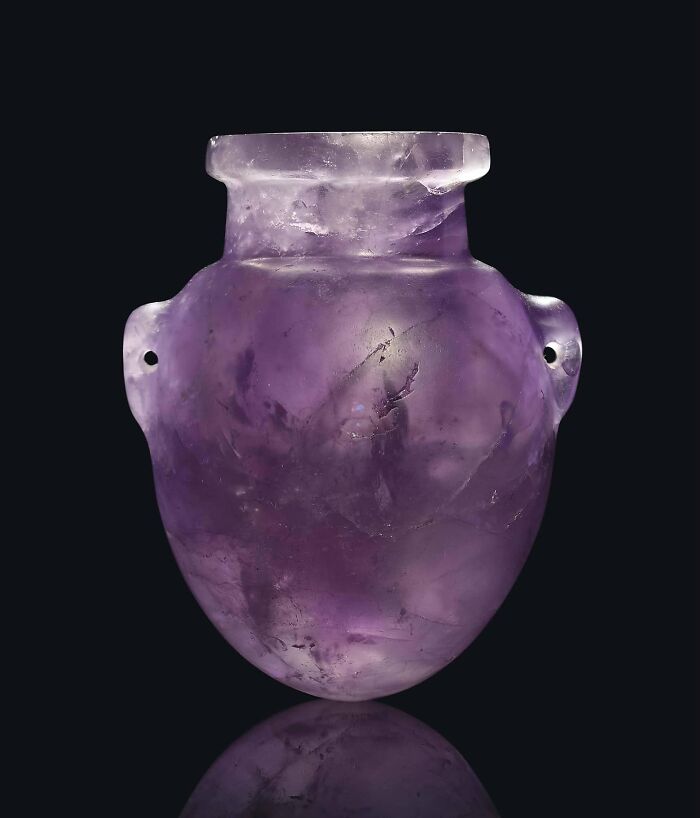
A Neo-Assyrian amethyst vase
- 8th century B.C.
Of ovoid form, with short cylindrical neck and overhanging disc rim, the mouth flat with a descending step framing the central opening, the interior hollowed out, with two trapezoidal lugs on the shoulders, drilled horizontally for suspension. Vases of this type were used to store perfume oils.
Sold at Christies in 2012
Dimensions: 2 1/8 in. (7.9 cm.) high
© Photo: historiante_
#48
Formal outfit worn by one of the last daimyō - Japan, Edo Period, 1830
Kamishimo is a combination of hakama pants and kataginu, a sleevless jacket, both made in the same fabric(hemp), worn over the kimono.
Kamishimo was worn daily by samurai men during the Muromachi, Sengoku, Momoyama and Edo periods. It could have various colors and patterns, and sometimes had the owner's kamon (family crest) on both sides of the chest/shoulders, and in the middle back of the kataginu.
In Edo period (1603-1868), the subdued colors like grayish blue, gray and brown became "the rule" for male outfits, as well as more discrete patterns. Kamishimo became no longer daily, but formal outfit for samurai. The kataginu front pannels became more narrow, and the shoulders of the garment turned into wide, firm "wings".
This particular kamishimo was worn by Nabeshima Naomasa which was the 10th and final daimyō of Saga Domain in Hizen Province, Kyushu Japan. His honorary title was Hizen-no-Kami, and he was occasionally referred to as “Prince Hizen” in western accounts during the Bakumatsu period.
Fun fact: The Star Wars saga was inspired by Japanese culture.
The kamishimo resides now at The Kyoto Costume Museum in Japan
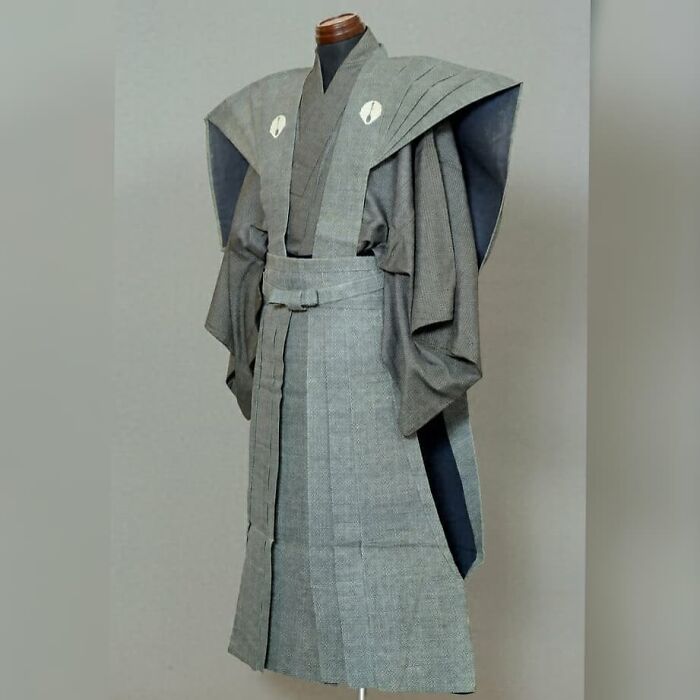
© Photo: historiante_
#49
Bronze and gold sword - Eastern Zhou Dynasty, 4th century BC
China's bronze weapon manufacturing technology reached its peak during the Eastern Zhou Dynasty, and the most exquisite swords were produced in the southern states of Wu and Yue.
This sword is densely decorated with gold patterns and should have been used in ceremonies or decorations.
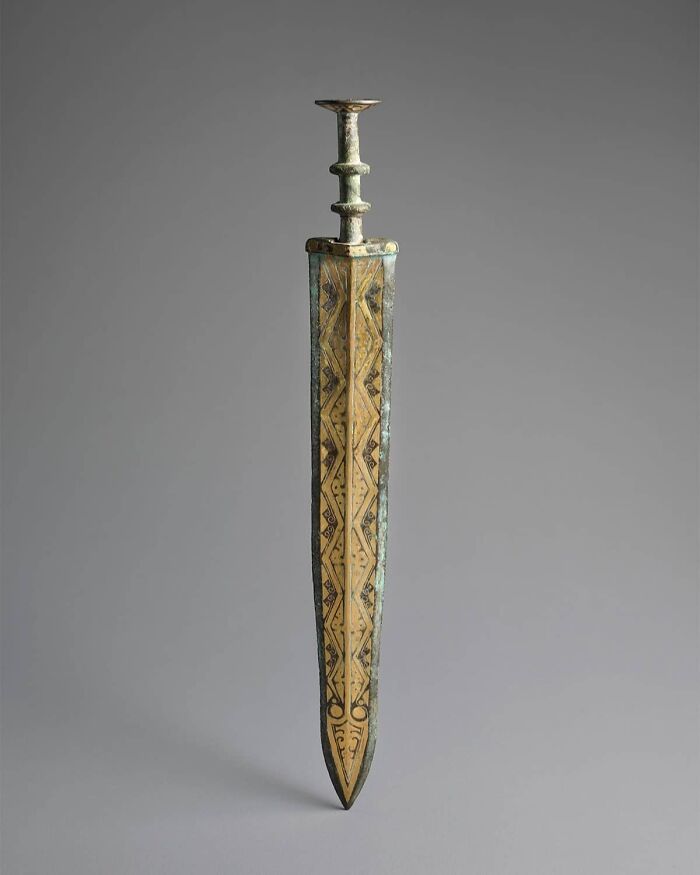
© Photo: historiante_
#50
Bowl with fish, Iran, Kashan region, late 13th - 14th century
Kashan is famous for producing these kinds of bowls. A great number of blue and black painted bowls employing radiating panels filled with willow tendril designs like this one have been archaeologically dated to between 1204 and 1215.
This type of ware has been shown to originate from Kashan, an important ceramic center in western Iran that, between 1175 and 1225, produced a remarkable variety of luster, underglaze, and overglaze painted wares.
Similar Kashan bowls occasionally show inscriptions drawn from Persian literature in the bands radiating from the center like the black and white example shown to the left.
Kept now at the Hossein Afshar Collection
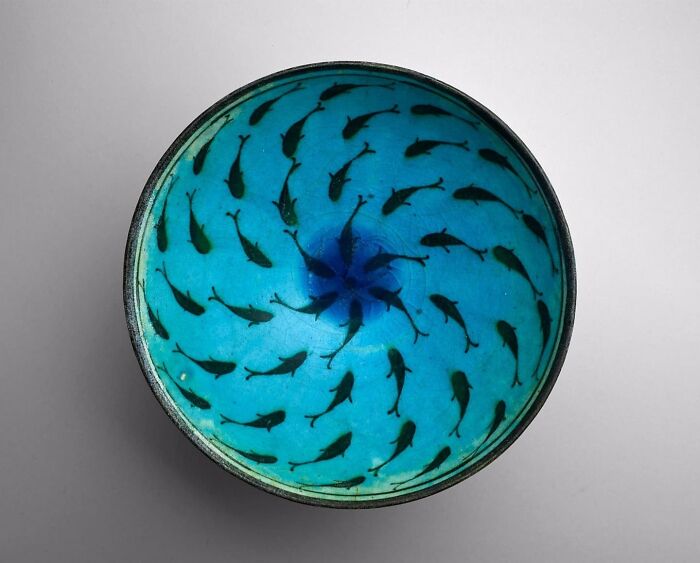
© Photo: historiante_
#51
Sword with rock crystal parrot-headed hilt and gold damascene - India, Late Mughal, 1720 - 1750
The Mughal Empire at its zenith commanded resources unprecedented in Indian history and covered almost the entire subcontinent.
From 1556 to 1707, during the heyday of its fabulous wealth and glory, the Mughal Empire was a fairly efficient and centralized organization, with a vast complex of personnel, money, and information dedicated to the service of the emperor and his nobility.
This steel blade sword with rock crystal parrot-headed hilt and gold damascene is form the Late Mughal period and belongs to the Northern part of India.
The long curving ‘shamsher’ sword is a typical Mughal-style blade. Although the elaborate decoration and parrot-headed hilt is more like an eighteenth-century piece when many Mughal objects were received and reset in Rajput courts.
Dimension: 86.6 cm L
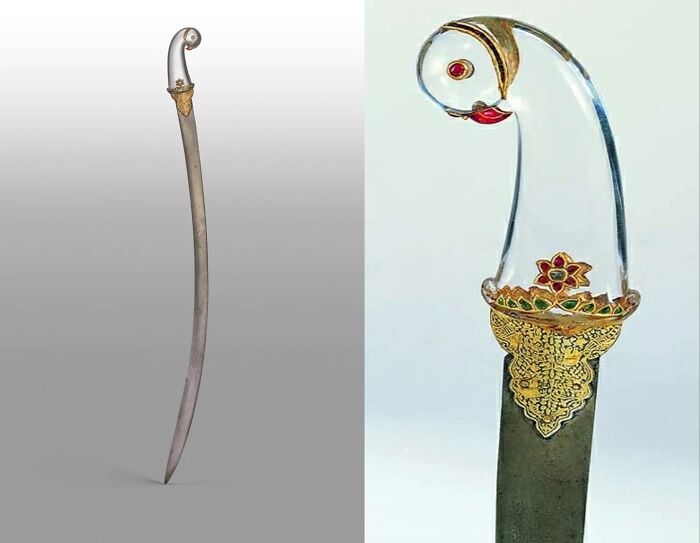
© Photo: historiante_
#52
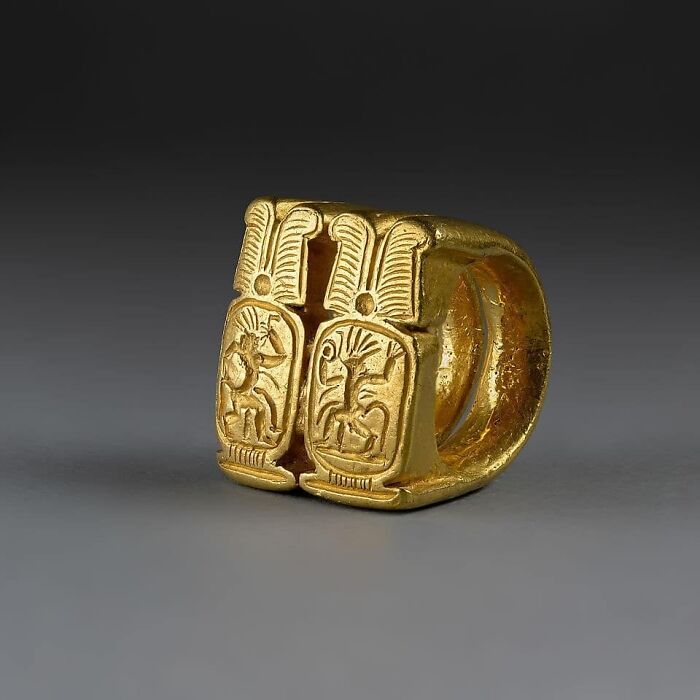
Gold signet ring with Bes figure - New Kingdom, Amarna Period
ca. 1353–1323 B.C.
The ring bezel is decorated with the royal device of two cartouches topped by ostrich plumes. The cartouches frame dancing figures of Bes, a minor god who frightened away demons and slayed snakes and other harmful animals.
Bes was closely associated with women in labor and with small children, and use of his image on this ring suggests that it belonged to a queen.
On display at the Metropolitan Museum of Art in New York
© Photo: historiante_
#53
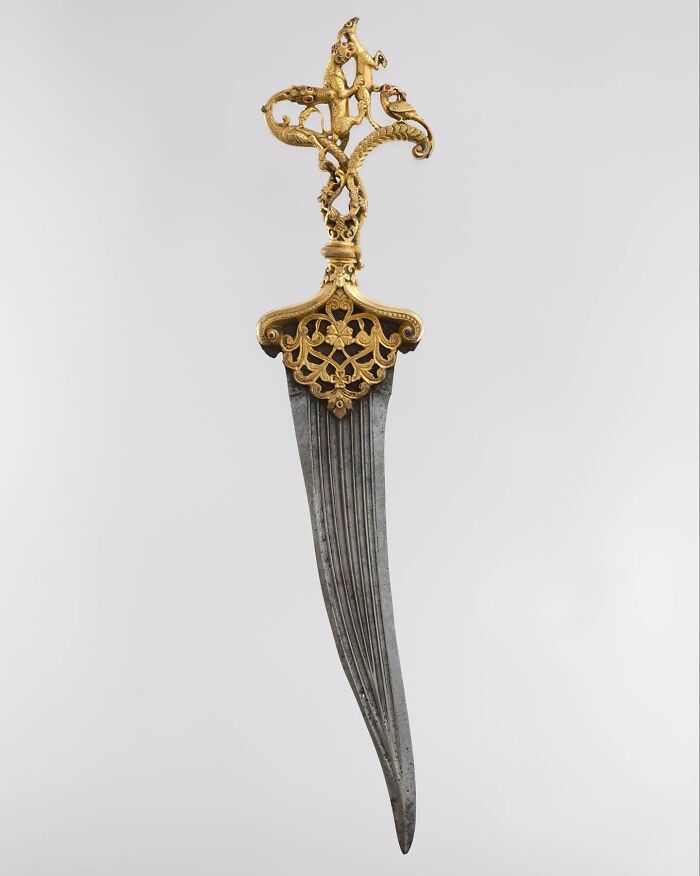
Dagger with zoomorphic hilt - India, 1655
Medium: Hilt: copper; cast, chased, gilded, and inlaid with rubies.
Blade: steel; forged
Portraits of Sultan 'Ali 'Adil Shah of Bijapur show him wearing daggers with zoomorphic hilts which combine Persian and Indian symbols of power.
In this superlative, ruby-studded example, a dragon, whose tail wraps around the grip, attacks a lion, which in turn attacks a deer. Before the deer is a parrot-like bird with a snake in its beak, symbolism associated with the deity Garuda.
Lower down on the hilt is the head of a yali, a mythical lion-like animal, with floral scrolls issuing from its mouth.
Now on display at the Metropolitan Museum of Art in New York
© Photo: historiante_
#54
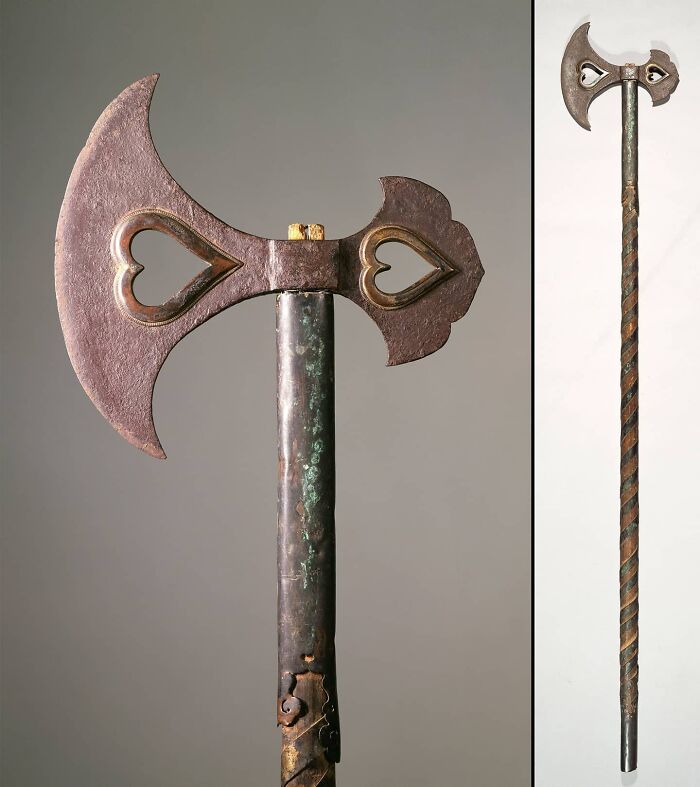
Mountaineer's axe with heart-shaped holes and bronze reinforced shaft
Japan, Muromachi period - 1325
This axe was carried by a 'yamabushi' (a follower of Shugendō) leading a group on 'nyūbu'(mountain ascetic training), which was usually a long pilgrimage stopping at every temple in the mountains. It's derived from more utilitarian axes that monks used to clear the brush while training in the wild.
Two *inome* ("boar's eyes") have been worked into the axehead, or what English speakers would call heart shapes. They are a common motif on temples and shrines. The shaft has been reinforced with a bronze coil and caps.
Now on display at the Nara National Museum in Japan
© Photo: historiante_
#55
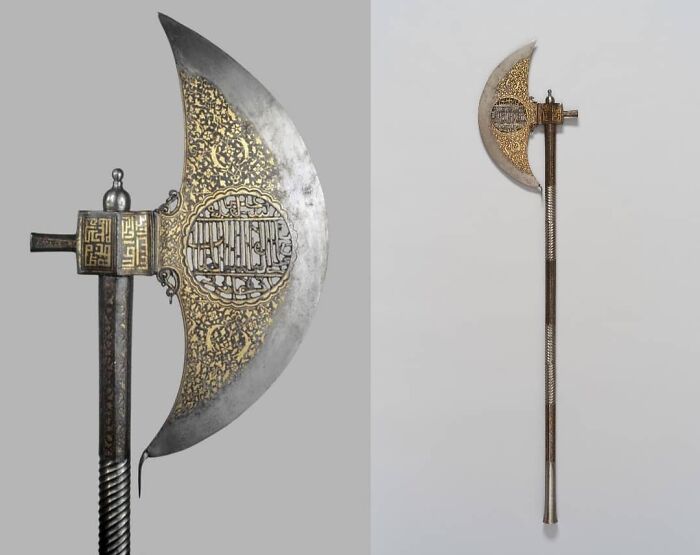
Battle axe of a member of the Life Guards of the Mamluk Sultan Muhammad ibn Qaytbay, 1496 - 1498 AD
Sultan Abu Al-Nasr Sayf Qaytbay was the eighteenth Burji Mamluk Sultan of Egypt from 1468–1496 AD.
During his reign, he stabilized the Mamluk state and economy, consolidated the northern boundaries of the Sultanate with the Ottoman Empire, engaged in trade with other contemporaneous polities, and emerged as a great patron of art and architecture.
In fact, although Qaytbay fought sixteen military campaigns, he is best remembered for the spectacular building projects that he sponsored, leaving his mark as an architectural patron on Mecca, Medina, Jerusalem, Damascus, Aleppo, Alexandria, and every quarter of Cairo.
An-Nasir Muhammad ibn Qaytbay was the son of Qaytbay, and a Mamluk sultan of Egypt from 1496 to 1498.
This axe belonged to a member of the Life Guards of Sultan Muhammad ibn Qaytbay from the Caucasian-Burji Mamluks.
The Mamluks ruled Egypt and Syria from 1250 AD until their empire fell to the Ottomans in 1517 AD, when a wealth of Mamluk booty was removed to Istanbul.
Medium: Iron, gold damascening, heat-blued
Dimensions:
Length: 99.5cm, Width: 20.5cm
Kept now at Kunsthistorisches Museum in Vienna
© Photo: historiante_
#56
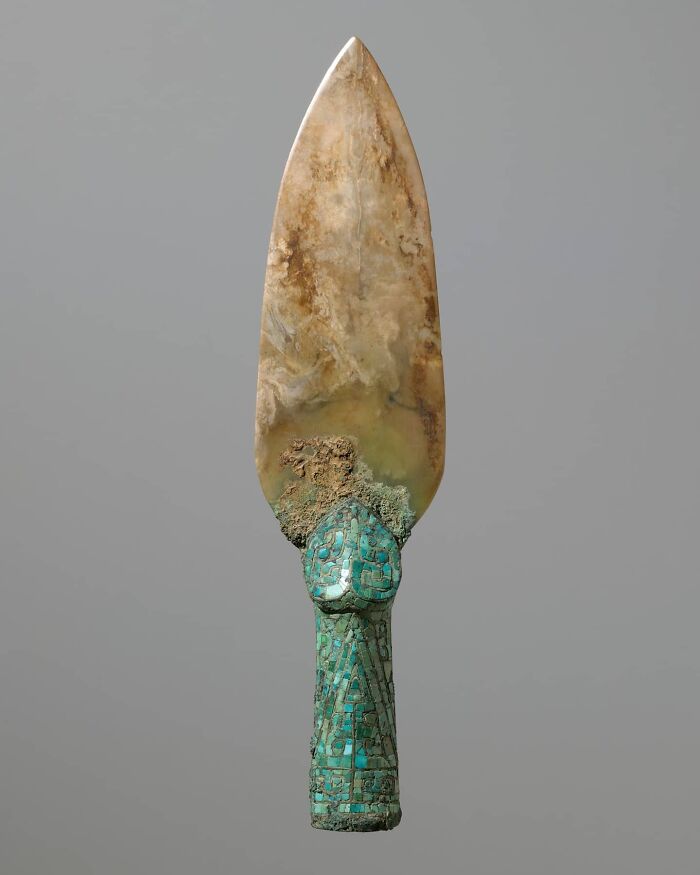
Jade spearhead in a bronze socket - China, Shang dynasty - 1250 BC
A highly religious and ritualistic society, the Shang established their dynastic kingdom in northern China around 1600 BCE. Their king served as the intermediary between his subjects, a powerful god known as Shang Di, and deceased ancestors that the Shang believed could intercede on their behalf.
The extraordinary emphasis placed on ancestor worship and state ritual during the Shang dynasty necessitated the production of massive numbers of bronze vessels and ceremonial weapons.
Specific types of bronze vessels for cooking, warming, or serving sacrificial offerings of food and wine were required for ceremonies designed to feed and appease ancestral spirits.
Ceremonial weaponry, such as the jade blades with turquoise-inlaid bronze hafts were an important part of state regalia, as Shang rulers owed their domination over neighboring societies to their military prowess.
Ritual bronzes and weapons were essential burial objects, for they represented the power and authority that the deceased intended to take with him into the afterlife.
Now on display at the Harvard Art Museum in U.S.A
© Photo: historiante_
#57
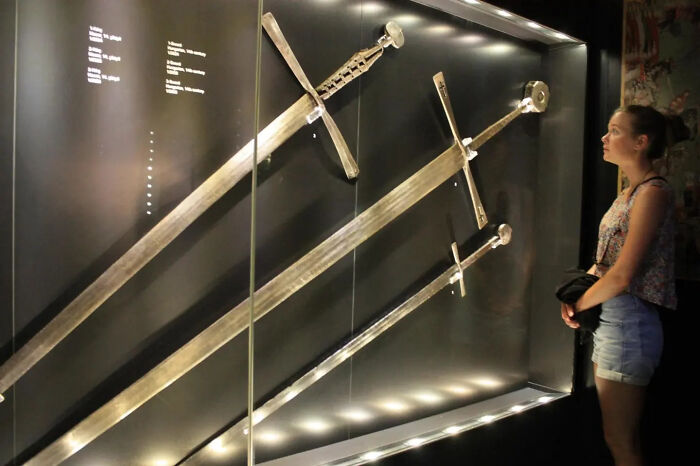
Massive swords of Hungarian origin dating back to the 14th century
Zweihänder swords developed from the longswords of the Late Middle Ages and became the hallmark weapon of the German Landsknechte from the time of Maximilian I (d. 1519) and during the Italian Wars of 1494–1559.
These swords represent the final stage in the trend of increasing size that started in the 14th century. In its developed form, the Zweihänder acquired the characteristics of a polearm rather than a sword due to their large size and weight and therefore increased range and striking power. Consequently, it was not carried in a sheath but across the shoulder like a halberd.
These Parade Swords were carried at the front of parades, often for church saint's days and similar civic events during the later medieval and renaissance period. most of them have pommels which are designed to hook into a belt, so they can be carried point-upward, but the weight supported on the person's waist.
The one in the middle (the biggest) is 270 cm long
There are now on display at the Topkapi Palace Museum in Istanbul.
© Photo: historiante_
#58
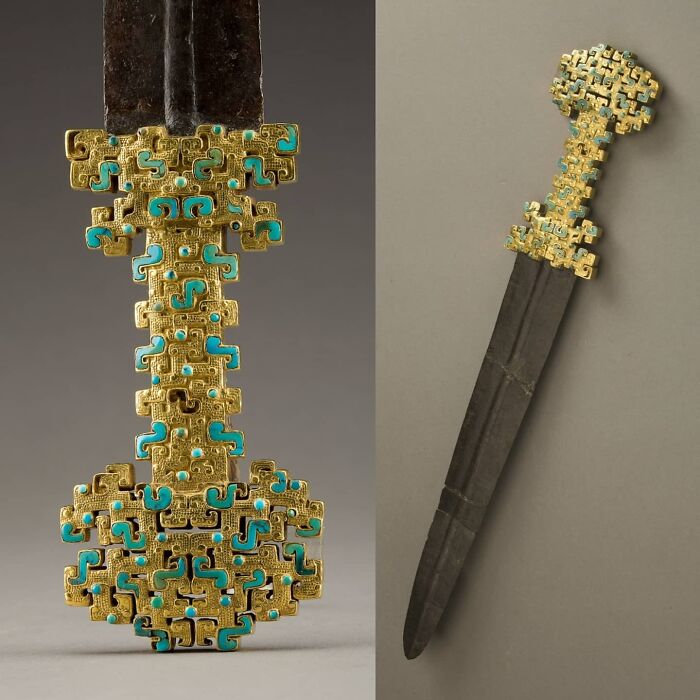
Short sword with gold ornate handle inlaid with turquoise(The Qin Sword) - China, Zhou dynasty 776-476 BC.
In Ancient China, gold and silver were not the prestigious materials they were in the West. Jade and bronze were more highly prized. Gold was used for decorative purposes, as inlay or coating on bronze or lacquer, and only very rarely for vessels or other independent objects.
However, in the Eastern Zhou period(771-221 BC) gold began to be increasingly used on a larger scale, though goldworking still relied to a great extent on well-established bronze technology, with ornaments and other items cast using moulds instead of beaten into shape.
This sword's handle has a conspicuous line on its sides, showing that it was probably cast in a two-piece mould. The hilt is hollowed out and both sides are decorated with a design known as 'dragon interlace'
The gold handle is fragile, which probably made it impractical for use on a battle sword. The sword may have been made for display or for placing in a tomb for taking to the afterlife.
The sword was excavated at Yangjiagou in Baoji, and it is now on display at Baoji Bronze Museum, in China
© Photo: historiante_
#59
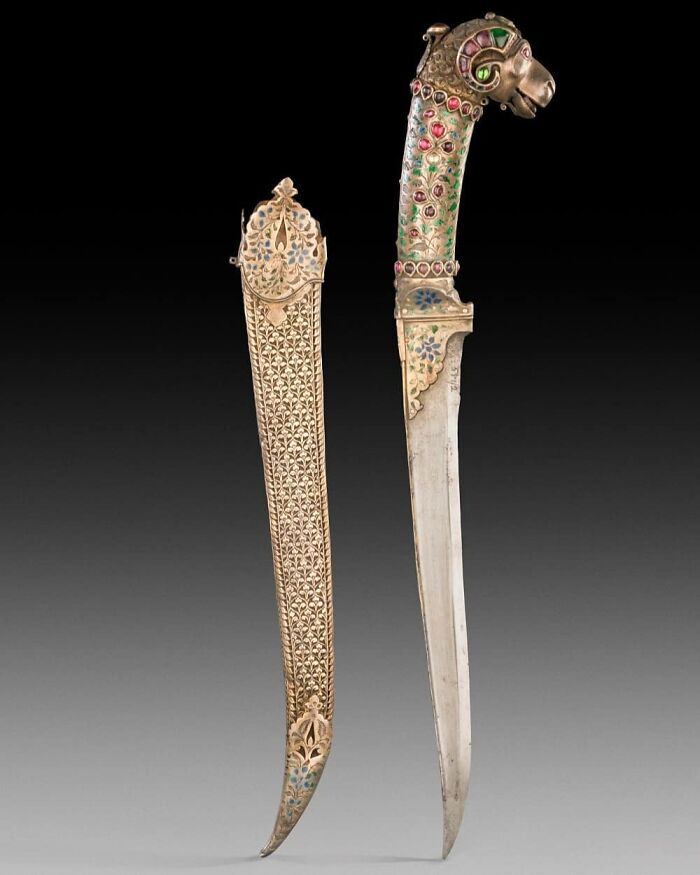
Enameled dagger with ram-headed hilt. Encrusted with rubies and emeralds - Mughal India, 1720
Often tucked into a sash or horseman’s boot, daggers in Mughal India displayed the wealth and power of their owners.
An intricately patterned ram’s head pommel adorns the hilt of this dagger, made in the kundan technique in which gems are set into malleable pure gold foil, allowing them to be arranged in any pattern or density over curved surfaces.
The ram’s head is decorated with a floral scroll and is separated from the hilt grip by a quartz collar, also in the kundan method. The ram's horns are encrusted with rubies and emeralds
The dagger was intended for ceremonial events in the Mughal Empire.
On display at the National Museum, New Delhi, India
© Photo: historiante_
#60
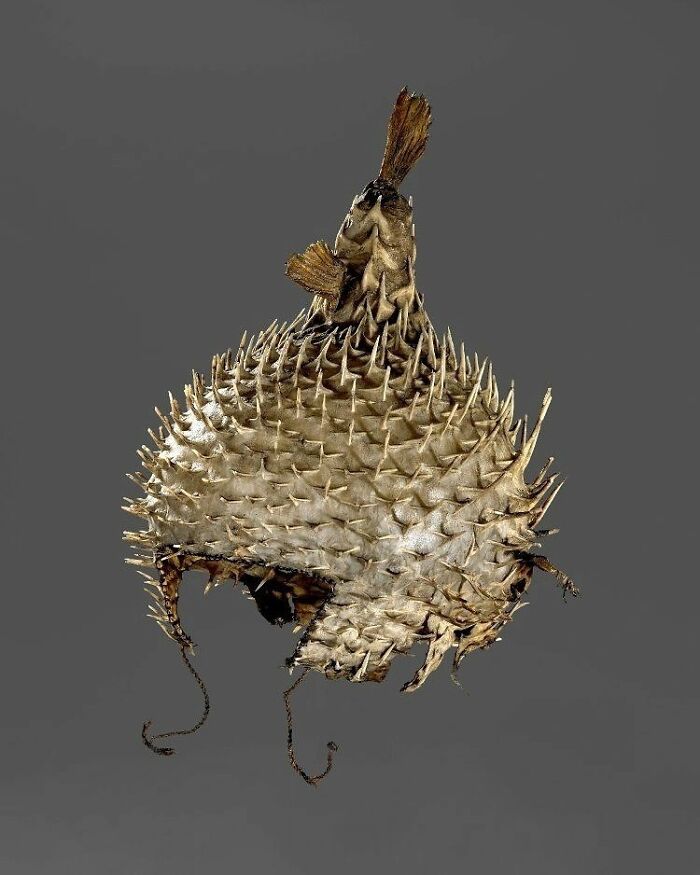
Porcupine fish helmet - Kiribati, late 19th century
For millennia, a Kiribati family’s wealth was measured by both that land and their ability to wring clothing, food, and shelter from it.
But given the scarcity of terra firma in Kiribati—and the power it conveyed—families and individuals frequently sparred over territory.
Kiribati men were famed for their fierceness, and when it came time for battle, they dressed the part, in head-to-toe armor made from coconut fiber and stingray skin. The crown jewel of Kiribati armor, though, was a spiky helmet made from the porcupinefish.
Porcupinefish helmets, known as te barantauti, were made by capturing one of these agitated, puffed-up porcupinefish, peeling the skin away from the body, and drying it.
The spiny skin that remained was reinforced with coconut-fiber padding and fashioned into a brittle helmet.
Though the helmets offered little in the way of actual protection, they instantly made their wearers appear bigger, taller, and more formidable.
For Kiribati warriors, this intimidation was more important than protection from 'losing their lives. That’s because in traditional Kiribati culture, a person who took someone’s life—even in a fair fight—paid with their most prized resource: their land.
So instead of going for the lethal battle, warriors sought to wound and humiliate their enemy. Fish-skin and coconut-fiber offered just the right amount of protection.
Fish helmets don't save lives. They were more about drama than defense
Museum courtesy: Harvard College, Peabody Museum of Archaeology and Ethnology
© Photo: historiante_
#61
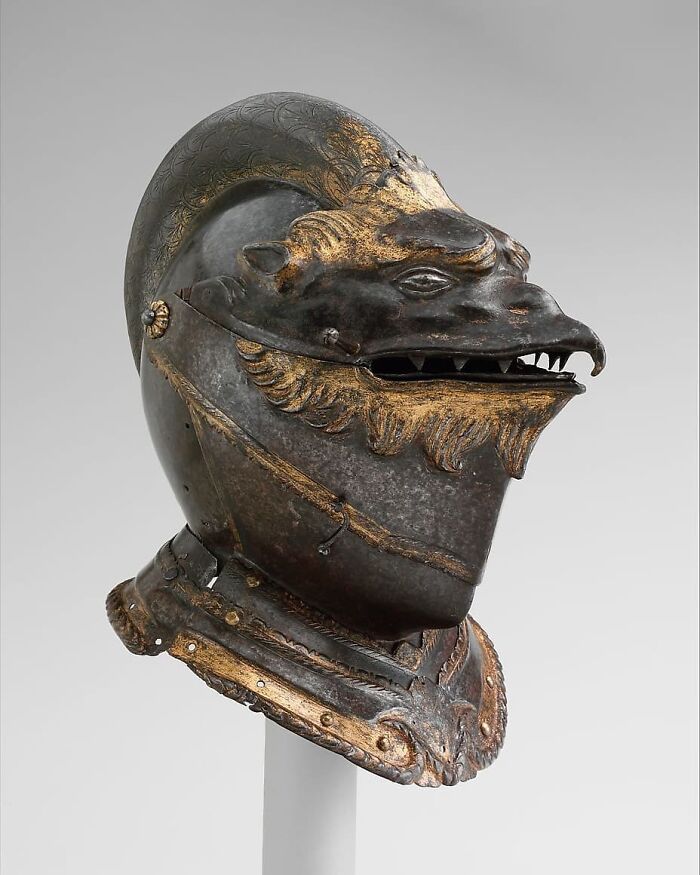
Helmet shaped like a griffin's head from Italy, 1550
The fantastic appearance of this helmet, with its visor shaped like a griffin's head and the comb of the bowl raised into the form of a serpent's body, indicates that it was part of an elaborate pageant armor.
Made of: gold, silver, steel
Now on display at the Metropolitan Museum of Art in New York
© Photo: historiante_
#62
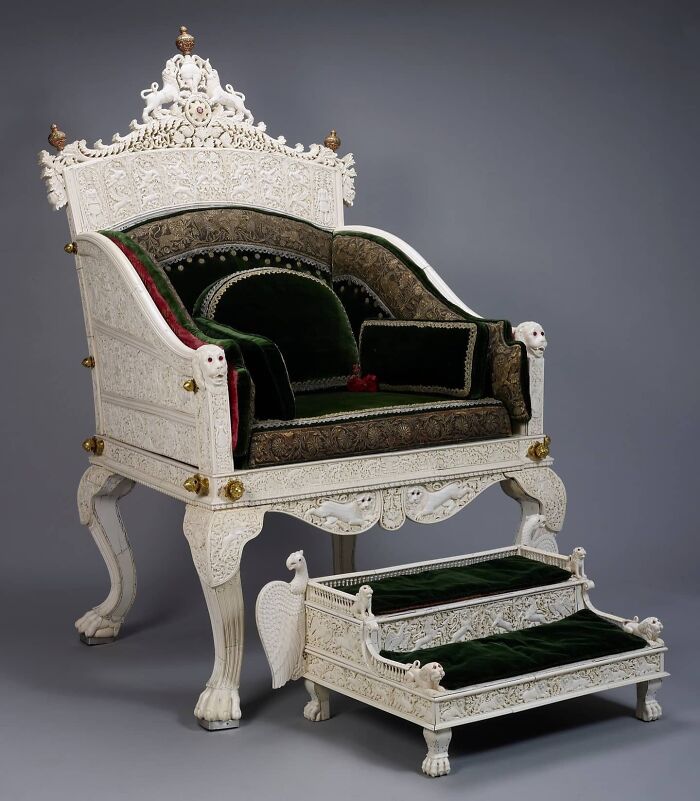
Carved ivory throne and footstool adorned with gold, diamonds, emeralds, rubies, gilt bronze, hardwood and embroidered silk velvet. Presented to Queen Victoria by Travancore king - 1851
This spectacular throne, the centrepiece of the Indian section in the Great Exhibition of 1851, was presented to Queen Victoria in part to advertise the carving skills of Travancore in southern India. The densely-carved elephant-ivory plaques incorporate Indian and European motifs, and the conch-shell emblem of Travancore forms the cresting.
Travancore was widely regarded in India as one of the leading centres of ivory carving, and successive rulers in the nineteenth century, including Maharajah Martanda Varma (ruled 1847-60), were keen to promote and support this industry.
The throne arrived in time to be lent by the Queen to the Great Exhibition, where it occupied the centre of the tented and richly hung Indian section.
The Queen particularly noted her 'magnificent chair, carved in ivory' on a visit to the Exhibition with King Leopold of the Belgians on 24 June; and at the closing ceremony in October the throne was prominently placed on the dais at the centre of the Nave for Prince Albert's use.
When the Queen became Empress of India in 1876, she chose to be shown seated on the throne at Windsor for her official photograph.
It is now on display at the Royal Collection Trust in UK
© Photo: historiante_
#63
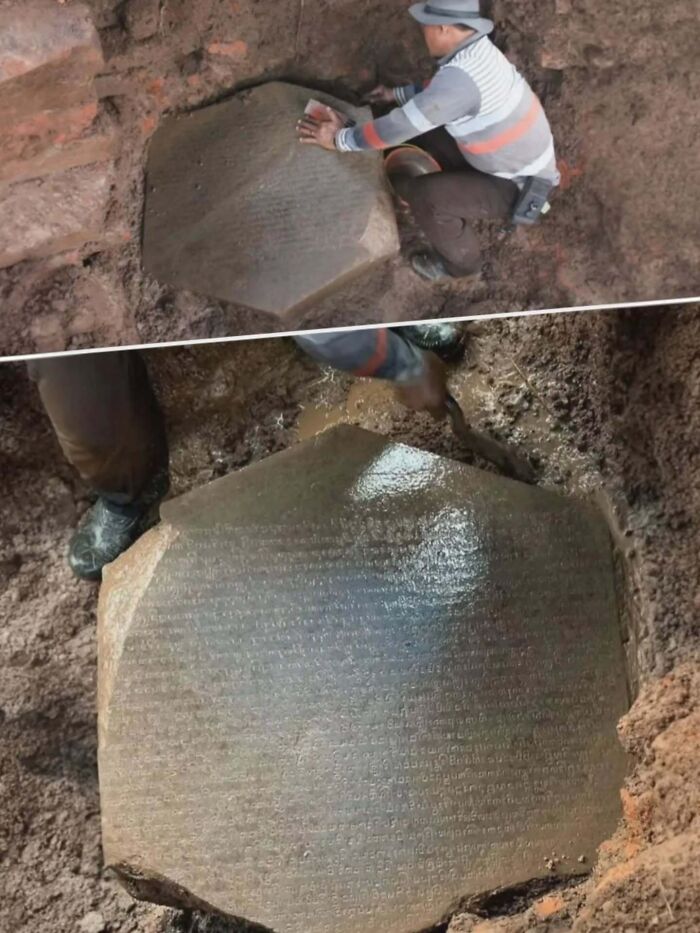
In 2022, archaeologists in Indonesia discovered a 1,096-year-old inscription stating that King Mpu Sindok declared a tarukan rice field tax-exempt. The inscription also describes a ceremonial feast featuring alcohol, salted fish, eggs, beef jerky, boiled vegetables, coconut, and other foods.
© Photo: historiante_
#64
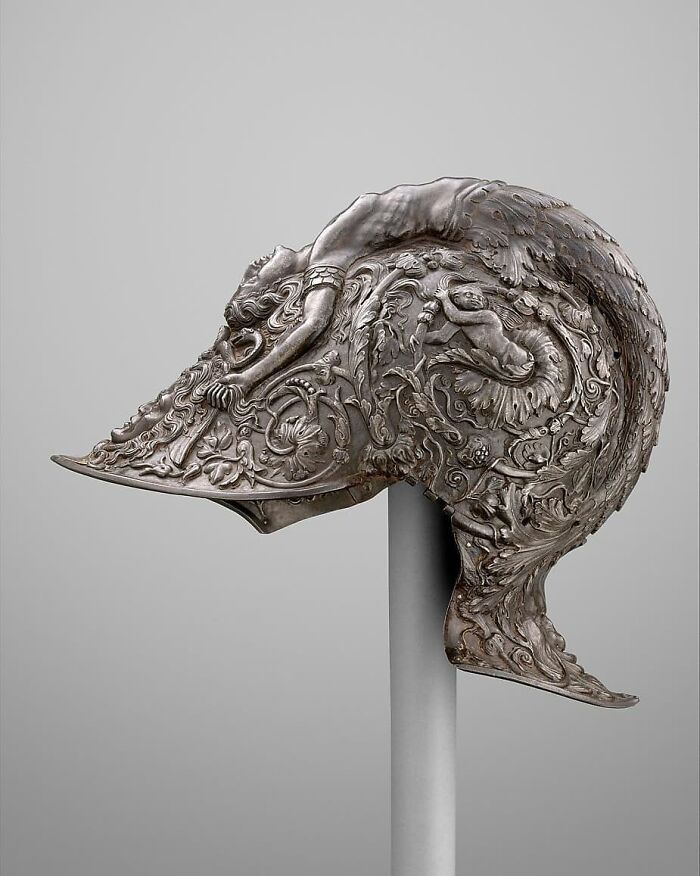
Renaissance burgonet with medusa designs made by Filippo Negroli - Milan, Italy 1543
This masterpiece of Renaissance metalwork is signed on the browplate by Filippo Negroli, whose embossed armor was praised by sixteenth-century writers as "miraculous" and deserving "immortal merit."
Formed of one plate of steel and patinated to look like bronze, the bowl is raised in high relief with motifs inspired by classical art. The graceful mermaidlike siren forming the helmet's comb holds a grimacing head of Medusa by the hair.
The sides of the helmet are covered with acanthus scrolls inhabited by putti, a motif ultimately derived from ancient Roman sculpture and wall paintings.
Now on display at the Metropolitan Museum of Art in New York
© Photo: historiante_
#65
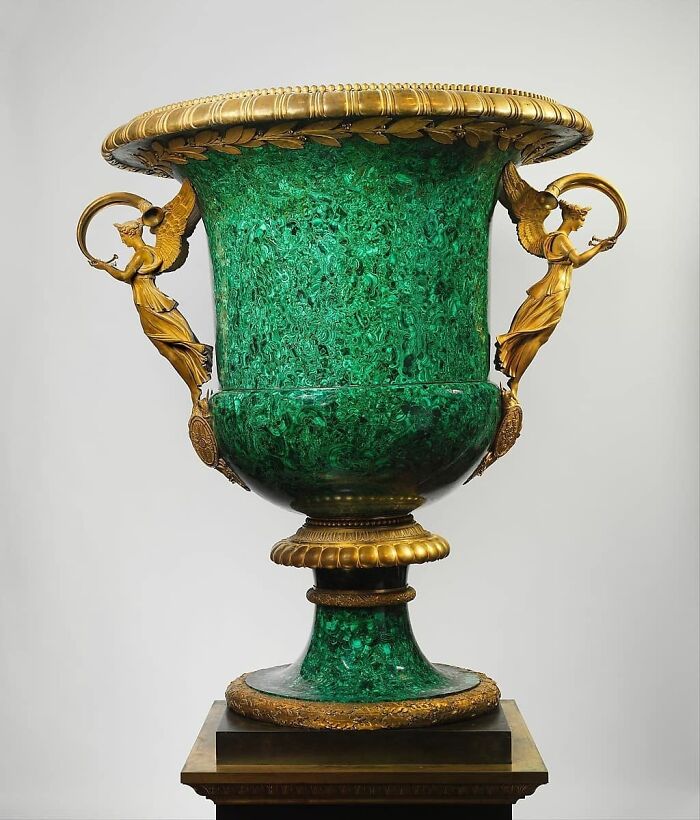
Russian malachite monumental vase with gilt-bronze mounts. Pedestal and mounts by Pierre Philippe Thomire French - 1819
Malachite is a carbonate mineral often associated with copper ores.
In the late eighteenth and nineteenth centuries, most malachite came from mines in Russia owned by the noble Demidov family, who exploited hardstone quarries and metal deposits on their estates in the remote Ural Mountains.
One of the great discoveries in the history of semiprecious stones occurred in the 1820s, when an enormous boulder of malachite weighing about five hundred tons was unearthed in the Urals.
A schistose material, malachite is extremely brittle, and only small display objects can be cut from single blocks of this rock. Large objects require a core structure, to which the malachite can be attached in thin pieces.
Russian craftsmen perfected a way of utilizing the stone’s natural pattern and a precision cutting technique to form a continuing or, on the round body of a vase, an "endless" ornament. This type of veneer, called "Russian mosaic," looks almost seamless.
The Demidovs used the showy appearance of malachite to increase their social status. They filled their palaces and decorated a whole room in one of them with the green stone, inspiring Czar Nicolas I to commission the famous Malachite Room in the Winter Palace in Saint Petersburg.
The winged female figures in gilded bronze mounted on the body of the vase represent Fame. Their trumpets are shaped like handles—something of a paradox, since the object is far too heavy to be lifted like a loving cup.
Dimensions: 277.5 cm, 714.4153 kg
Technique: lapidary work
On display at the Metropolitan Museum of Art in New York
© Photo: historiante_
#66
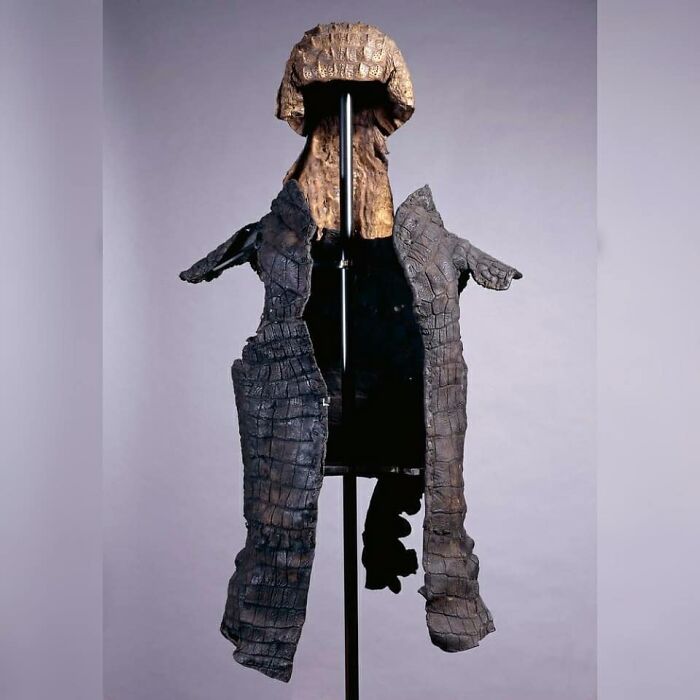
Crocodile-skin suit armour - Roman Egypt, 250 AD
In ancient Egypt the crocodile was seen as sacred and divine, and worshipped as a god, so this suit might have been worn by priests of the crocodile sect who by wearing such a garment would take on the spirit of the deity.
In many parts of Africa the crocodile is seen as a fearsome and invincible creature and so by wearing a crocodile armour and a headpiece like this, a warrior might be transformed in some magical way and take on the attributes of the animal.
When the province of Egypt became part of the Roman Empire, it put Romans into direct contact with Egyptian culture and religion. In Egypt Roman garrisons were closely integrated into civic and religious life and participated in local cults.
Around Manfalout, on the banks of the Nile in central Egypt, Roman soldiers were particularly attracted to the crocodile cult centered on the sacred grottoes of the region.
This imposing armour is made from the skin of a crocodile. It comprises a helmet and a cuirass(body armour) and would have been used in military-style ceremonies of the regional crocodile cult. The skin has been radio-carbon dated to the 3rd century AD.
Although the cold, dry environment of the grotto preserved the suit well, the cuirass in particular was flattened and brittle. It has been painstakingly remoulded by the British Museum Department of Conservation and it resides there from 1846.
Photos courtesy: Google Arts&Culture
© Photo: historiante_
#67
Head of Medusa cameo by Benedetto Pistrucci, 1850 - Red jasper mounted in gold with white enamel
One of the most elegant of all Medusas, this head borrows freely from the ancient marble mask known as the Rondanini Medusa in the Glyptothek, Munich.
The cameo was commissioned from Benedetto Pistrucci for the impressive sum of 200 guineas by a London dentist and collector, Samuel Cartwright, who also ordered a marble bust of himself (National Portrait Gallery, London).
The wings and snakes on the cameo’s frame allude to the caduceus of Mercury, emblem of the medical profession. The existence of a silver copy of the Medusa head bearing the mark of the silversmith Carlo Giuliano (sold at Sotheby’s in New York in 2006) proves that he was the author of the strikingly handsome mount.
Overall (visible cameo): 5.3 cm
Overall (in setting): 6.8 x 6.8 cm
Now on display at the Metropolitan Museum of Art in New York
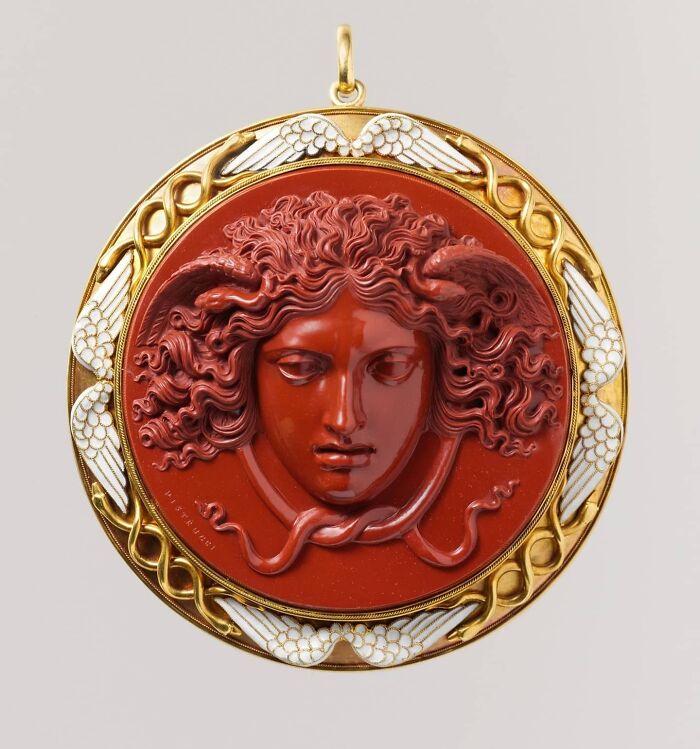
© Photo: historiante_
#68
Spanish helmet - 1560
This unusual plaited-straw helmet-shaped hat is very similar in both shape and ornament to contemporary steel military helmets.
However, this highly decorative example was likely worn by a high-ranking official for festive peacetime occasions.
Medium: straw, metal, silk
Now on display at the Metropolitan Museum of Art in New York
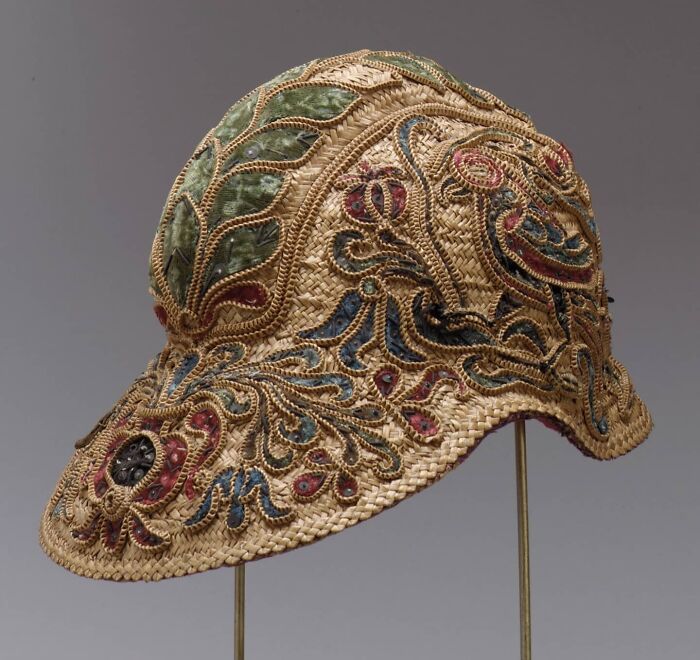
© Photo: historiante_
#69
Dagger with sheath(Khanjar) studded with diamonds, nephrites, sapphires
Hilt, 17th–18th century(India, Mughal); blade and sheath(Turkish, Ottoman), 19th century
A khanjar is a traditional dagger originating from Oman. Worn by men for ceremonial occasions, it is a short curved sword shaped like the letter "J" and resembles a hook.
Although it is not known when the Omani khanjar was first created, rock carvings epitomizing the dagger were found on gravestones located in the central part of the Ru’us al Jibal region.
These are believed to have predated the Wahhabi revival, which occurred in the late 1700s. They were also mentioned in an account by Robert Padbrugge of the Dutch Republic, who journeyed to Muscat in June 1672.
The Ottoman Empire spread further the use of this type of knife. In the Balkans, where it was known as Handschar, such knives were regularly carried by Ottoman policemen, and it remained in local use also after the end of Ottoman rule.
The most elemental sections of the khanjar are its handle and blade, with the material utilized in the former playing a significant role influencing the final price of the dagger.
Rhinoceros horn and ivory were once the common standard, as it was "considered the best material" to make the hilt out of. However, with the international ban on the ivory trade and rhinoceros horn, the usage of other materials such as wood, plastic, and camel bone has become more prevalent
The inscription on the blade includes the names of the owner and the maker and the date, A.H. 1151 (A.D. 1689–90).
4th picture: overall view with daggers displayed on tray
Medium: Steel, nephrite, gold, emerald, ruby, diamond, sapphire, jade
Dimension: overall 48.7 cm
On display at the Metropolitan Museum of Art in New York
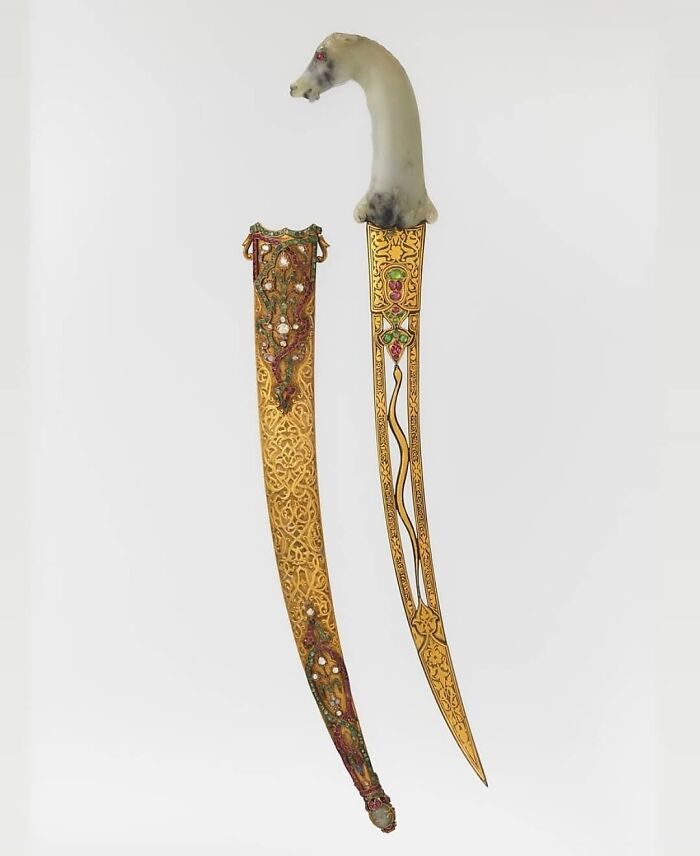
© Photo: historiante_
#70
Aquamanile in the form of Aristotle and Phyllis - 14th century, South Netherlands
Medium: gilded bronze
An aquamanile is a vessel for pouring water used in the ritual of washing hands in both religious and secular contexts—by the priest before Mass and in a private household before a meal.
The subject of this celebrated example is the moralizing legend of Aristotle and Phyllis, which achieved popularity in the late Middle Ages.
Aristotle, the Greek philosopher and tutor of Alexander the Great, allowed himself to be humiliated by the seductive Phyllis as a lesson to the young ruler, who had succumbed to her wiles and neglected the affairs of state.
Encouraging Alexander to witness his folly, Aristotle explained that if he, an old man, could be so easily deceived, the potential consequences for a young man were even more perilous.
The ribald subject indicates that this aquamanile was made for a domestic setting, where it would have doubled as an object of entertainment for guests at the table.
The object has the size of an artifact and it is displayed at the Metropolitan Museum of Art in New York
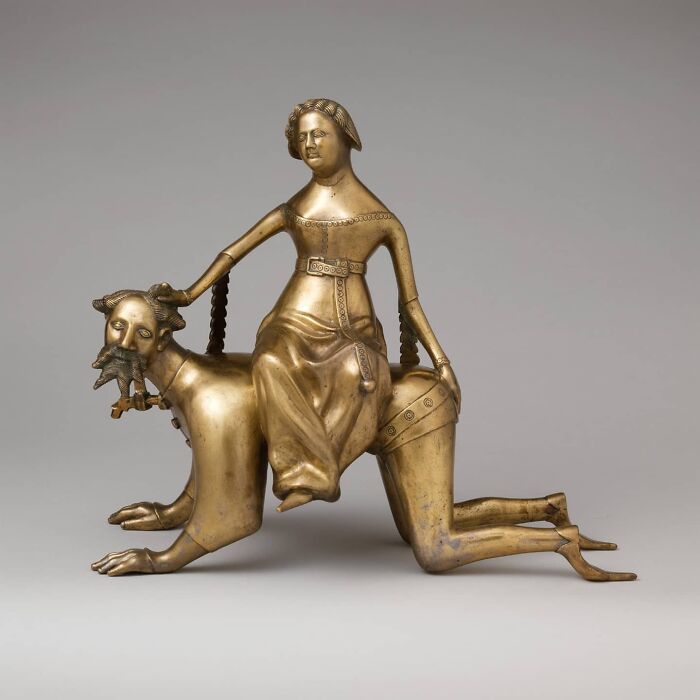
© Photo: historiante_
#71
Siege helmet weighing 8kg - Italy, 1625
The siege helmets were worn by hostages after they were taken away from the warfares.
All helmets are designed to protect but beyond a certain point this will come at the expense of your ability to see what you're doing, turn your head, hear, breath and communicate. This design made an impossible mission for the hostages to see the surroundings on their way to the prisons.
It is now on display at the Metropolitan Museum of Art in New York
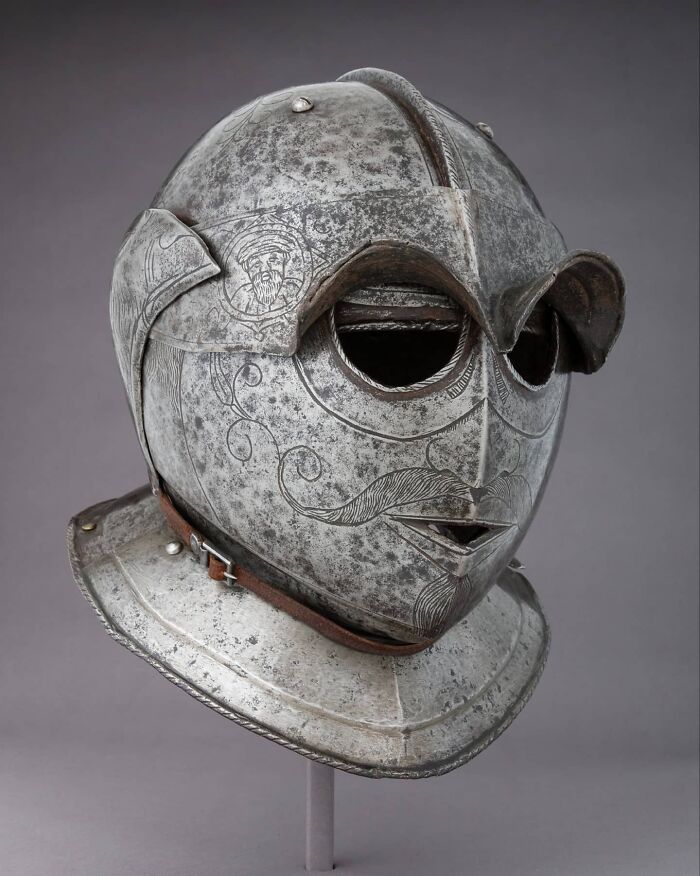
© Photo: historiante_
#72
Tecpatl - Aztec ceremonial knife for use in human sacrifice, 1400 - 1521
Sacrificial knife, in the form of a crouching eagle warrior, with flint blade. Handle made of cedro wood (Cedrela odorata) and covered with mosaic made of turquoise, malachite and three types of shell.
Pine resin is used as adhesive and decoratively as inlay. The blade hafting is bound with maguey fibre and coated with Protium resin.
Plain, unadorned knives served many practical purposes in hunting, food preparation and warfare, while more ornate decorated examples were probably reserved for ritual sacrifice.
Flint blades were often placed in temple offerings, sometimes set vertically in resin to represent the glyph tecpatl (meaning flint or sacrificial knife).
It is now on display at the British Museum in London
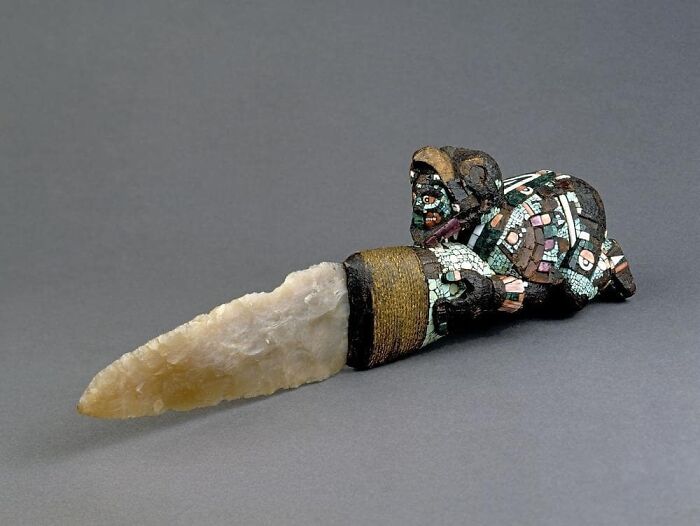
© Photo: historiante_
#73
Ivory carving of a skull and coiled snake with carnelian eyes - Japan, Edo Period, 1860
Ivory carving for interior ornaments, or okimono, developed from the tradition of meticulous ivory carving for netsuke that flourished in particular around the mid-19th century, at the end of the Edo period.
Netsuke were initially used as toggles tied to the end of inro medicine cases, tobacco cases, and precious belongings, to carry them by hanging from the waist. Eventually, however, they became fashion accessories to represent the wearers’ tastes. This resulted in the production of elaborately formed, designed, and crafted netsuke. Many ivory works, notably figures and animals, demonstrate the artisans’ expertise as well.
As Western fashion spread from the time of modernization in the Meiji era, which is the last quarter of the 19th century, netsuke gradually became obsolete. Instead, ivory carving techniques for netsuke came to be applied to ornament making.
Ornaments of figures and animals, therefore, often display features common to netsuke. These ivory carved netsuke and ornaments became popular among Westerners who visited Japan from overseas, and as early as the beginning of the Meiji period, ivory okimono became favorites of exported Japanese decorative art. Ivory okimono were once so dominate that they were reputed to have “whitened the world of sculpture.
Dimensions: 11.5 x 12.5 x 14.8 cm
Kept now at the Art Gallery of Greater Victoria in Canada
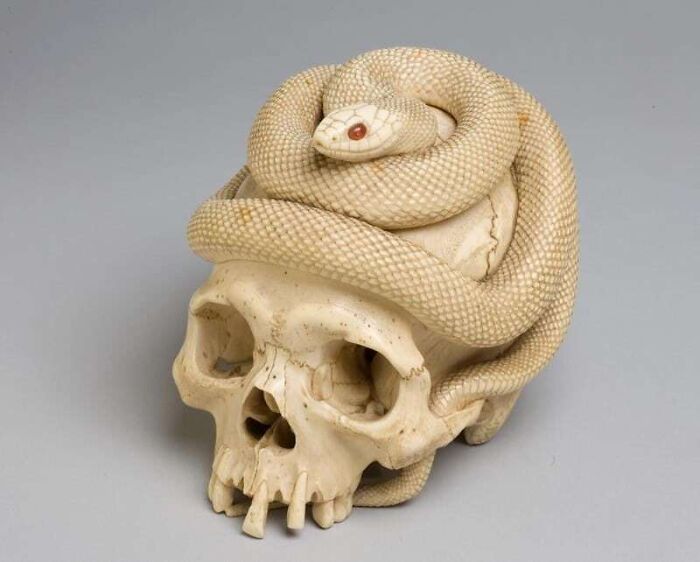
© Photo: historiante_
#74
Dagger and scabbard, made of: watered crucible steel, gold, ivory, velvet, diamonds - South India, 1820
This dagger is incised directly below the hilt with the ten avatars of the Hindu god Vishnu and was probably made for a Hindu patron.
The scabbard mounts have been adapted for presentation with the addition of the Prince of Wales’s feathers.
It is now on display at the Royal Collection Trust in England
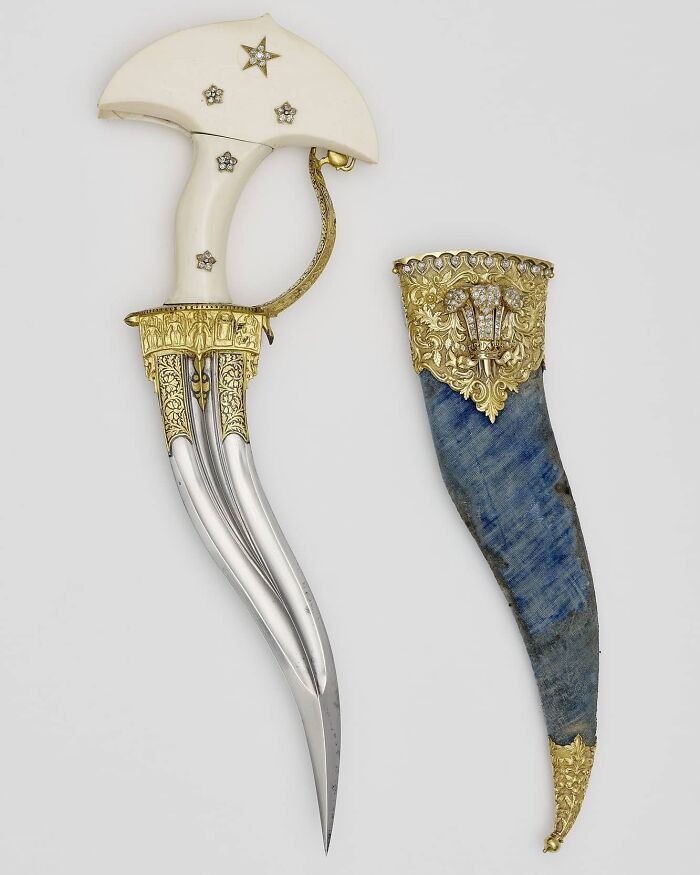
© Photo: historiante_