
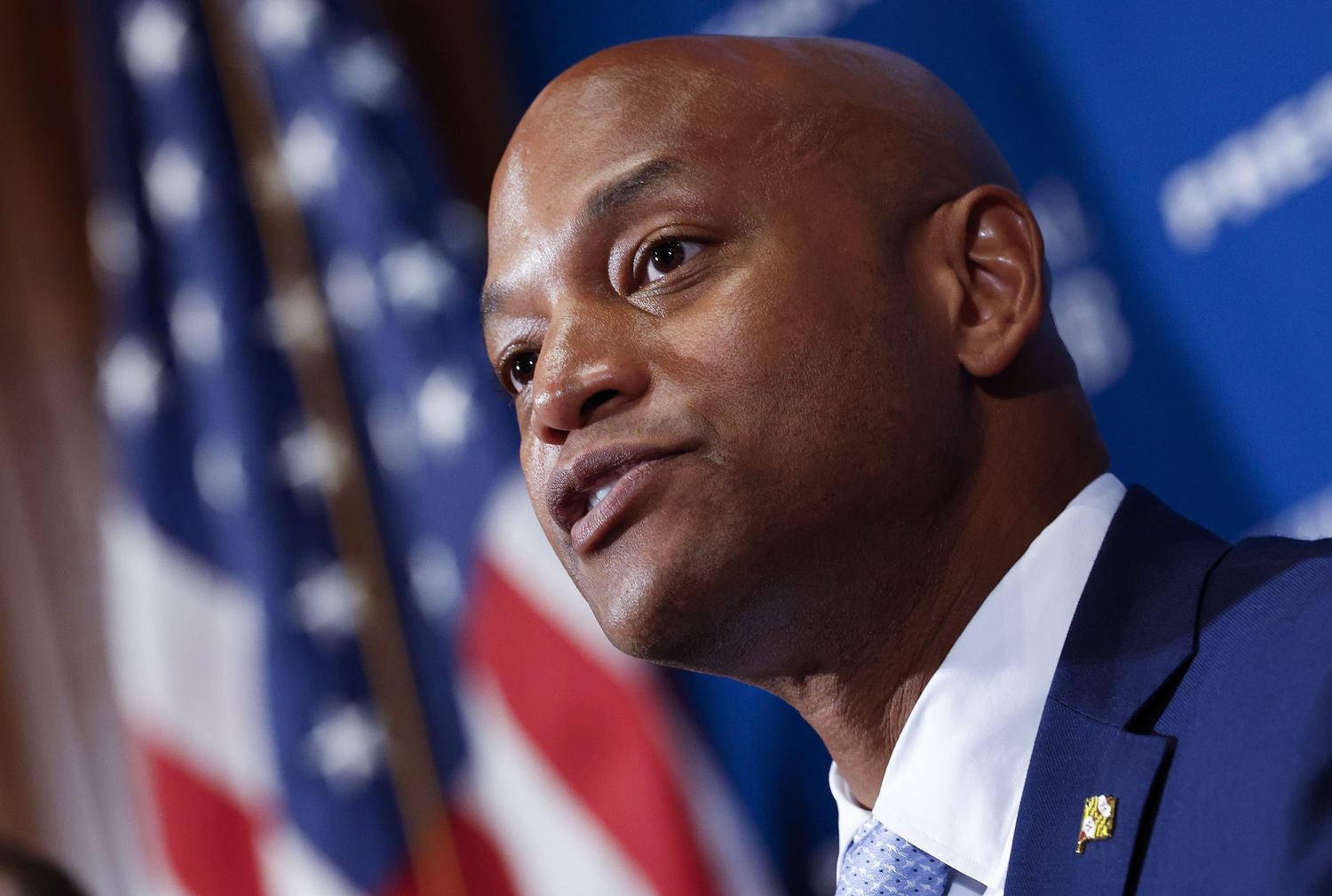
BALTIMORE — Maryland Gov. Wes Moore is expected to cruise to re-election on Nov. 3. But he’s sweating the campaign nonetheless.
Moore’s political prowess is being tested at home beyond his own race for a second term, as Maryland voters prepare to take sides on a ballot question that would allow state Democratic leaders to redraw congressional district lines in a way that favors the party even more than the current 7-1 map.
Moore and his allies — including former President Barack Obama — are framing a vote for the ballot question as a vote to fight back against President Donald Trump and Republicans, an argument that might usually be expected to find purchase in a deep-blue state.
But it has become apparent in recent weeks that support for the ballot measure may not be as strong as Moore and other Maryland Democrats had hoped, and a major late effort has ramped up to promote passage of the measure. If it doesn’t pass, it would be a major political setback for Moore amid wide speculation that he’s gearing up for a potential 2028 presidential campaign.
Moore and his allies in Annapolis sought to redraw congressional districts this year, arguing that the Legislature could draw a map with all eight districts favoring Democrats to replace the current map in the wake of GOP redistricting efforts elsewhere.
But the effort was halted by state Senate President Bill Ferguson, a fellow Democrat who claimed that the push didn’t have the support of a majority of lawmakers in his chamber. Ferguson noted that Maryland Democrats tried to draw a more favorable congressional district map in 2021, only for a state judge to toss it out in 2022.
The ballot measure stemmed from that, seeking to address the state constitutional issue that sank the 2021 map first. In August, Ferguson and other Democrats in the Legislature overwhelmingly moved to put a measure before voters to eliminate the requirement that Maryland’s congressional districts obey natural boundaries, like the Chesapeake Bay. The state’s lone GOP U.S. House member, Andy Harris, represents a district concentrated on the state’s Eastern Shore.
After a legal challenge, Maryland’s Supreme Court allowed the question to be put to voters in a form rewritten by state judges.
With Election Day closing in, passage of the ballot question is far from certain.
A poll released this month by the University of Maryland, Baltimore County, found that a majority of likely Maryland voters (53%) planned to vote against the measure. That included 42% of Democrats, 74% of Republicans and 59% of unaffiliated voters who planned to vote no.
“To me, there was a broader underlying, interesting question about democracy. Do people want district lines to favor one party over the other? And most Marylanders don’t like that idea,” Mileah Kromer, the director of the UMBC Institute of Politics, told NBC News.
Kromer’s survey used plain language instead of the legalese that will appear on the ballot defining Question 3 and still found broad opposition from members of both parties and independent voters.
“Certainly there are a lot of Democrats who want to see some fighting back against President Trump but maybe don’t believe that, you know, redrawing congressional district lines just to favor their outcome is the way that they’d like to do it,” Kromer said.
She added that part of the reluctance of Maryland voters in particular is the fact that Democrats would gain only one seat in redistricting efforts. A similar measure that passed in California last year allowed the state to redraw congressional district lines in a way that gained Democrats advantages in five seats, overriding the state’s independent redistricting commission just months after Texas redrew its congressional maps to boost Republicans in an additional five seats.
A national fight over district lines
The two states’ moves last year set off yet more state redistricting efforts this year. A number of red states succeeded in redrawing their maps, while others still face legal challenges.
A longtime Democratic strategist in Maryland also pointed to the fact that Maryland voters are usually especially well-informed about national politics, particularly those who live in counties that border Washington.
“I wonder if there aren’t a lot of people in the state, Democrats in particular, who don’t feel like co-opting the Republican strategy of mid-decade redistricting is the best way to fight back,” said the strategist, who, like others in this article, was granted anonymity to speak candidly. “If they heard anything in the news about mid-decade redistricting, it’s about, you know, Republicans or Donald Trump breaking the rules. They may not be that comfortable with that.”
Still, Kromer cautioned that the UMBC survey was conducted before the groups backing and opposing the ballot question began spending heavily on TV, digital and physical advertising.
Maryland’s Democratic voters are “upset about the Trump administration, and the messaging of, like, fighting back against Trump could be a really, really good messaging strategy,” Kromer said. “It might actually knock people more into the attitude of ‘I don’t like it, but it’s necessary.’”
After the poll was released last month, Moore and his allies began spending in earnest to persuade voters to support the ballot measure.
So far this month, Fight Back MD, a group supporting the measure, has spent $550,000 on TV ads urging voters to vote in favor of Question 3, according to AdImpact. Last week, Moore’s campaign decided to switch advertising from promoting his re-election bid to urging voters to support the measure.
But even raising money among Democrats to support the measure has been an uphill battle, with the redistricting divide between Moore and Ferguson still present behind the scenes.
Moore’s campaign released an ad last week featuring some of the state’s Democratic leaders urging voters to support Question 3, which was backed by a $700,000 investment by the campaign. On Monday, the campaign used an additional $500,000 on a TV and digital ad featuring Obama telling voters to support Question 3.
One state leader noticeably absent from the push is Ferguson. While he worked in August to convene a special session to pass a measure to put the redistricting question to voters, he hasn’t publicly or privately committed to pursue redistricting during next year’s legislative session if it passes next month.
Meanwhile, some donors who had expressed interest in the redistricting campaign have shown hesitation to donate this fall because Ferguson refuses to commit to passing new congressional maps, according to an operative familiar with the pro-Question 3 campaign.
Ferguson’s communications director, David Schuhlein, told NBC News that Ferguson “is primarily focused on retaining our Democratic state Senate seats and also trying to build on that and gain one or two more in a couple of districts throughout the state, and that takes an immense effort from him and the rest of our leadership team.”
“That’s where most of his efforts have been focused from the primary till now,” Schuhlein added.
Redistricting on the 2028 campaign trail
Moore in recent years has demurred about his potential presidential aspirations, but his out-of-state travel schedule has fueled speculation.
Last year, he told NBC News’ “Meet the Press,” “Yeah, I’m not running for president,” adding that he was focused on his re-election bid.
But in a gubernatorial debate this month against his GOP opponent, former state Del. Dan Cox, Moore didn’t commit to serve a full term if he’s re-elected this fall.
“Being the governor of Maryland has been the honor of a lifetime,” he told debate moderators when he was asked whether he’d commit to serve a full second term. “And I would not be running for re-election if I was not committed to the people of Maryland.”
Republicans in the state, who oppose Question 3, have accused Moore of pushing redistricting in Maryland to bolster his political aspirations.
A digital video produced by the state’s conservative Freedom Caucus tells viewers that 100% Democratic control of Maryland’s eight congressional districts would be “a trophy for his run at the White House.”
But some of Moore’s allies stressed that even if Moore fails to persuade voters to pass Question 3, it wouldn’t be a stain on a future presidential run.
“I just cannot imagine people caring that much about this” outside Maryland, a national Democratic strategist told NBC News. “He has a great record to talk about on issues people care about. ‘You didn’t knock off Andy Harris’ is not going to be an issue in early [Democratic presidential primary] states.”
“This is not the end-all, be-all for his political aspirations,” the strategist added.
Michael Hanmer, the director of the Center for Democracy and Civic Engagement at the University of Maryland, told NBC News, “The average voter, they’re not going to notice and they’re not going to care in terms of how they think about this when they’re looking at the candidates.”
“The problem in that situation, if it doesn’t pass, is that opponents are going to bring it up, and they’re going to use it as an example. They’re going to say: ‘Look at the makeup of your state. You couldn’t get this? It was just one; you couldn’t flip one?’” Hanmer added.
He predicted that redistricting and how elected officials wield political power in their states could emerge as a wedge between potential 2028 candidates, particularly governors, because of their broad agreements on issues like the economy, foreign affairs and immigration.
“I don’t think that we’re going to see a lot of candidates with massive distance between themselves on policy, right?” Hanmer said.
He added: “Gov. Moore is an extremely skilled politician. He is extremely, I think, quick on his feet and smart. I am sure he will have a response, but I would be surprised if [redistricting] is not something that others — if they were successful and he was not — bring up.”