
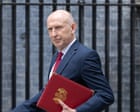
John Healey is expected to cut red tape requirements, particularly for smaller businesses
Kalyeena Makortoff is the Guardian’s banking correspondent.
CS Venkatakrishnan, CEO at Barclays, seems to have admitted defeat over bank tax hikes, which are expected to be a headline measure in Healey’s budget next week.
I recognise that the chancellor and the government has been entrusted with an important duty by the public and the people. And they have to balance a host of considerations. He [Healey] is the man in the arena, and I deeply respect the responsibility he bears on his shoulders and wish him well.
His long term goal is the same as our long term goal, which is to get growth.
So what is the chancellor now concentrating on? One could be forgiven for thinking him utterly unreconstructed: a party man and proud of it. There is no such thing as Healeyism, he says when the conversation turns to Anthony Crosland’s evangelism for the mixed economy: “I’m just Labour.”
“Just Labour” is exactly what the bond markets fear — and, indeed, it is what gives Kemi Badenoch hope of pulling off a comeback to rank alongside Lazarus and Bobby Ewing for utter implausibility.
Healey argued that his budget next week would refute the claim made by Andy Haldane, the former Bank of England chief economist, about Labour not having the right policies to promote growth. In an article for the Financial Times, Haldane said Conservative policies were better for the economy, partly because they were more likely to support “cuts to business and employment taxes and regulation to unleash animal spirits”. In his write-up, Maguire says:
It was Haldane who also said, memorably and mercilessly, that the markets had concluded that this was a “traditional tax-and-spend socialist government with better TikTok videos”. At Westminster, this sort of criticism is at risk of curdling into thick and immovable consensus. What does Healey say to that? “I’d say to Andy Haldane,” he growls, fixing me with a cold stare, “speak to me next Thursday.” And, for the record, he speaks explicitly of “making an argument for how you bring welfare costs down” — albeit not via the “crude cuts” that were Starmer’s undoing.
Healey hinted that he was sympathetic to arguments that Labour should drop its plan to let younger workers qualify for the full national living wage. In his article Maguire says:
[Healey] is “acutely conscious”, too, of the “trade off” between an ever-increasing minimum wage — particularly for the youngest workers — and levels of employment.
He knows the many businesses who “want to employ young people” sometimes cite that upward ratchet as a reason they cannot.
Healey defended the part he played in bringing down Keir Starmer. Healey resigned from Starmer’s government over defence spending, and this contributed to the loss of support for Starmer in the parliamentary party that led to him standing down. Referring to this period, Healey said:
The country was ready for a change … Wherever you stood on the spectrum of the [parliamentary Labour party], there was a recognition that we needed a change.
We have a very rare moment now. We’re in the middle of a parliament, the second half of a parliament, and we’ve got a chance of a new hearing. People are at least willing to listen again … the Labour party is actually quite determined and disciplined, and in any party, the second half of a parliament starts concentrating minds.
Continue reading...