
Welcome to From the Politics Desk, a daily newsletter that brings you the NBC News Politics team’s latest reporting and analysis from the White House, Capitol Hill and the campaign trail.
In today’s edition, Sahil Kapur explains why the results of the midterms will have reverberations long after President Donald Trump is out of office. Plus, we look at a long-running GOP streak that is at risk next month.
— Adam Wollner
How the midterms will shape 2028 and beyond
Analysis by Sahil Kapur
The winners of Congress in the 2026 midterms will wield power to shape the final two years of President Donald Trump’s term, from his legislative agenda to his administrative and judicial appointees.
But the outcome of next month’s election will reverberate well beyond the Trump presidency, carrying enormous consequences for his successor in the White House. Beyond which party controls the two chambers, the margins will also matter.
Start with the Senate. The winners will be elected to six-year terms, meaning they’ll serve through January 2033, or the end of the next president’s first term.
If Democrats manage to win in GOP-leaning states like Texas, Alaska and Iowa — as polls indicate they might — the impact would endure well beyond Trump. And if Republicans fail to hold even redder states like Kansas or Nebraska, that would significantly narrow their path to recapturing the Senate in 2028, even if they have a strong year.
The 2028 Senate map will require Democrats to defend seats in Arizona, Georgia, Nevada and Pennsylvania. Republicans failed to capture those seats in a favorable midterm environment in 2022, so it’ll be even more challenging to win them in a presidential cycle while they control the White House. In addition, the GOP will have to defend seats in purple states like North Carolina and Wisconsin that year.
(This year’s Ohio Senate race is an exception because it’s a special election for a two-year term, so the seat will come before voters again in 2028.)
Conversely, if Republicans are able to hold onto red states that Trump won three times, and protect the seat of Sen. Susan Collins in Maine, or pull off an upset in a purple state like Michigan, where former Rep. Mike Rogers faces Democrat Abdul El-Sayed, they could put Democrats in a jam for 2028.
In the modern era, it’s almost unheard of for a new president to enter office without his party controlling both the White House and Senate.
The last president to move into the Oval Office under divided government was George H.W. Bush in 1989. In the modern era of polarization — with the two parties far apart on priorities, and the Senate’s power to block Cabinet appointees — it could stymie any new president and put an early dagger in most of his or her legislative agenda. It could also hinder their ability to appoint Supreme Court justices.
In the House, where all 435 members are elected to two-year terms, the consequences next month are more immediate. Still, recent history suggests the 2026 midterms carry important consequences for 2028 and beyond.
Opposition parties tend to do better in the House in midterm years than the ensuing presidential election. In 2022, Republicans captured the House and then lost a few seats in the 2024 election. In 2018, Democrats captured the House and then lost seats in 2020. In 2010 and 2014, Republicans won the House majority only to lose seats in the subsequent presidential elections of 2012 and 2016.
In other words, if Democrats fail to capture the House majority or win it narrowly in 2026, history tells us their power would be in danger two years later. But if they run up the score and flip Republican-held seats, it would give them a cushion in 2028.
The last time a party out of power gained House seats in both a midterm and the subsequent presidential election was the Democrats in 2006 and 2008, following one wave cycle with one that took place under the unusual circumstances of a once-in-a-century financial crash.
The bottom line: Every seat that Republicans successfully defend in the Senate and the House — even if they lose control of both chambers — could pay off in two years’ time.
🗳️Related read: A blue-collar bellwether weighs ousting longtime GOP Sen. Susan Collins in Maine, by Bridget Bowman
Trump and Republicans fight to protect the midterms’ most surprising battleground
By Brennan Leach, Stephanie Gosk and Jacob Cavaiani
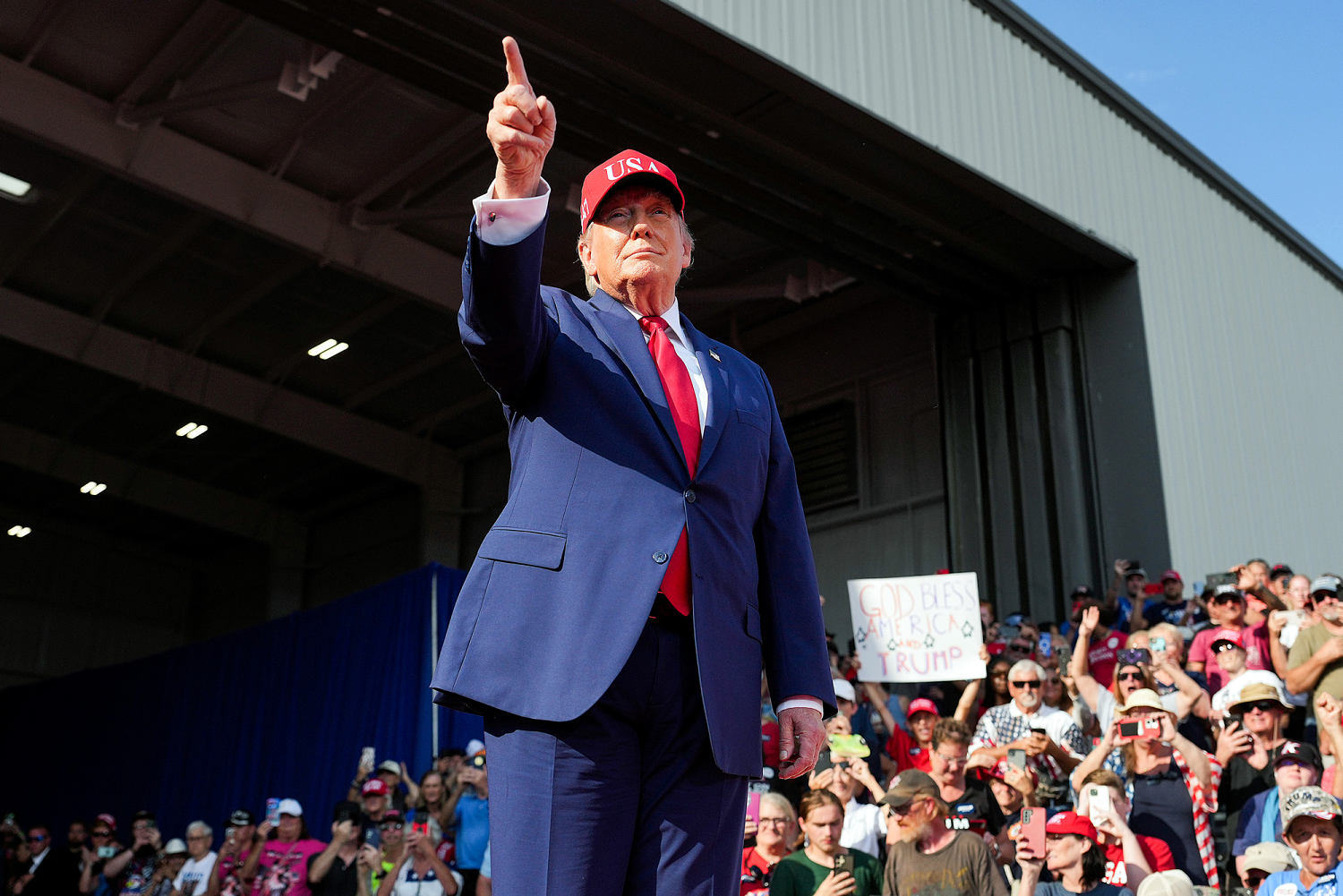
NEWTON, Kansas — No state has shut out one party in U.S. Senate races for as long as Kansas. But with days to go in the 2026 midterm elections, President Donald Trump is headlining a rally near Wichita today in a bid to head off the biggest threat in years to the GOP’s local winning streak.
Megachurch pastor Adam Hamilton is hoping to make history as the first Democrat elected to the Senate in ruby-red Kansas in nearly a century. And Republican Sen. Roger Marshall is fighting for his political life in a state he won by over 11 points in 2020, with polls showing a toss up race between Hamilton and the incumbent.
Early voting is already underway as Trump heads to the state, which he has carried by at least 14 points three times. But Hamilton has painted Marshall as a “yes man” for the president, in a race that has been defined by the unpopularity of some of Trump’s actions, from high diesel prices hurting farmers to Immigration and Customs Enforcement raids throughout the state.
Kansas is one of several reliably red states from recent elections that Democrats have put in play this year as they try to net four seats to take control of the Senate.
Wint Winter Jr., a former GOP state senator who is backing Hamilton but remains a registered Republican, told NBC News it wouldn’t surprise him “at all” if Hamilton “won and won big.”
“He epitomizes that kind of thinking — how can we do things different?” Winter said. “How can we be thoughtful and kind and open-minded to our opponents?”
🗞️ Today's other top stories
- 📊 Survey says: According to a new NBC News Decision Desk poll powered by SurveyMonkey, 71% of adults think the country is on the “wrong track” — the highest share yet in Trump’s second term. Read more →
- 👉 Blame game: Weeks out from Election Day, Texas Republicans have started finger-pointing ahead of potential losses in races for Senate and governor. Read more →
- 👍 Vote of confidence: Trump told NBC News in a brief phone interview this weekend that his White House chief of staff, Susie Wiles, will remain in the job “until the end.” Read more →
- 🔵 2028 watch: Sen. Elissa Slotkin, D-Mich., will campaign for Democratic candidates tomorrow in South Carolina. Read more →
- ⚖️ SCOTUS watch: The Supreme Court agreed to hear a new challenge to school admissions policies aimed at fostering diversity, taking up a case targeting a lottery-based process for magnet programs in a Maryland county. Read more →
- ⛳ Extreme makeover: Trump said his administration has developed a plan to redevelop the East Potomac Golf Links course in Washington, D.C., which has been at the center of a legal battle over his renovation plans. Read more →
That’s all From the Politics Desk for now. Today’s newsletter was compiled by Adam Wollner and Lauren Zola.
If you have feedback — likes or dislikes — email us at [email protected]
And if you’re a fan, please share with everyone and anyone. They can sign up here.