

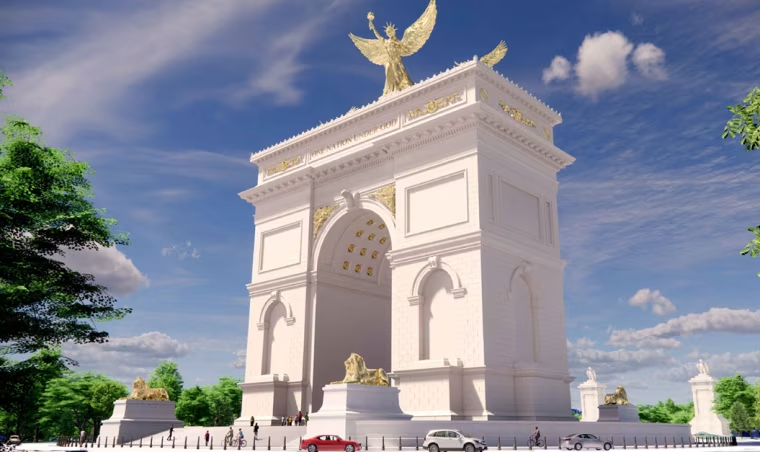
A federal judge late Thursday temporarily blocked construction on President Donald Trump’s “Triumphal Arch” shortly after a planning commission led by Trump appointees approved it.
U.S. District Judge Tanya Chutkan granted a temporary restraining order blocking the administration from “initiating, making, or otherwise effectuating any construction, excavation” or other steps in the arch project for 14 days.
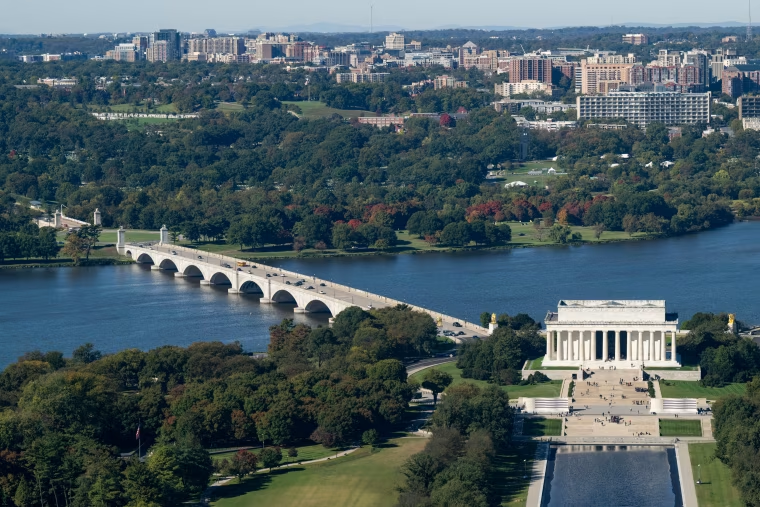
Chutkan’s order came within an hour of the National Capital Planning Commission’s approval of the massive and controversial arch project, which would sit in Memorial Circle between the Lincoln Memorial and Arlington National Cemetery.
The District of Columbia and Virginia, who are suing over the project, filed a motion for the temporary restraining order. In an opinion accompanying her order Chutkan said they have demonstrated a likelihood of standing to sue and an immediate harm.
Chutkan wrote in the opinion that “the harm is certain” and that the Trump administration has said it was ready to start construction almost immediately after the commission’s approval.
The commission passed the motion to approve final site building plans 8-4, with the four votes in opposition coming from commissioners who were not appointed by Trump.
Rep. Don Beyer, D-Va., whose district includes the cemetery, applauded the ruling and accused Trump of trying to bypass legal barriers.
“This fight is not over. While this decision prevents Donald Trump from immediately implementing his plans to create a monument to his own ego, the courts and Congress must put in place permanent safeguards to stop the Trump Administration from violating the law and proceeding with this project,” Beyer said in a statement.
The Department of Interior and National Park Service did not immediately respond to requests for comment about Chutkan’s order early Friday.
The commission gave the project a green light after a hearing at which scores of area residents lined up to voice their opposition to the project.
Public comment at the hearing lasted more than nine hours, which commission Chair Mark Paoletta said was “more than ever.” The comments mostly related to the impact on Arlington National Cemetery, which is the final resting place of the nation’s fallen service members, as well as the project’s height, scale and safety.
Paoletta, who is general counsel at the Office of Management and Budget and was appointed chairman of the commission in August, said at the meeting that it was a “national disgrace” that such a memorial had not already been built. He also praised Trump’s “monumental vision,” saying it would be “the grandest arch ever built by mankind.”
The virtual meeting was interrupted for around 30 minutes during public comments by what Paoletta said was a “malicious attack” that caused the site to crash. He said it’s the “first time this has ever happened.”
Close to 130 members of the public were signed up to speak.
“We’ll have this thing done, whether it’s past midnight or not,” Paoletta said after the interruption. The vote ended in the 10 p.m. hour.
Reps. Brian Mast, R-Fla., and Andrew Clyde, R-Ga., spoke in favor of the project, while Beyer expressed concern over the project and criticized the Trump administration over the approval process.
The governments of Virginia and the District of Columbia have argued the project is illegal.
They asked a judge to immediately halt any construction in a bid to head off possible legal gamesmanship by the administration, citing its earlier destruction of the East Wing of the White House to build a ballroom that includes national security measures.
“It is entirely foreseeable that, once construction begins, Defendants will argue, as they have done in other cases, that an order halting construction would irreparably harm the federal government, pose security risks, and impermissibly alter the status quo they have unilaterally created,” they said. “The Court should not allow this cynical gambit to succeed.”
Following Thursday’s vote, attorneys for the Justice Department filed a document informing Chutkan, the judge, who had asked to be notified after the commission took action.
Trump has said the arch would celebrate the nation’s 250th anniversary and include a military complex with drones and snipers, which he said would be important for national security. The final plans submitted to the commission, however, did not mention drones, ammunition storage or sniper positions.
Asked about the omission at the hearing, Greg Wischer, deputy chief of staff at the Interior Department, said the current “design is capable of hosting national security functions,” but details of those functions aren’t public and have been filed under seal in the court case.
Preservationists and military veterans first sued to block the project this year, arguing that it needed to be authorized by Congress and that the site was improper.
“Its location on Memorial Circle would situate the monument on an axis between the Lincoln Memorial and Arlington National Cemetery, obstructing a line of sight that was designed to represent the unification of the Nation following the Civil War and that has existed for nearly a century,” they said.
Testifying at the meeting Thursday, one of the plaintiffs, Vietnam War veteran Michael Lemmon, who was U.S. ambassador to Armenia during the Clinton administration, called the planned arch “frankly blasphemous.”
Virginia and the District of Columbia filed their own action to stop the project last week, contending it “defies at least five federal statutes,” including one that “generally limits buildings in the District to a maximum height of 130 feet.”
The 250-foot arch “would exceed that limit almost twice over.”
They also argued it would harm both D.C. and Virginia residents.
“The Arch is slated to be built on a busy traffic circle that abuts the border between the jurisdictions, at the center of a historic viewshed, in a river whose environment the District has a statutory responsibility to protect,” their suit said.
“Both the construction of the Arch and the completed monument will disrupt the operations of both jurisdictions, impair their ability to carry out their responsibilities under federal and local law, and require the expenditure of substantial resources to mitigate and address those impacts,” they added.
In court filings, the administration countered that the city and state don’t have standing to sue and that Congress gave the project the green light about a century ago, when it “authorized erecting and redesigning 166-foot-tall columns surmounted by statues — exceeding any applicable height limits — and those columns have not yet been built.”
Attorneys for the city and Virginia called those arguments “implausible” and said those columns had initially been planned to be built with the Memorial Bridge before the idea was dropped.
“As Defendants do not dispute, the Memorial Bridge Act nowhere mentions an arch,” they said.
Chutkan in her Thursday opinion did not seem impressed with the administration’s argument about the 1925 act.
“Merely to state this argument is to reveal its flaws,” she wrote.
“The sheer improbability that a 100-year-old statute would contain authority, unknown to every previous administration, to erect a 250-foot arch at a principal location in the Nation’s capital indicates how far Defendants must stretch to justify this project,” Chutkan said in her opinion.