
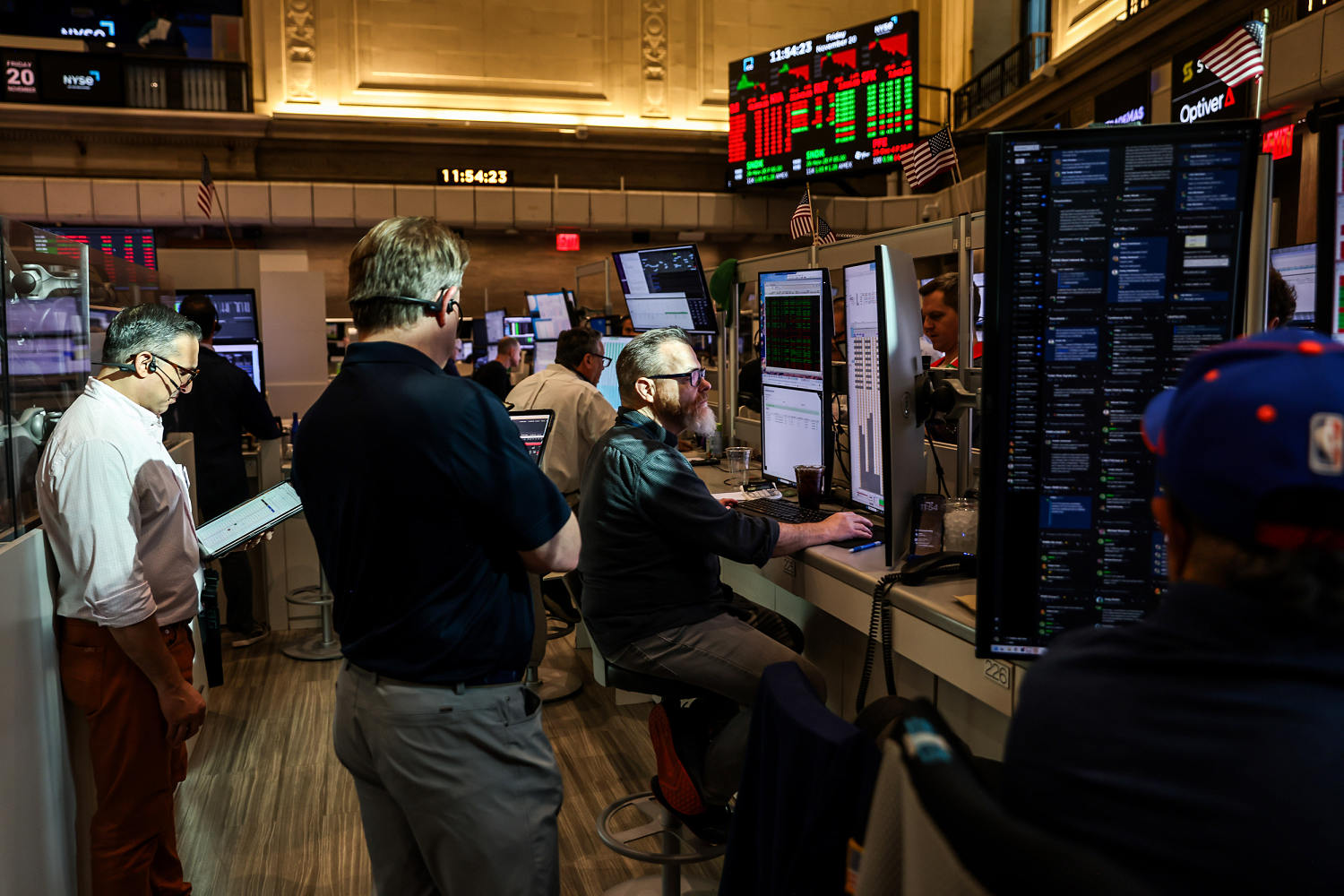
A bruising stock market sell-off gathered steam Friday, despite high hopes that Anthropic’s record-setting IPO a day earlier would revive sentiment around the flagging AI trade.
Instead, Friday’s downturn was led by Anthropic itself, whose shares were down as much as 13% on its first full day of trading on the Nasdaq Composite.
Nvidia shares also tanked more than 12% on a Reuters report that the Securities and Exchange Commission is looking into potential accounting issues at the embattled chip giant. That helped push major stock indexes, where Nvidia comprises a significant component, even lower.
At 2:30 p.m., the S&P 500 was trading 3% lower as it headed for its worst losing week since April 2025, when President Donald Trump announced his “Liberation Day” tariffs, and is now 10% off from its most recent high, entering what’s known as “correction territory.”
Meanwhile, the tech-heavy Nasdaq Composite plunged, down around 4.5% by mid-afternoon. Friday’s losses meant that the Nasdaq has erased all its previous gains in 2026.
Major AI-related stocks such as CoreWeave, Oracle and SanDisk also sold off.
The S&P 500 is now up less than 3% for the year. Its six-consecutive declining sessions mark the index’s longest losing streak since April 2024. A seventh losing day would make it the longest stretch since the pandemic slump in February 2020, according to Deutsche Bank.
For U.S. households relying on 401(k)s and pension funds for retirement, the downturn is especially unwelcome at a time when inflation continues to prove stubborn.

Given the importance the AI trade has played this year in propelling markets and economic growth writ large, its derailment over concerns about costs, debt, profitability and political risk could have broader implications.
Deepening worries about AI revenues tied to exports of advanced technology to China compounded Friday’s sell-off.
The Jensen Huang scandal pulling down Nvidia appeared to broaden Thursday, when a short-selling firm issued a report raising questions about whether Advanced Micro Devices, another chip giant, may also have had shipments to Asia diverted to mainland China.
Alongside the stock sell-off, there has been an increase in purchases of U.S. Treasury bonds — a sign that investors are seeing signs of weakening growth amid higher interest rates from the Federal Reserve and a stalling economy in China.
“The pressure is becoming increasingly widespread, and that’s been felt across other asset classes too,” Deutsche Bank managing director Jim Reid wrote in a note to clients Friday.
Kevin Gordon, head of macroeconomic strategy and research at Charles Schwab, told NBC News that markets are feeling particular pressure from an increasingly “hawkish” Federal Reserve that is signaling aggressive rate hikes in the face of unrelenting inflation.
“They’re signaling that they want to be aggressive in raising rates,” Gordon said. Combined with a weeks-long downturn among AI and tech stocks, “we have dual forces hitting the market.”
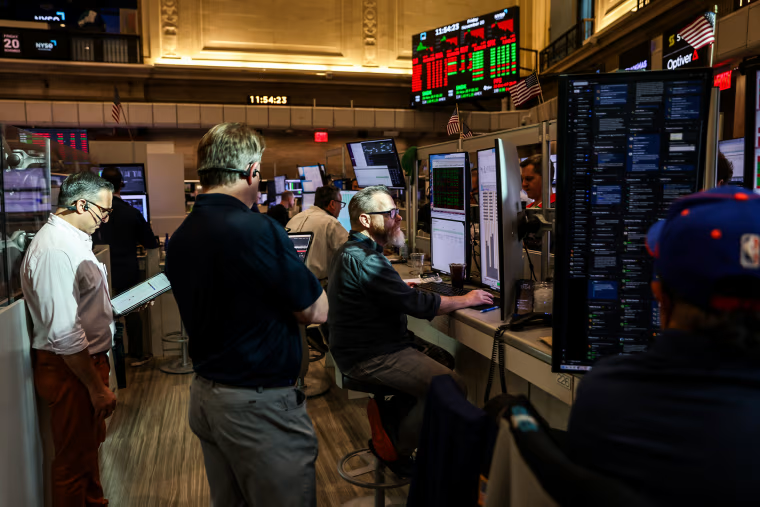
Gaurav Mallik, chief investment officer at New Jersey-based Modera Wealth Management, called the recent sell-off “a garden-variety correction.”
He noted that overall returns have still been respectable this year, “especially against a challenging backdrop of rising rates, persistent inflation and fears about an AI slowdown.”
But a prolonged downturn could begin to cut more deeply into economic growth.
“If you have enough of a protracted downturn, which we really haven’t had since 2007-2009 in terms of length and duration, that’s when you’d really start to worry,” he said.
This is a developing story. Please check back for updates.