
A magnitude-5 earthquake and series of strong aftershocks hit Southern California on Saturday, according to federal officials.
The earthquake and aftershocks hit the Manhattan Beach area, an affluent coastal city in southwestern Los Angeles County, around 9:30 a.m. PT, according to the United States Geological Survey. State officials said that more than 40 aftershocks have hit the area.
USGS data showed two aftershocks greater than magnitude 4 and eight greater than 3 following Saturday’s temblor.
“I would expect that these felt aftershocks, the threes, would be highly likely in in the next week or two,” seismologist Lucy Jones said at a news conference.
The city of Manhattan Beach advised residents in a post on social media to stay away from damaged buildings and downed power lines and secure heavy objects that could fall in aftershocks.
“Aftershocks should be expected to continue over the next days to weeks, decreasing in frequency with time,” the state’s geologic agency said.
Saturday’s earthquake was the strongest to hit the Los Angeles area since 2014. No significant injuries or structural damage was reported within nearby Los Angeles, L.A. Fire Department spokesperson Lyndsey Lantz said in an update Saturday afternoon.
Los Angeles Mayor Karen Bass said in a statement that there “there were no reports of major damage to critical infrastructure.”
She encouraged people to take the steps to be prepared in the event of an earthquake or aftershock.
“Today’s seismic activity serves as an important reminder that earthquakes can happen at any time in California,” she said.
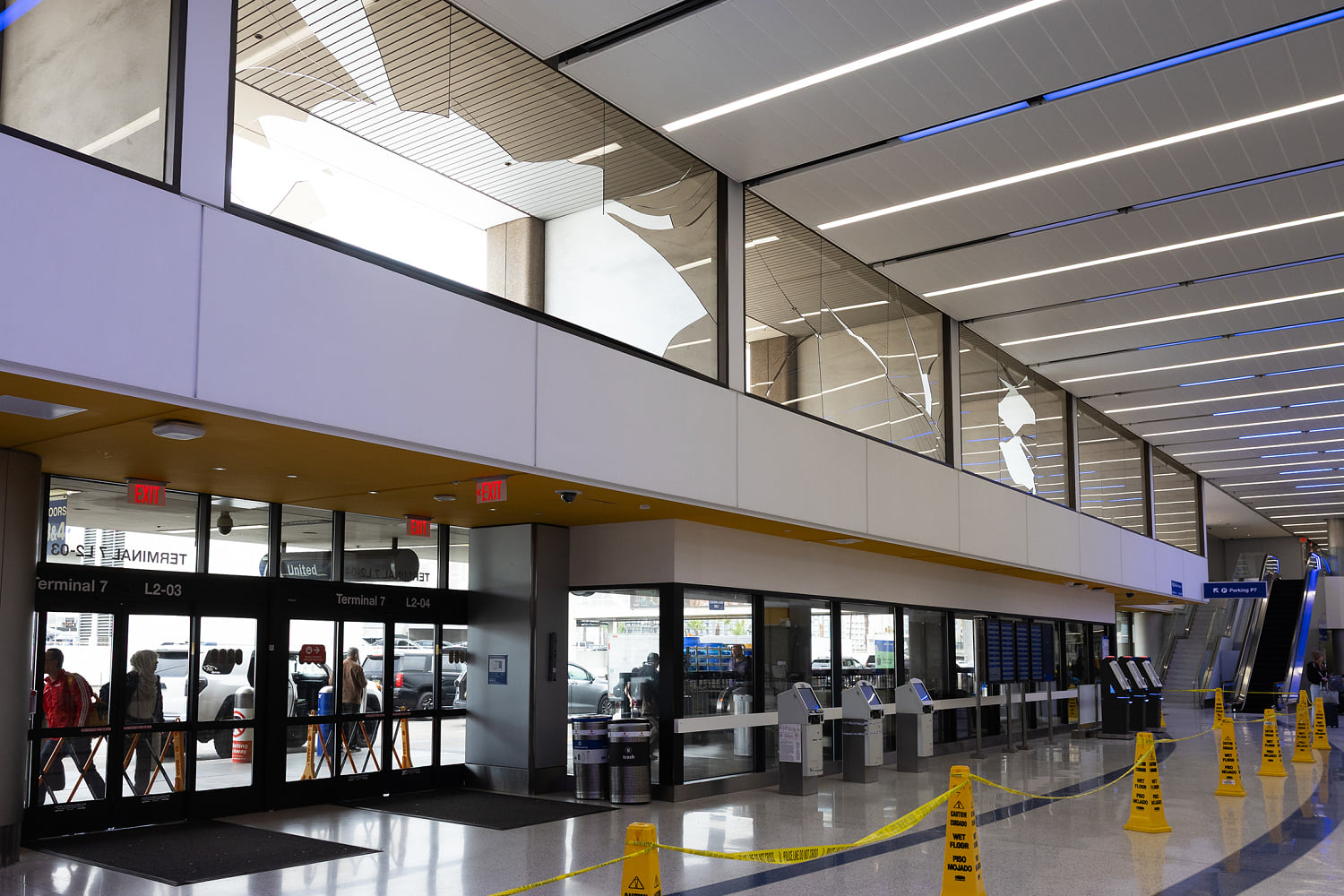
Windows at Los Angeles International Airport were shattered by the quakes, according to Bass and video posted on social media. Air traffic controllers at the airport were also warning nearby pilots about the earthquake.
“Still clear to land. Just be advised. There’s a pretty, pretty big earthquake here,” an air traffic controller said, according to a public recording of the interaction.
There were also some loose ceiling tiles at the airport, Bass said, but said flight operations were not impacted.
At the Chevron El Segundo oil refinery near Manhattan Beach, “automated safety systems” triggered by the quake set off precautionary, intermittent burn-offs called flaring, which do not pose a risk to the public but create skyward flames that can be seen for miles, Chevron said in a statement.
The city of Torrance said in a statement there was “visible unplanned flaring” at the Torrance Refinery as a result of the temblor.
‘Everything was moving violently’
Security footage from the Manhattan Beach-area shared with NBC News shows a home, plants and a metal fence forcefully shaking for about 20 seconds. A woman out of the camera’s frame appears to be screaming.
Michael Cullagh was in Manhattan Beach on Saturday visiting his son for Thanksgiving.
“Everything was moving violently,” he said. “Within seconds I just didn’t know if things were just going to explode.”
The USGS SkakeAlert system sent cellphone warnings triggered by the earthquake and an aftershock. Back-to-back warnings can happen when larger earthquakes are followed by strong aftershocks, USGS observational seismologist Elizabeth S. Cochran said at Saturday’s news conference.
The alerts race toward cellphones faster than a temblor’s wave, sometimes giving recipients seconds of advance warning. In Saturday’s case, those who signed up for ShakeAlert warnings in Manhattan Beach were so close to the offshore quake they were warned by ShakeAlert 0.0 seconds ahead of the temblor, according to the USGS.
Those in downtown Los Angeles got more notice, with 4.4 seconds, it said.
The University of Southern California sent an alert to its students noting that a “minor earthquake” was felt on its campuses just south of downtown Los Angeles.
Staffers at Nick & Sons Market in Manhattan Beach were mopping up broken bottles of wine and other products in the hours after the quake. Owner Nick Nahigian said that aside from a large crack in the window and the mess, there was no major damage to his storefront.
“Other than that, everyone’s safe. So, we’re fine with that,” he said.
Aftershocks within normal range
Jones said the region’s recent seismic activity, including a magnitude-3.3 temblor off Manhattan Beach on Nov. 22, and Saturday’s continued rumbling, is not unusual, and may be associated with the Palos Verdes Fault Zone off the coast
“I don’t consider the last few weeks particularly abnormal,” Jones said. “If you look on the longterm ... rate of earthquakes in the basin, the last month has been pretty much what our longterm rate is.”
She said the number of aftershocks Saturday may be “a bit more active than average” but she estimated it’s “well within the normal range.”
There is about a 5% chance of Saturday’s earthquake becoming a foreshock to a bigger quake, with that likelihood going down over time, Jones said.
“Aftershock is an earthquake that doesn’t surprise us,” she said.
Temblors like today’s, Jones said, are almost always downstream of the mighty San Andreas Fault.
“Everything that goes on in L.A. is related to plate motions primarily on the San Andreas,” Jones said. “The San Andreas has a bend in it by Los Angeles that’s created a whole web of faults, and you know they’re all the same overall system accommodating the bend in the San Andreas, but the timing we don’t think has any significance.”
How to prepare
In March 2014, a magnitude-5 earthquake hit the Los Angeles-area, prompting more than 100 aftershocks. The quake caused rockslides, water main breaks and thousands of power outages. No deaths were caused from the earthquake.
The L.A. County Fire Department said those caught in an earthquake should drop, find cover under a solid desk or table, and hold tight.
Earthquake preparation, the fire department said, should include learning how to shut off a home’s utilities and gathering supplies like food, water, medicine, clothing, blankets, cash and an old-school radio that can weather at least 72-hours of isolated and offline life.
Bass advised people to remember to “Drop, Cover and Hold On” in the event of an earthquake or aftershocks.
“Protect your head and neck while taking cover under sturdy furniture, near a sturdy interior wall, and away from windows and doorways,” she said.

Dennis Romero is a breaking news reporter for NBC News Digital.
Dennis Romero is a breaking news reporter for NBC News Digital.
Linda Takahashi
and
Christiana Corporon
contributed
.