Some people are simply unaware of how they come across. They may think their behavior is justified or harmless, not realizing it isn’t sitting well with the person on the receiving end.
This shop owner appears to be one of those folks. One day, he decided to follow a regular customer around the store and keep a watchful eye, as if he expected something unpleasant to happen. The shopper recognized this and immediately turned the tables on the distrustful owner by doing the exact same thing.
While it made for an awkward moment, it was a petty but necessary way to enforce boundaries at the time.
Some people seem to lack awareness about the boundaries they are crossing

magnific / magnific (not the actual photo)
A shop owner decided to follow a regular customer around his store, as if expecting something unpleasant would happen
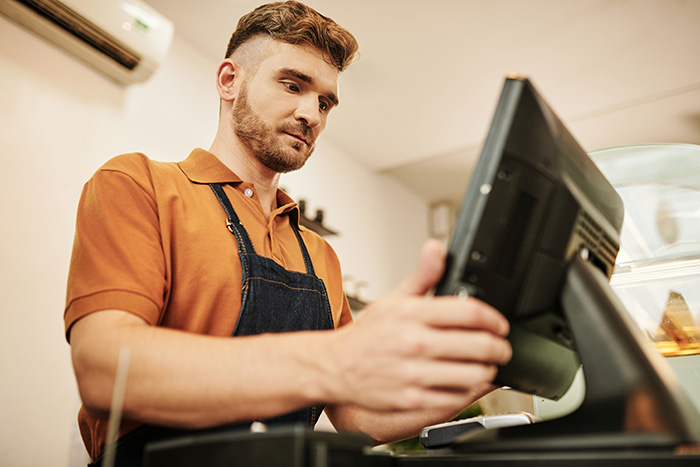
dragonimages (not the actual photo)
The shopper turned the tables around and did the exact same thing, which worked to their advantage

Misjudgments about someone’s character are often a projection of our personal issues
It’s not uncommon to judge someone wrongly. Most of us have done it at least once, and experts say our brains are wired that way.
In her article for UC Berkeley’s The Greater Good Magazine, psychologist Jill Suttie noted that the human brain is attuned to predicting what another person is thinking, feeling, or planning. In her own research, she cited Nicholas Epley’s book Mindwise: How We Understand What Others Think, Believe, Feel, and Want.
“While our evaluations of others may be vulnerable to the ‘correspondence bias ‘—the tendency to believe that one’s mind directly corresponds to one’s actions—we don’t make similar judgments about our own motivations,” Suttie wrote, noting that this way of thinking prevents us from seeing things from the other person’s perspective.
For her example, Suttie used the victims of Hurricane Katrina who refused to leave their homes when disaster struck. Many misjudged their actions as stubbornness, forgetting that most of them didn’t have the financial means to move somewhere safer.
Identifying common ground can help cultivate empathy much more easily
Having something in common with another person makes it easier to show empathy. As Yale University psychology professor John Dovidio tells the American Psychological Association, seeing someone as part of your own group triggers arousal of “common humanity.”
“When you experience this empathy, it motivates you to help the other person, even at a personal cost to you,” he said.
Similarly, NYU associate professor Jay Van Bavel notes that part of social intelligence is finding the identity you share with another person.
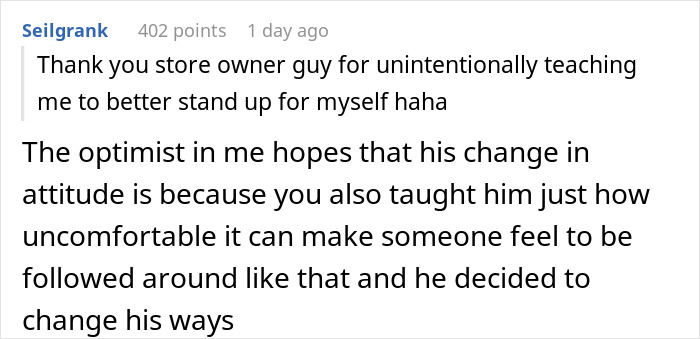
That’s likely why the shop owner stopped following the customer after he felt what it was like to have his space invaded. He may not have admitted it outright, but that shared experience likely turned him around 180 degrees.
A few people in the comments shared similar experiences


Others had varying reactions to what they read