
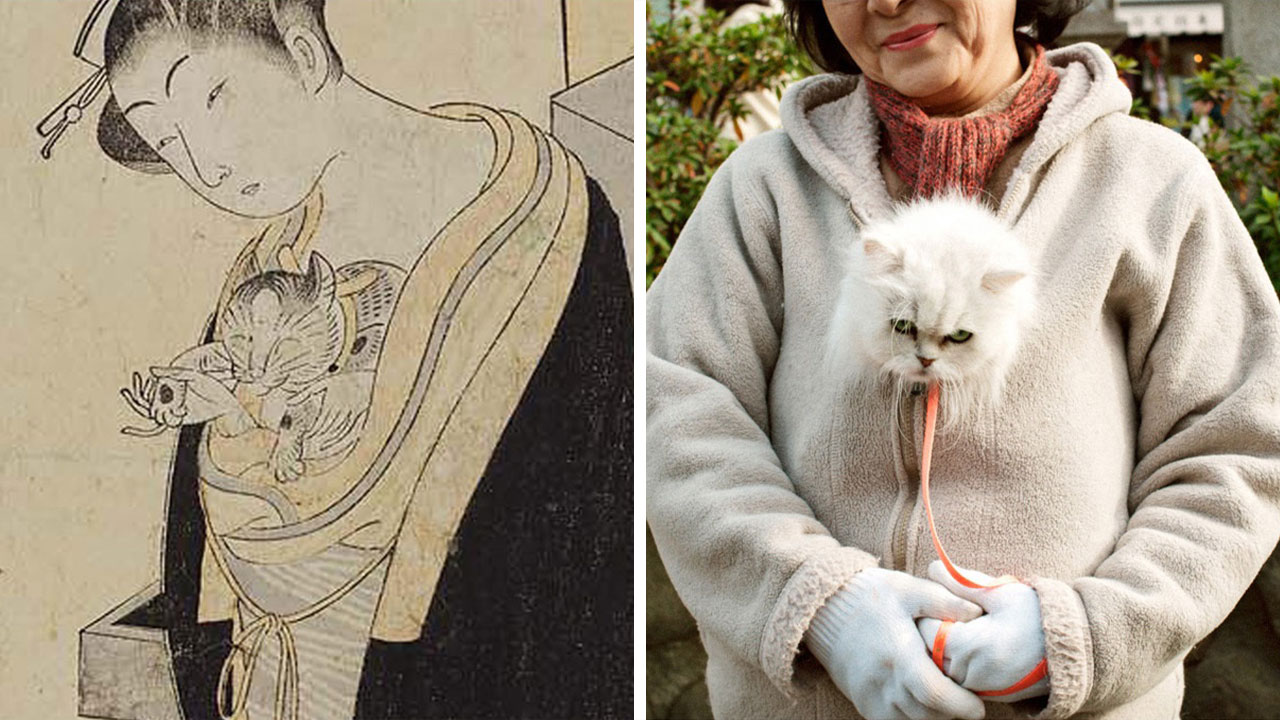
How much has everyday life really changed over the past two hundred years? Japanese street photographer Shin Noguchi explores this question through his project “Ukiyo-shashin/Ukiyo-e,” which pairs contemporary street photographs with traditional Japanese woodblock prints. Interestingly, Noguchi doesn't set out to recreate scenes from traditional Japanese art. His photographs capture spontaneous moments from his career, and the connections to ukiyo-e emerge naturally. Having admired Japanese art since childhood, he believes its influence has always shaped his photography, particularly how he composes his images.
We've featured Noguchi's street photography on Bored Panda before, but his latest project offers a different perspective on the everyday moments he has spent years documenting. By placing his photographs alongside ukiyo-e prints, he draws attention to the surprising similarities between life in Japan today and scenes depicted by artists centuries ago. After roughly two decades of photographing everyday life, Noguchi decided to share these artistic connections with a wider audience. However, his project isn't simply about finding visual similarities between old and new images. He's also interested in the emotions, relationships, and traditions that connect people across generations, even as their surroundings change dramatically. For Noguchi, these comparisons remind us that Japanese culture isn't confined to museums or history books. People continue to experience and shape it through their everyday lives. And perhaps most importantly, he hopes the project encourages viewers to pay closer attention to the ordinary moments around them, recognizing that these, too, are worth preserving.
Scroll down to explore Shin Noguchi's fascinating comparisons between contemporary street photography and traditional Japanese art. We also spoke with the photographer about the inspiration behind his project, how he discovers connections between past and present, and what he hopes people will take away from his work.
More info: Instagram | shinnoguchiphotography.com | shinnoguchiphotography.com
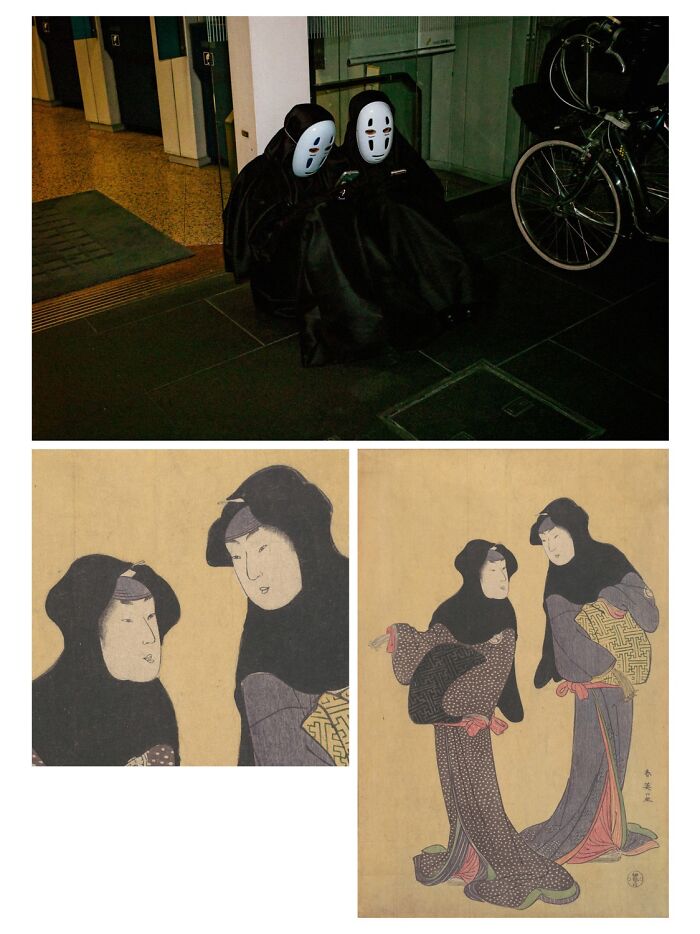
#1
Photo: Two people dressed as No-Face from Spirited Away, sitting together during Halloween celebrations in Shibuya, Tokyo, October 2017. © Shin Noguchi. Ukiyo-e: Two Women Conversing, by Katsukawa Shun'ei, late 18th century. ©The Metropolitan Museum of Art.
© Photo: shinnoguchiphotos
Bored Panda first asked Noguchi what inspired him to create “Ukiyo-shashin/Ukiyo-e” and how the idea for bringing together his photographs and traditional Japanese prints originally came about: “Ukiyo-e are pictures of the everyday life of their time. ‘Ukiyo’ is the very world that people actually lived in. I have always photographed the same thing: the living figures of the people I have encountered, just as they are. I have loved ukiyo-e and painting from Japan and beyond, since I was a child, and ukiyo-e lies at the base of my photographs, especially in their compositions. Now, some twenty years into my work, I decided to make that root public. I wanted people to notice anew that the scenes and gestures in the photographs I have taken already existed in woodblock prints from two hundred years ago, and that the present and the past are one continuous ground. This project, ‘Ukiyo-shashin/Ukiyo-e,’ was born from that. Its statement is a single line: ‘To chronicle an era, and pass it on.’”
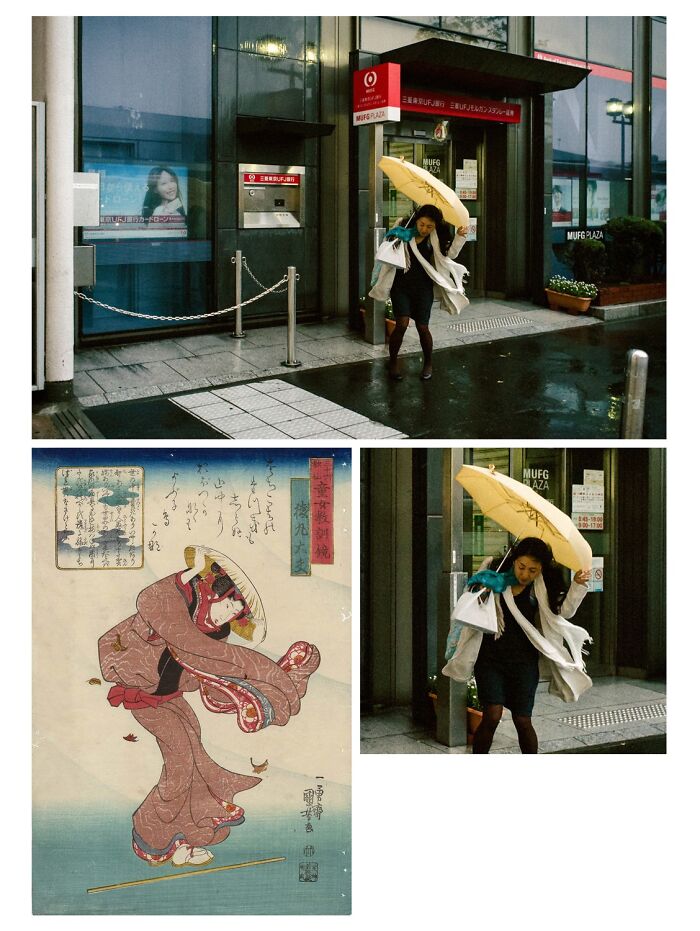
#2
Photo: A woman struggling against strong winds while holding a yellow umbrella during a bomb cyclone in Komachi, Kamakura, Japan. April 3, 2012. © Shin Noguchi. Ukiyo-e: “Sarumaru-dayu,” from “The Thirty-six Immortals of Poetry: Mirror of Ethics for Girls” (c. 1843–1847), by Utagawa Kuniyoshi. © Museum of Fine Arts, Boston.
© Photo: shinnoguchiphotos
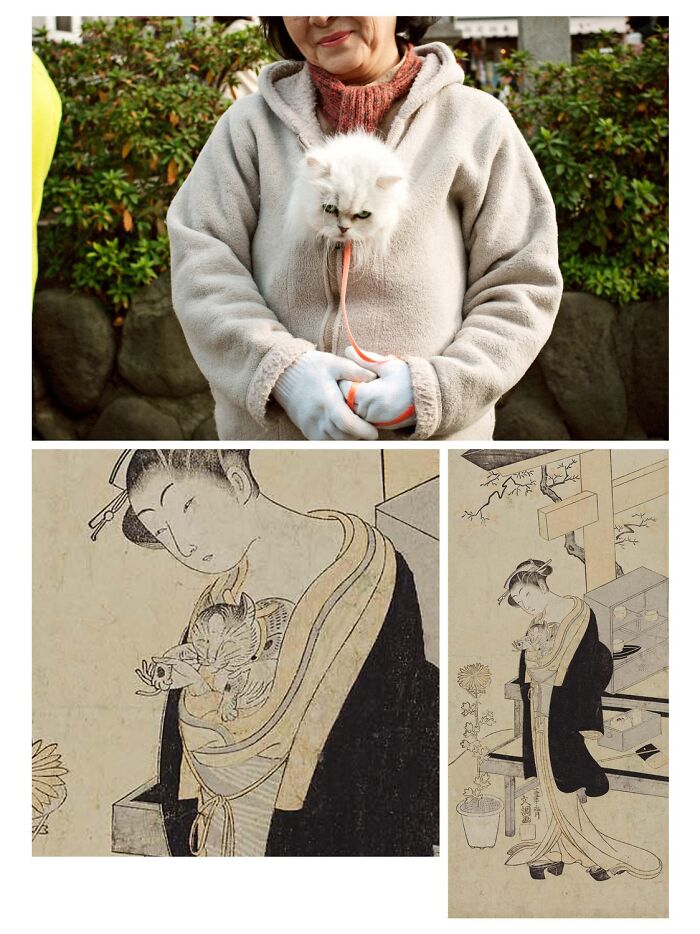
#3
Photo: A woman with a fluffy white cat accessory during Hatsumode, the traditional first shrine visit of the New Year, at Tsurugaoka Hachimangu Shrine in Kamakura, Japan, January 2011. © Shin Noguchi. Ukiyo-e: Osen of the Kagiya Holding a Cat, by Ippitsusai Buncho, circa 1769. ©Museum of Fine Arts, Boston.
© Photo: shinnoguchiphotos
We were also curious about his approach to street photography and how he captures everyday scenes that seem to reflect the spirit and visual style of traditional ukiyo-e art: “I do not go out looking for scenes that resemble ukiyo-e, and I never stage anything. I photograph my family, my town, and the people I meet from inside their lives, not from outside them. When I release the shutter naturally before a scene in front of me, the worlds of ukiyo-e and other works I have seen in the past may be projected over it, semi-transparent, like a filter. So the resemblance to ukiyo-e appears naturally. It is there before I am conscious of it. I came to realize that people's everyday gestures may in fact have hardly changed at all. If we suppose that I am searching for pairs with ukiyo-e, what I search for is not a match of surface subjects or scenes, but the inner structure: gesture, scene, composition, and within the frame, the feelings that people have left there.”
#4
Photo: A giant, weathered human-like head partially hidden among overgrown vegetation in Izu, Shizuoka, Japan, February 2011. © Shin Noguchi. Ukiyo-e: The Ghost of Oiwa (Oiwa-san), from One Hundred Ghost Tales, by Katsushika Hokusai, circa 1831–1832. ©Museum of Fine Arts, Boston.
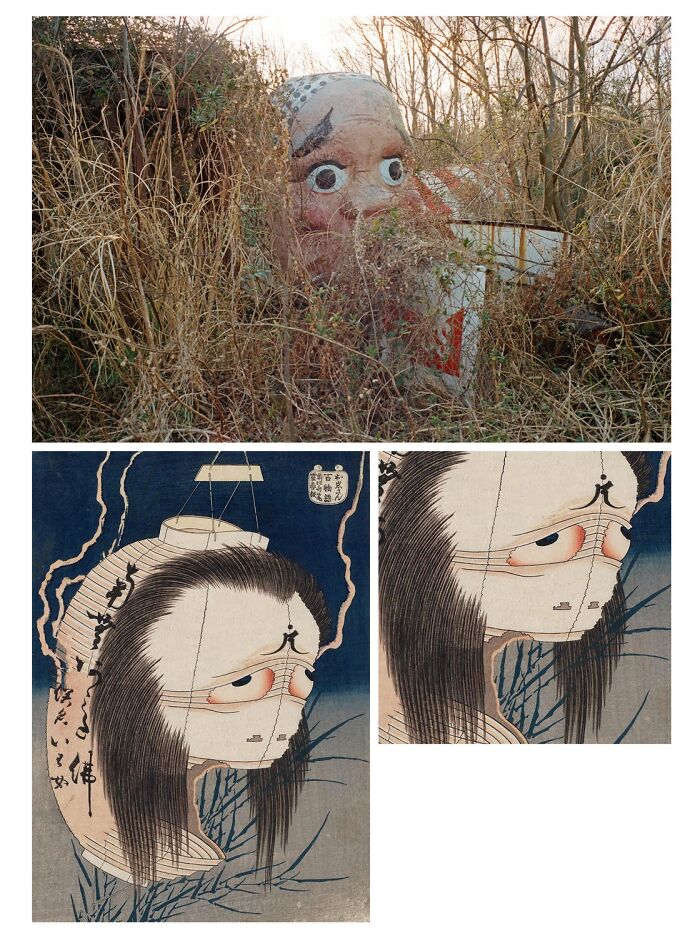
© Photo: shinnoguchiphotos
#5
Photo: A group of young people wearing striking kabuki-style makeup inside a vehicle during Hatsumode, the first temple visit of the New Year, near Sensoji Temple in Asakusa, Tokyo, January 2020. © Shin Noguchi. Ukiyo-e: Hoshizukiyo Kenmon Jikki, by Toyohara Kunichika, 1880. © Tokyo Metropolitan Library.
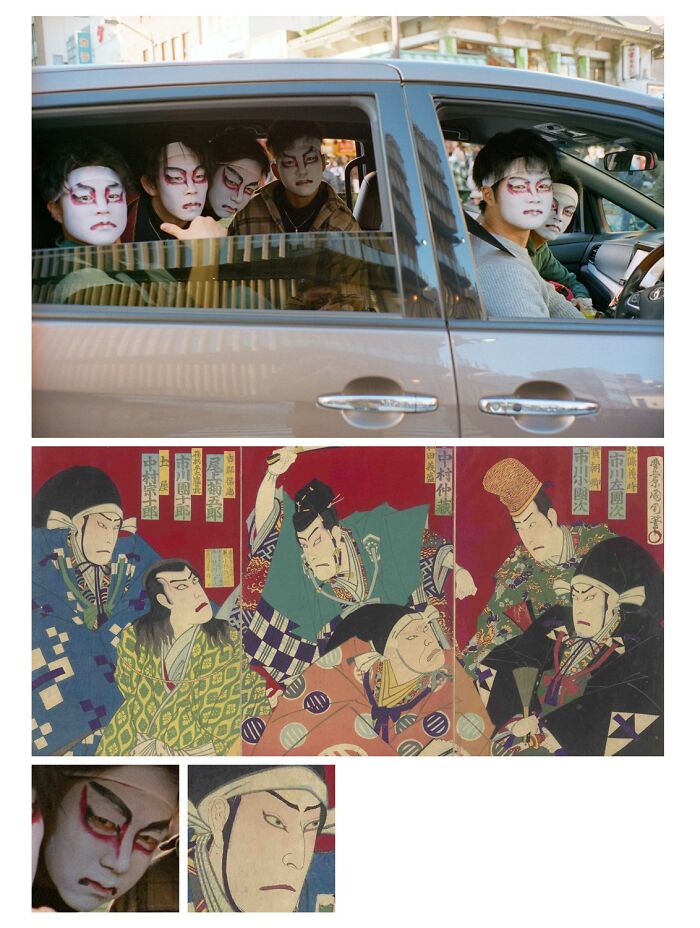
© Photo: shinnoguchiphotos
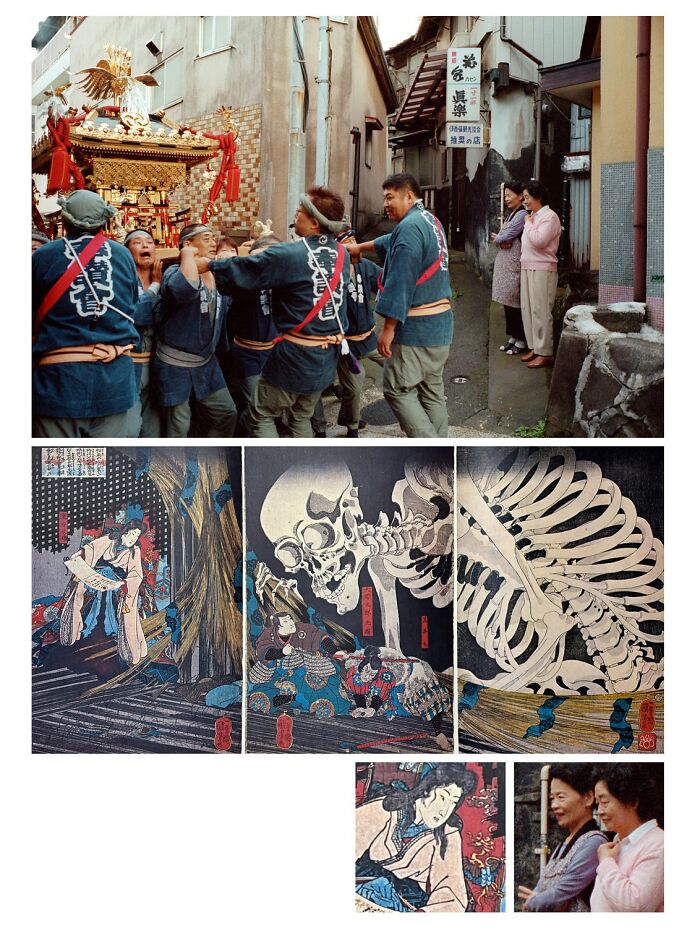
Next, we asked Noguchi whether he had encountered any particular challenges while putting the project together and if there was a photograph or comparison that held special meaning for him: “I do not photograph in order to build this project, so there is no difficulty in putting it together. But there may be a slight embarrassment, as if I were opening, one by one, the secret drawers inside my head and sharing them with others. One pair expresses what I want to say particularly well: my photograph of the mikoshi carried by men at the Ikaho festival, watched over gently by the okami, the women who run the inns there, paired with Kuniyoshi's ‘Soma no Furudairi.’ Their subjects and themes could hardly be more opposite: a festival procession, and a haunted house with a skeleton monster. Yet inside, both are scenes in which women have gone on to watch over and protect a place and its history, while the men, as if entrusting themselves to that, show their own way of life. And both are built on the same three-part composition. Through this combination, I would be glad if people noticed that I am looking not only at the surface charm of the everyday life of the street, but at something much deeper.”
#6
Photo: A man sitting on the floor against a wall while a worker cleans the entrance to Shimbashi Station in Tokyo, Japan, September 2011. © Shin Noguchi. Ukiyo-e: Sumiyoshi no Meigetsu, from Tsuki Hyakushi (One Hundred Aspects of the Moon), by Tsukioka Yoshitoshi, 1887. ©Tokyo Metropolitan Library.
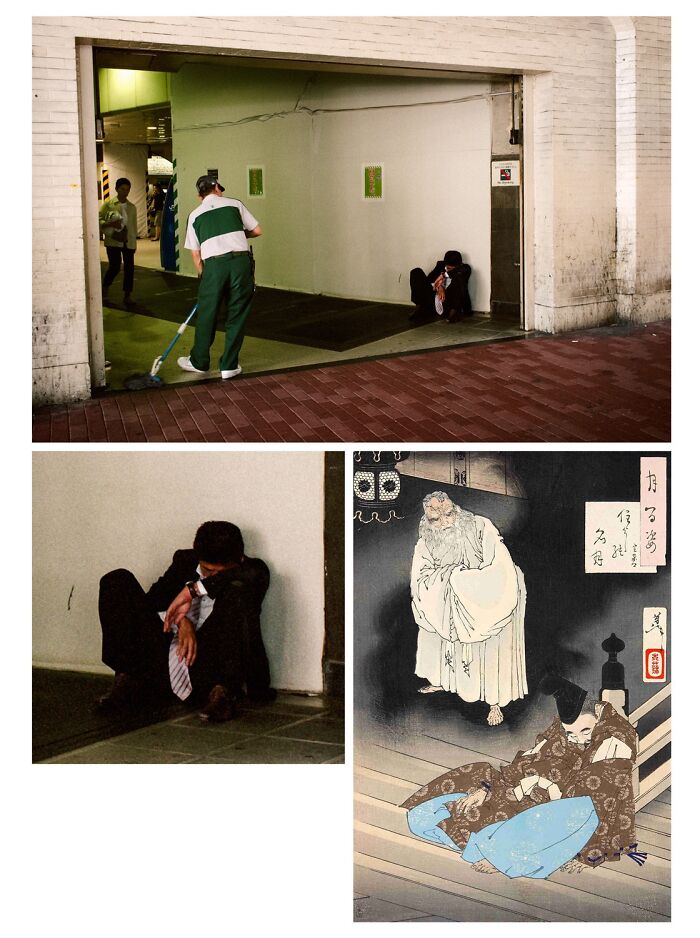
© Photo: shinnoguchiphotos
#7
Photo: Five schoolchildren walking together in a playful line, holding onto one another's backpacks at an elementary school in Onarimachi, Kamakura, Japan, March 2017. © Shin Noguchi. Ukiyo-e: Young Children's Games: Ko-o-toru, Ko-o-toru Game, by Utagawa Hiroshige III, 1868. © Tokyo Metropolitan Library.
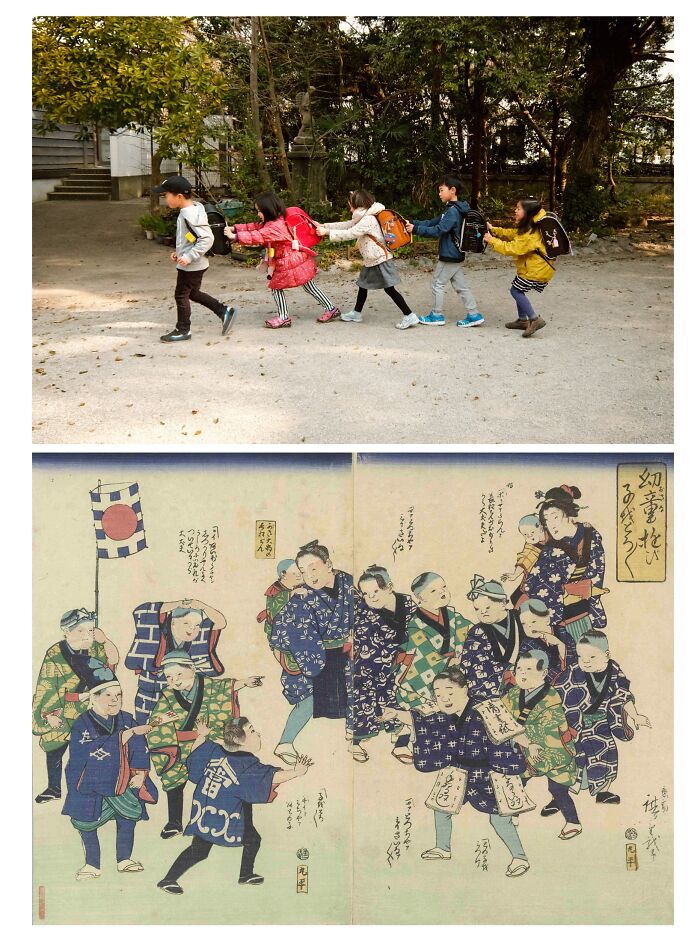
© Photo: shinnoguchiphotos
Finally, we wanted to know what Noguchi hopes viewers around the world will discover about Japanese culture through these comparisons between contemporary photography and traditional art: “I hope people feel that Japanese culture is not something frozen in the past. A mother carrying her child on her back, children walking in a line holding on to each other, people working, people playing, people celebrating. These movements have continued without interruption from the Edo period to today. By looking at contemporary street photographs and ukiyo-e at the same time, I would be glad if readers could feel the connection of time from their own past to the present, and hope for what lies ahead, and above all, feel the preciousness of their own daily lives, and of the daily lives of the others they have been involved with, even if only slightly, and look at them a little more carefully.”
#8
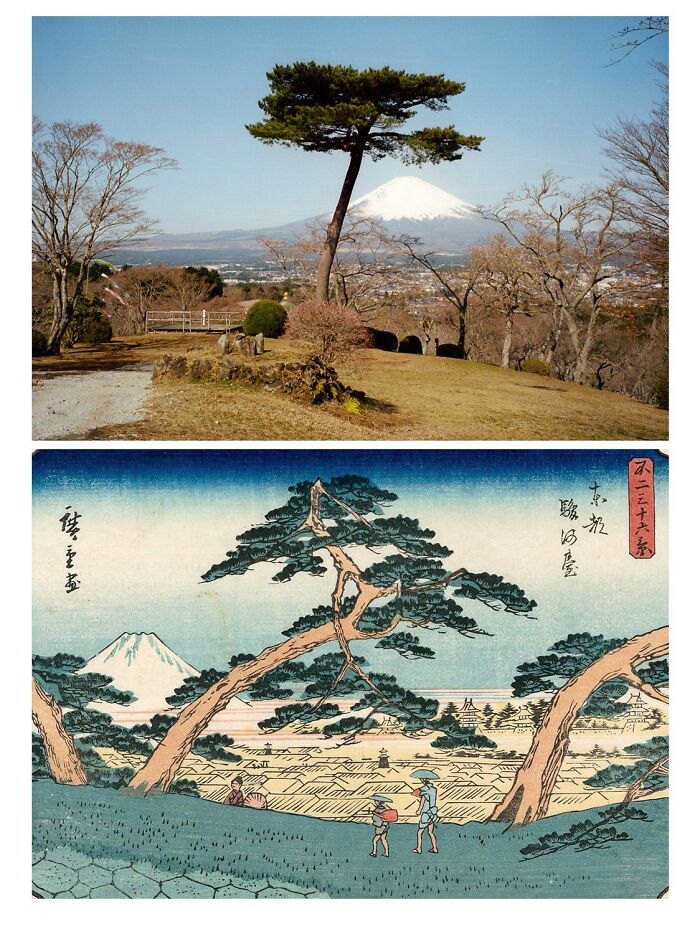
Photo: Mount Fuji framed by a pine tree in Gotemba, Shizuoka, Japan. March 2020. © Shin Noguchi. Ukiyo-e: “Toto Surugadai (Surugadai in Edo),” from “The Thirty-six Views of Mount Fuji” (1852), by Utagawa Hiroshige. © Museum of Fine Arts, Boston.
© Photo: shinnoguchiphotos
#9
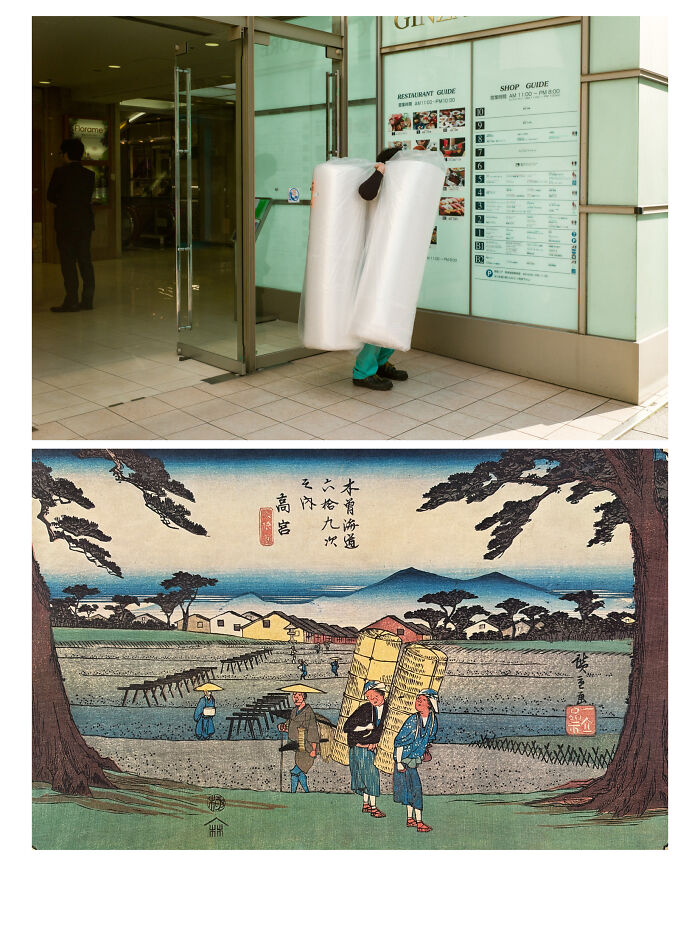
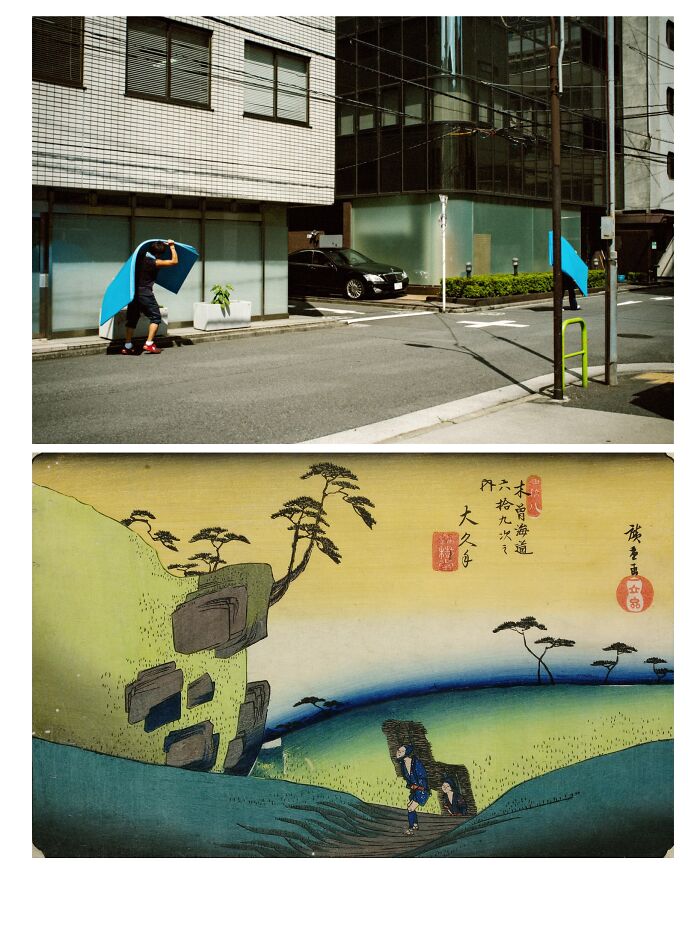
Photo: Shimbashi, Tokyo, September 2011. © Shin Noguchi Ukiyo-e: Okute from the Sixty-nine Stations of the Kisokaido by Utagawa Hiroshige. circa 1837-1839 From Shin Noguchi's personal collection.
© Photo: shinnoguchiphotos
#10
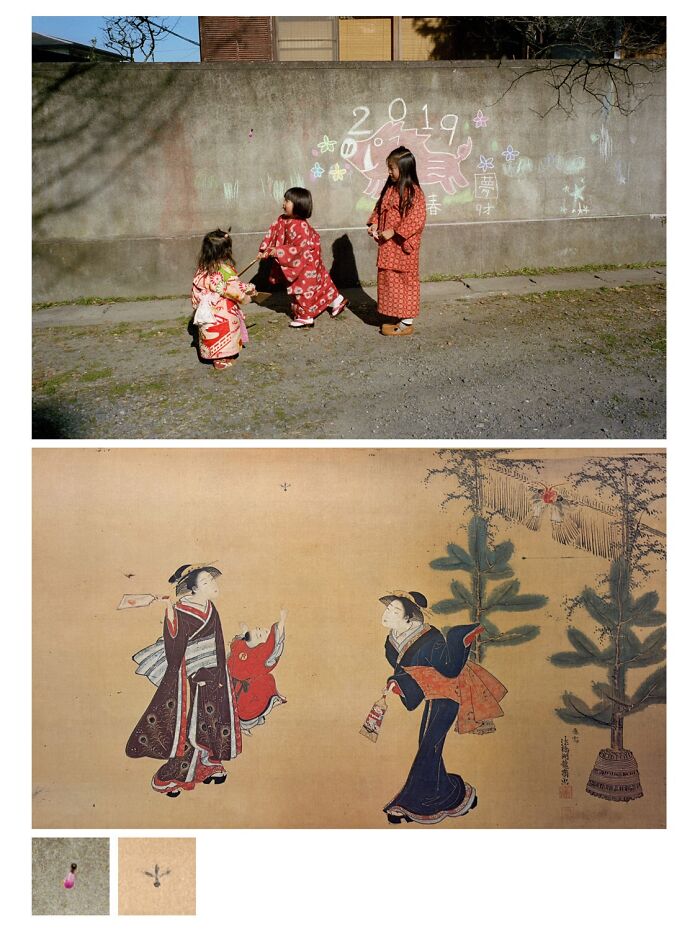
Photo: Three young girls wearing colorful kimonos playing hanetsuki, a traditional Japanese battledore-and-shuttlecock game, outside a home in Kamakura, January 1, 2019. © Shin Noguchi. Ukiyo-e: Hanetsuki (Battledore and Shuttlecock), by Isoda Koryusai, circa 1764–1781. Source: Shin Noguchi's personal collection.
© Photo: shinnoguchiphotos
#11
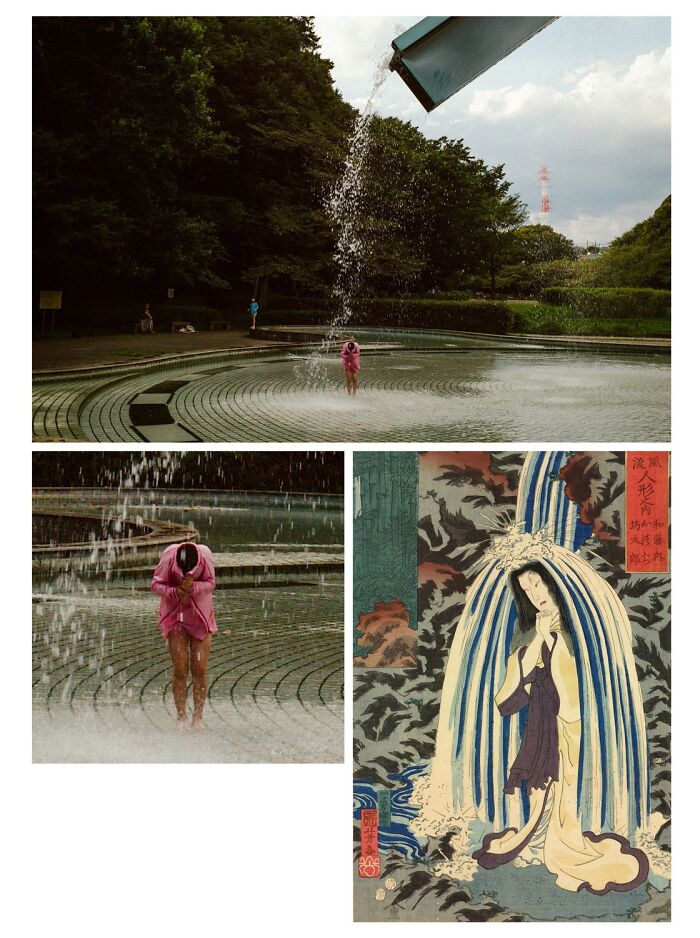
Photo: A child standing beneath a cascade of water at Serigaya Park in Machida, Tokyo, Japan. September 2016. © Shin Noguchi. Ukiyo-e: “O-tsuji,” from “Furyu Ningyo No Uchi” (c. 1856), by Utagawa Kuniyoshi. © Tokyo Metropolitan Library.
© Photo: shinnoguchiphotos
#12
Photo: A young woman wearing a traditional kimono aboard a train in Tokyo during Japan's Coming of Age Day celebrations, two months before the Great East Japan Earthquake. January 10, 2011. © Shin Noguchi. Ukiyo-e: “Flowers (Hana),” from “The Three Beauties (San Bijin)” (c. 1804–1818), by Utagawa Toyokuni. Scanned from a volume in Shin Noguchi's personal collection.
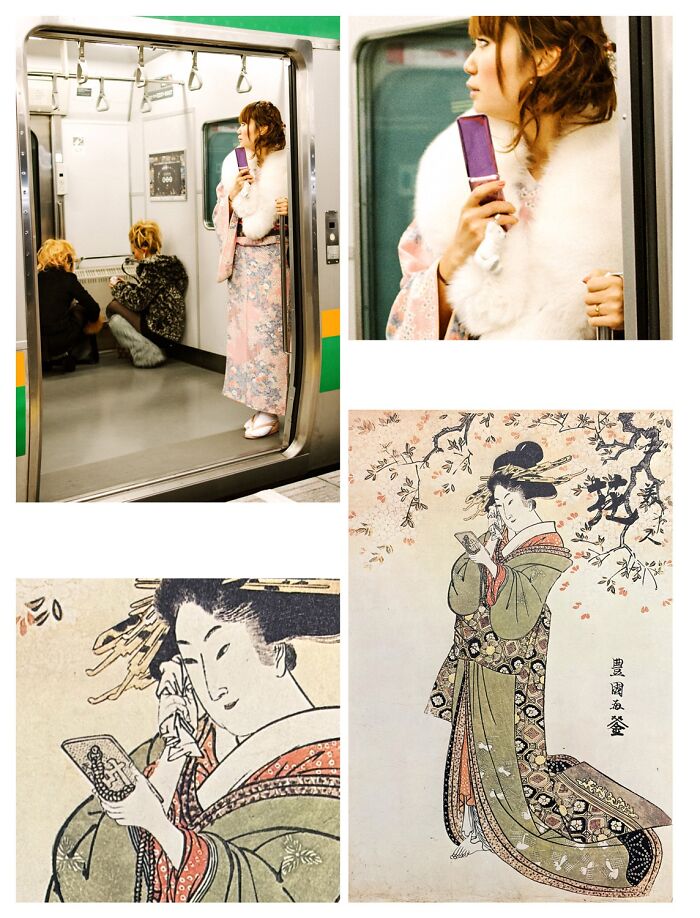
© Photo: shinnoguchiphotos
#13
Photo: Visitors enjoying colorful pedal-powered carts at Onuma Quasi-National Park in Hokkaido, Japan, September 2005. © Shin Noguchi. Ukiyo-e: Children's Games, from the Tawamure-e series, by Adachi Ginko, circa 1885. © Museum of Fine Arts, Boston.
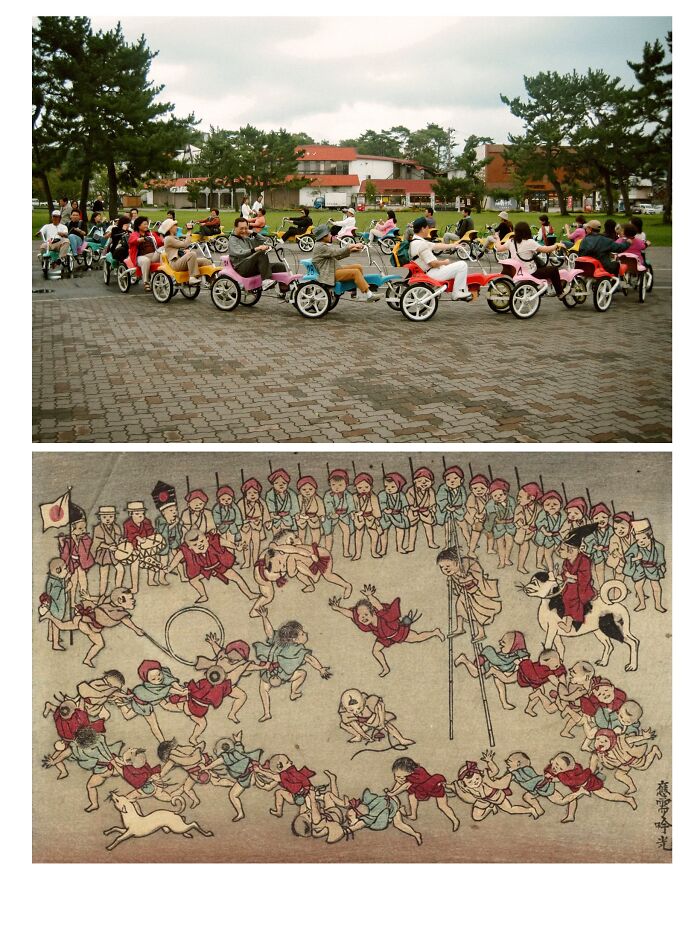
© Photo: shinnoguchiphotos
#14
Photo: Mount Fuji rising behind a modern construction site, with concrete structures reflected in water in Gotemba, Shizuoka, Japan, May 2019. © Shin Noguchi. Ukiyo-e: Bushu Senju, from Thirty-six Views of Mount Fuji, by Katsushika Hokusai, circa 1830–1832. Source: Shin Noguchi's personal collection.
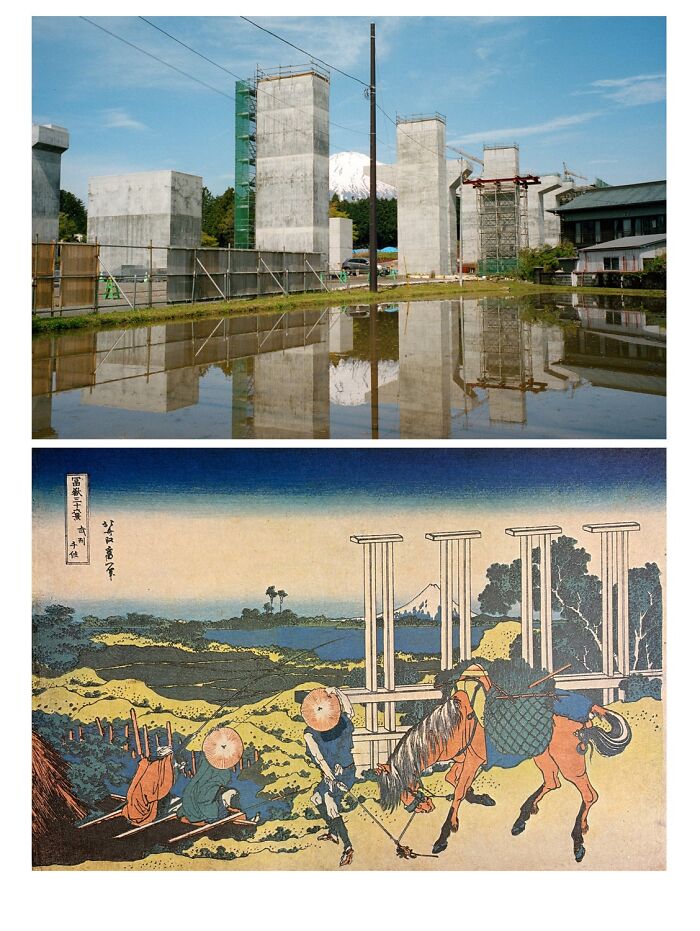
© Photo: shinnoguchiphotos
#15
Photo: A woman with extraordinarily long black hair sitting at an outdoor café in Komachi, Kamakura, Japan, June 2016. © Shin Noguchi. Ukiyo-e: Sarayashiki (The House of Broken Plates), from One Hundred Ghost Tales, by Katsushika Hokusai, circa 1831–1832. Source: Shin Noguchi's personal collection.
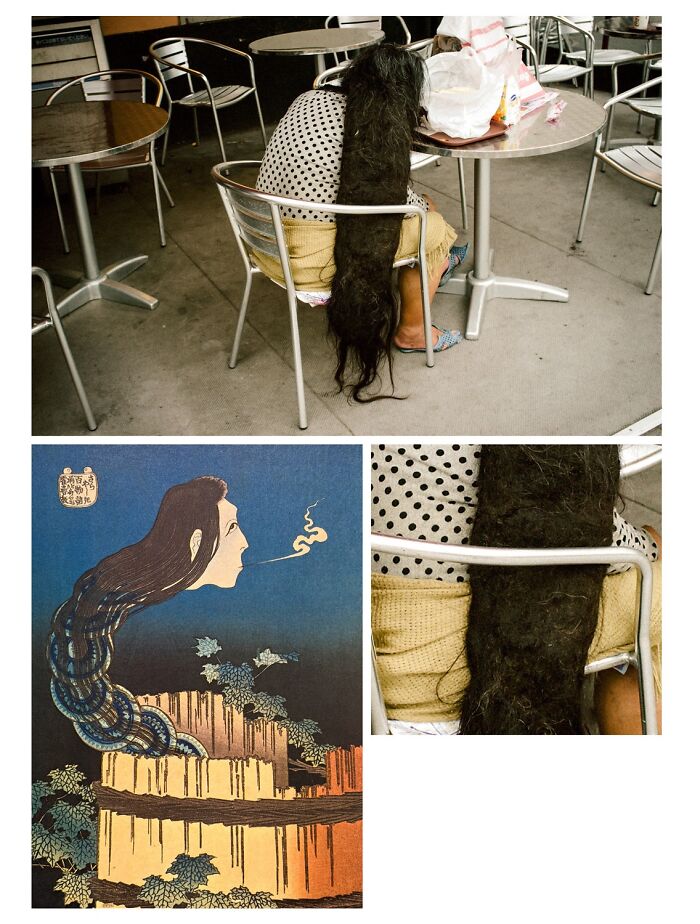
© Photo: shinnoguchiphotos
#16
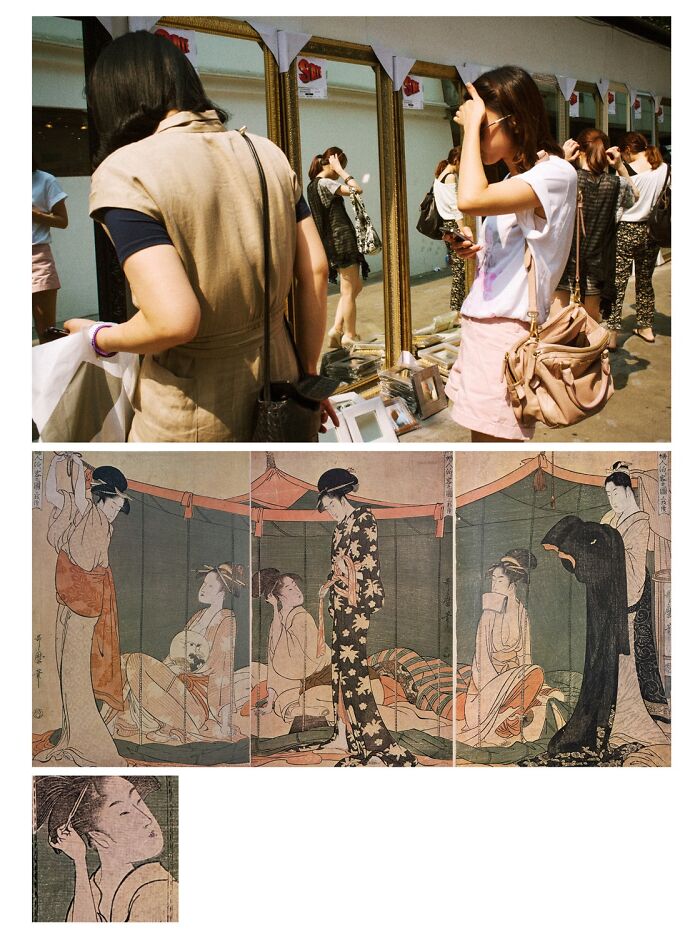
Photo: Women looking at their reflections in a series of large mirrors at a shopping location in Seoul, South Korea, June 2011. © Shin Noguchi. Ukiyo-e: Women Overnight Guests, by Kitagawa Utamaro, circa 1790. Source: Shin Noguchi's personal collection.
© Photo: shinnoguchiphotos
#17
Photo: A group of young people wearing striking kabuki-style makeup inside a vehicle during Hatsumode, the first temple visit of the New Year, near Sensoji Temple in Asakusa, Tokyo, January 2020. © Shin Noguchi. Ukiyo-e: Hoshizukiyo Kenmon Jikki, by Toyohara Kunichika, 1880. ©Tokyo Metropolitan Library.
© Photo: shinnoguchiphotos
#18
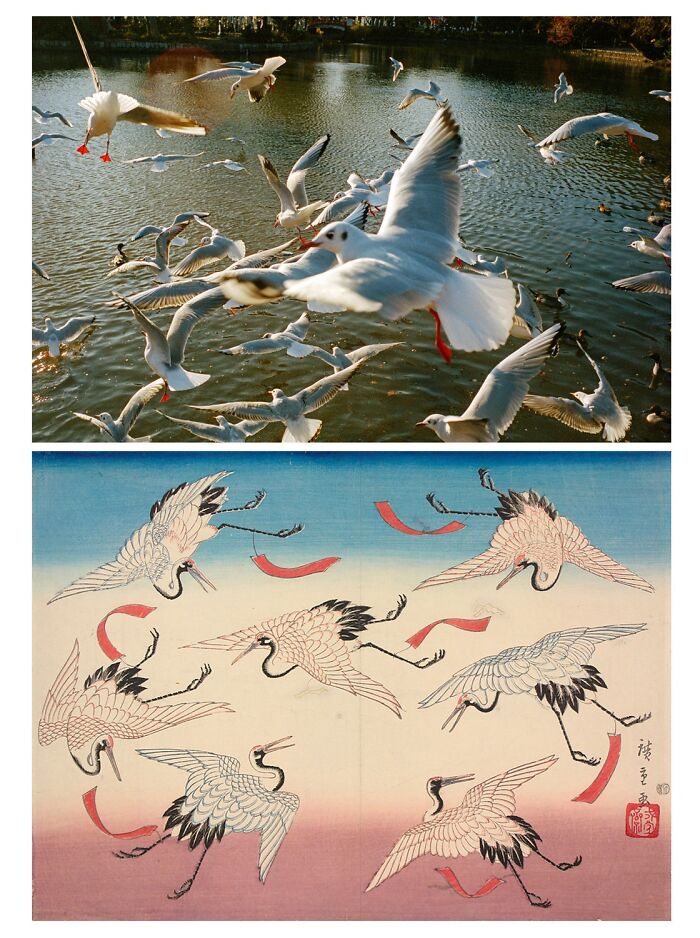
Photo: A flock of seagulls soaring over the water at Tsurugaoka Hachimangu Shrine in Kamakura, Japan, December 2019. © Shin Noguchi. Ukiyo-e: Seven Flying Cranes, by Utagawa Hiroshige II, 1862. ©Chazen Museum of Art, University of Wisconsin–Madison.
© Photo: shinnoguchiphotos
#19
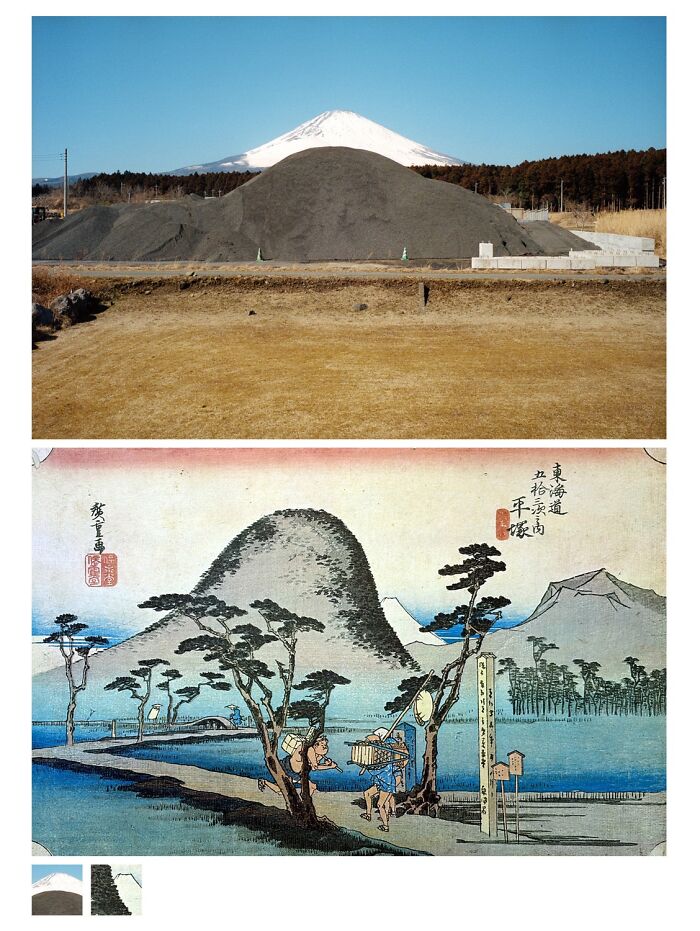
Photo: The snow-covered summit of Mount Fuji rising behind a large mound of gravel in Gotemba, Shizuoka, Japan, February 2021. © Shin Noguchi. Ukiyo-e: Hiratsuka, Nawate Do, from The Fifty-three Stations of the Tokaido, by Utagawa Hiroshige, circa 1833–1834. Source: Shin Noguchi's personal collection.
© Photo: shinnoguchiphotos
#20
Photo: Two people carrying large blue coverings along a quiet street surrounded by modern buildings in Shimbashi, Tokyo, September 2011. © Shin Noguchi. Ukiyo-e: Okute, from The Sixty-nine Stations of the Kisokaido, by Utagawa Hiroshige, circa 1837–1839. © The British Museum.
© Photo: shinnoguchiphotos
#21
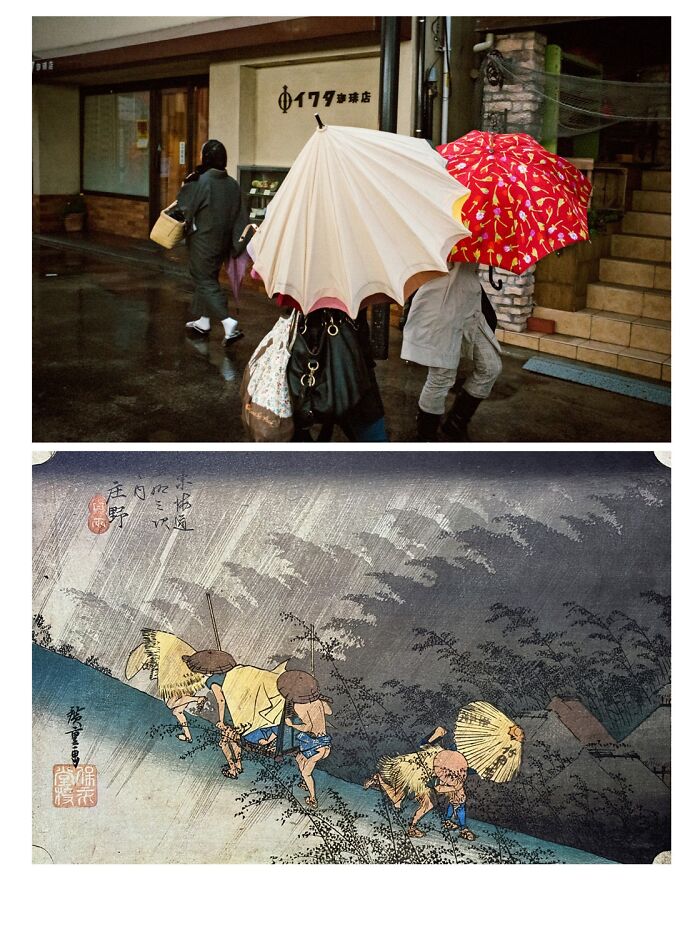
Photo: Pedestrians struggling with umbrellas during a powerful bomb cyclone in Komachi, Kamakura, Japan, April 3, 2012. © Shin Noguchi. Ukiyo-e: Shono Hakuu (Driving Rain), from The Fifty-three Stations of the Tokaido, by Utagawa Hiroshige, circa 1833–1836. Source: Shin Noguchi's personal collection.
© Photo: shinnoguchiphotos
#22
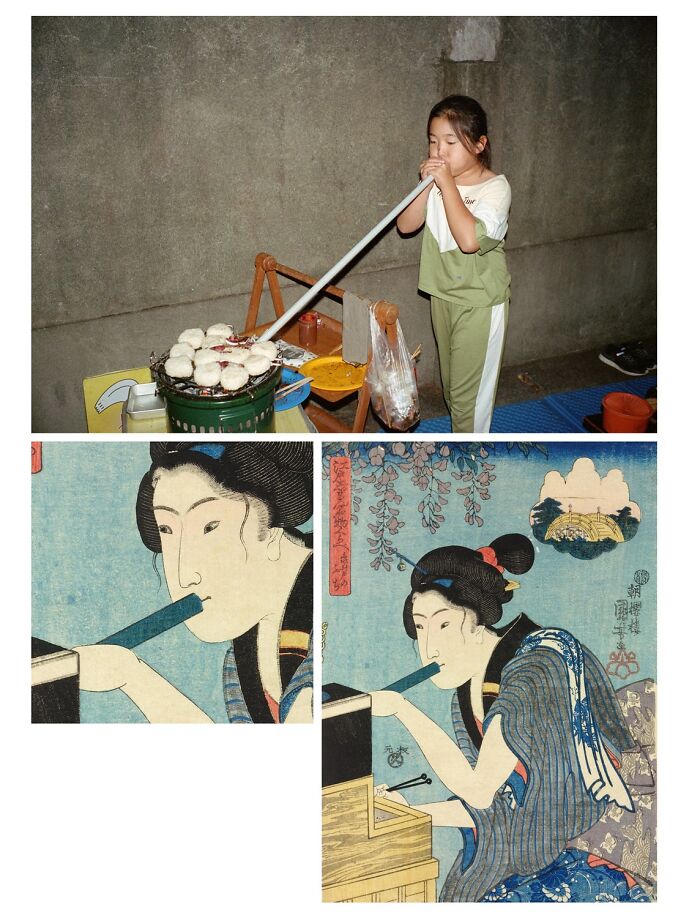
Photo: A young girl blowing into a tube at home in Kamakura, Japan. December 2023. © Shin Noguchi. Ukiyo-e: “Kameido no Fuji,” from “Pride of Edo: Comparison of Famous Products” (1844), by Utagawa Kuniyoshi. © The Trustees of the British Museum.
© Photo: shinnoguchiphotos
#23
Participants carrying a traditional portable shrine during the Ikaho Matsuri Festival, while two women watch from the roadside in Ikaho, Gunma, Japan. September 2015. © Shin Noguchi. Ukiyo-e: “Soma no Furudairi” (c. 1845–1846), by Utagawa Kuniyoshi. Scanned from a volume in Shin Noguchi's personal collection.
© Photo: shinnoguchiphotos
#24
Photo: Sensoji Temple, Asakusa, Tokyo, March 2014 © Shin Noguchi Ukiyo-e: The Fishermen Kuni and Take, the Woman Diver, and the Priest Shiki Hoin by Utagawa Kunisada, 1861 © National Diet Library
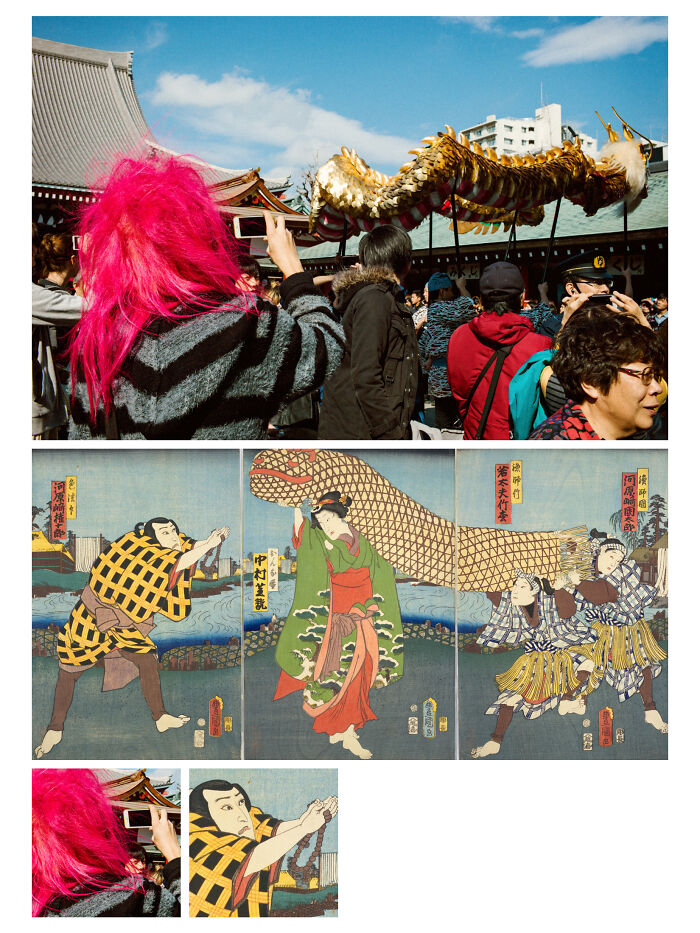
© Photo: shinnoguchiphotos
#25
Photo: Three sisters spending time together at Myohonji Temple in Kamakura, Japan, April 2025. © Shin Noguchi. Ukiyo-e: Myohonji Temple, Kamakura (Flowering Aronais), by Kawase Hasui, 1931. Source: Shin Noguchi's personal collection.
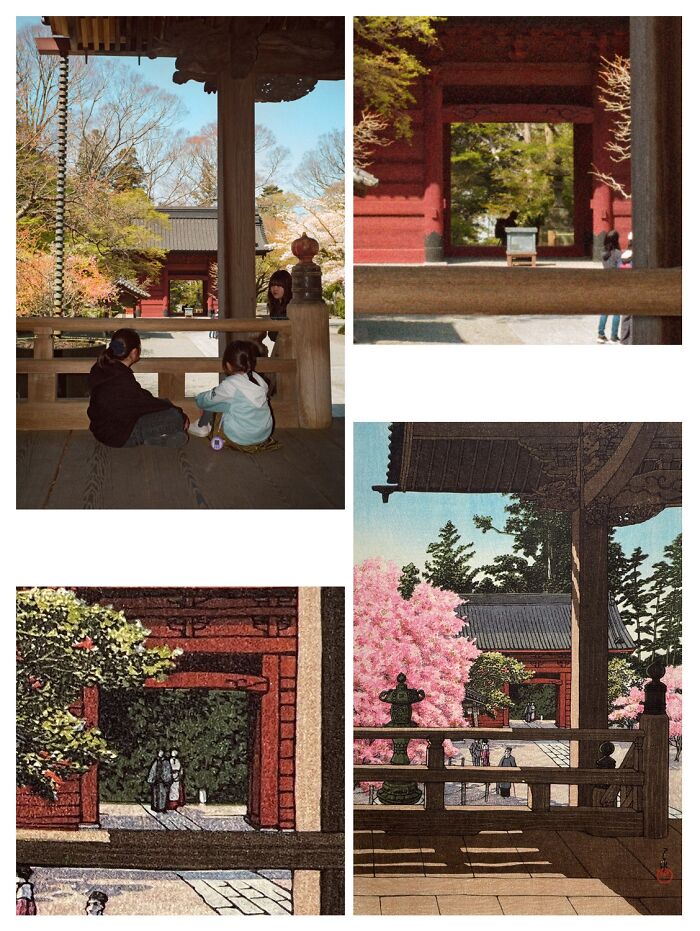
© Photo: shinnoguchiphotos
#26
Photo: Two girls playing a traditional hand game beneath the trees in Yoyogi Park, Shibuya, Tokyo, October 2016. © Shin Noguchi. Ukiyo-e: The Courtesans Murasaki and Shushu Play the Kitsune-ken Hand Game, by Suzuki Harunobu, circa 1770. ©The Metropolitan Museum of Art.
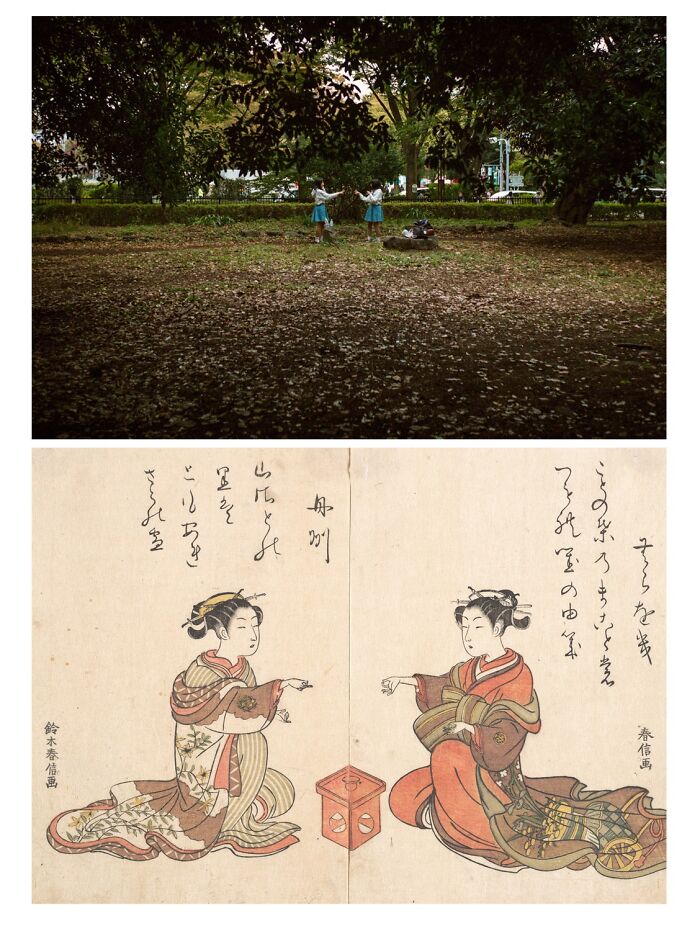
© Photo: shinnoguchiphotos
#27
Photo: Children enthusiastically searching for crayfish along a stone-lined waterway at Myohonji Temple in Kamakura, Japan, June 2018. © Shin Noguchi. Ukiyo-e: Kiba No Natsu (Summer in Kiba), by Keisai Eisen, circa 1835. ©Museum of Applied Arts, Vienna.
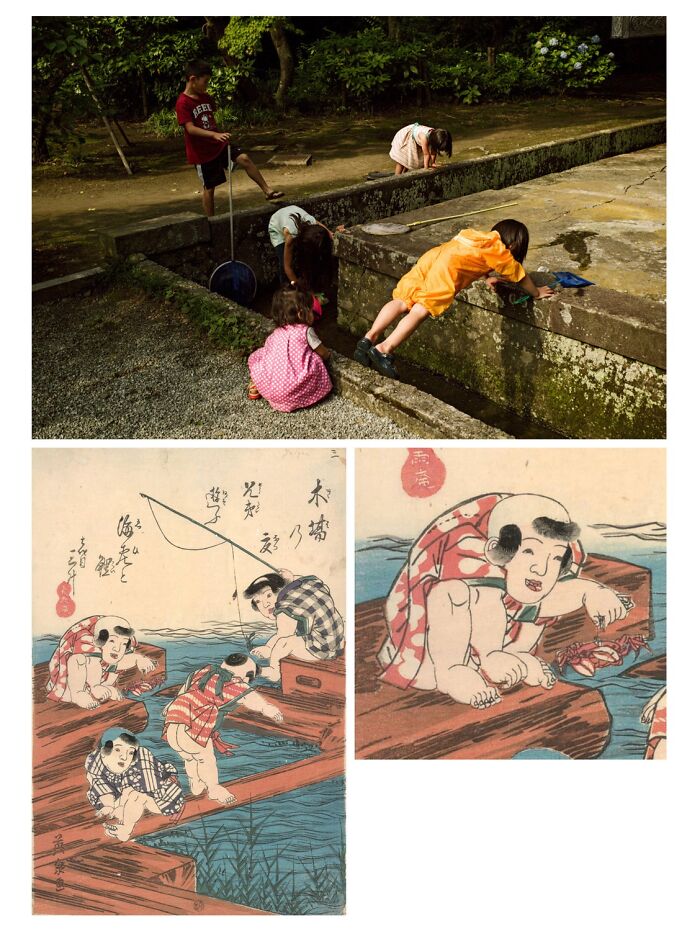
© Photo: shinnoguchiphotos
#28
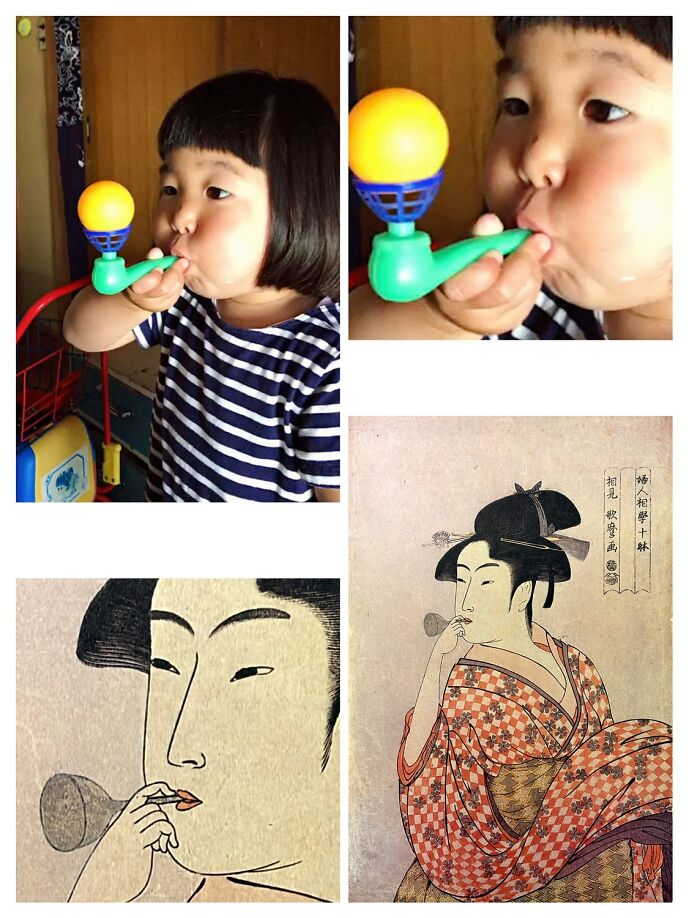
Photo: A young girl named Kotoyo blowing into a colorful toy at home in Kamakura, Japan, May 2017. © Shin Noguchi. Ukiyo-e: Young Woman Blowing a Glass Pipe (Poppin), from Fujin Sogaku Jittai, by Kitagawa Utamaro, circa 1792–1793. Source: Shin Noguchi's personal collection.
© Photo: shinnoguchiphotos