
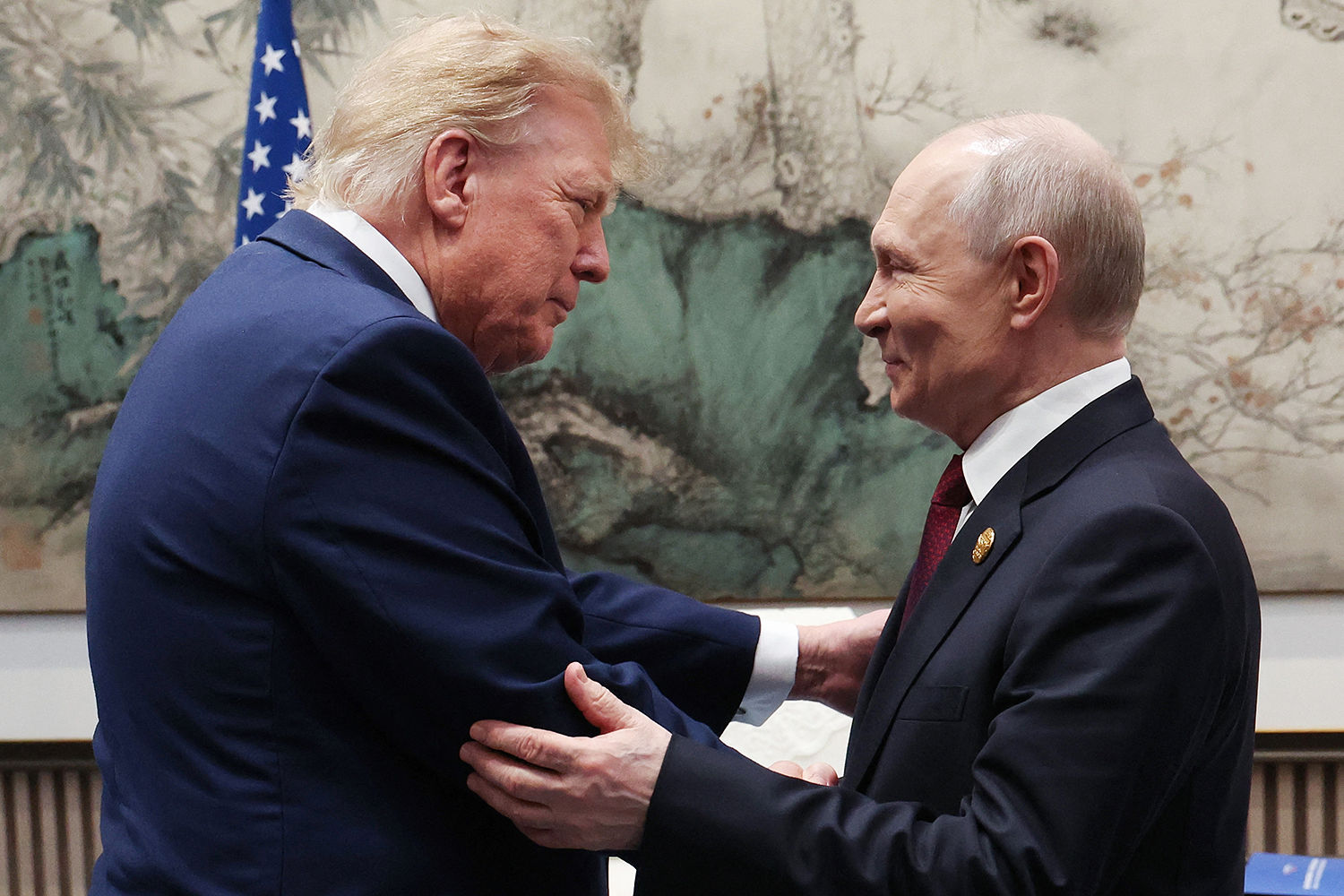
Russian President Vladimir Putin launched a full-scale invasion of Ukraine, is wanted by the International Criminal Court on allegations of war crimes, and is accused of overseeing a yearslong campaign of election interference, sabotage and cyberattacks against the West.
So when President Donald Trump pointed to the Russian leader and declared, “He’s my friend,” at the historic Asia-Pacific Economic Cooperation summit in China on Thursday, the reaction from some of America’s closest European allies was one of alarm and disbelief.
“God, protect us from such friends,” Polish Prime Minister Donald Tusk posted to X shortly afterward.
“The optics of embracing Putin and calling him a friend cause us some concern,” Poland’s foreign minister, Radosław Sikorski, told a news conference Thursday. He added that it posed the question of whom Trump considered a closer friend, Putin or Poland, and “if push came to shove, which friend would he choose?”
Their comments came hours before Poland’s defense minister, Wladyslaw Kosiniak-Kamysz, accused Russia of violating the country’s airspace overnight with three objects that were probably two missiles and a drone. Elsewhere, Estonia said it would close its road border crossings with Russia on security grounds for at least six months.
Much of the criticism of Trump’s remark has come from Poland, historically one of Washington’s closest allies in Europe but whose officials have grown increasingly wary of Trump’s dealings with Russia. The country, which borders Ukraine, Russia and Moscow’s close ally Belarus, has long been among the most outspoken European governments warning about the threat of Russian aggression. Its security strategy also relies heavily on the United States and NATO.
More broadly, the word “friend” also caused fresh alarm among other European governments, some of which are openly warning that Putin may expand his aggression beyond Ukraine and attack them, too.
Ultimately, there is widespread concern that elevating Putin alongside Trump and China’s Xi Jinping will legitimize and embolden a leader whom Western governments have sought to isolate over his record of grave human rights abuses and aggression against other countries, allegations he has routinely denied.
The joint declaration made by Trump, Putin and Xi after their meeting made no mention of Ukraine but condemned the International Criminal Court, which has issued a warrant for Putin’s arrest over the alleged unlawful deportation of Ukrainian children to Russia.
Danish Prime Minister Mette Frederiksen said it was “very incomprehensible” that Trump would meet with Putin, while German Chancellor Friedrich Merz was among those who warned against the meeting becoming a rerun of the Yalta Conference of 1945. The summit toward the end of World War II saw President Franklin D. Roosevelt, British Prime Minister Winston Churchill and Soviet leader Joseph Stalin effectively carve up occupied Germany and other parts of Europe.
Others, including British Prime Minister Andy Burnham, were more restrained. Asked whether Trump had “fallen for Putin’s charm offensive,” he replied that it was “quite the opposite” and that Trump had “talked about the horrific loss of life, including the loss of young Russian lives, and he spoke quite passionately about that subject.”
NATO Secretary-General Mark Rutte also defended the principle of nuclear powers meeting to pursue diplomacy.
Burnham and Rutte were speaking at a meeting in Berlin of the “Coalition of the Willing,” a group of nearly 40 countries working to support Ukraine and provide security guarantees.
They were joined by Steve Witkoff and Trump’s son-in-law Jared Kushner, the U.S. envoys tasked with brokering peace between Moscow and Kyiv.
Trump called into a meeting of dozens of European leaders and Ukrainian President Volodymyr Zelenskyy on Thursday, telling the group that Putin was ready to end the war, according to five European officials briefed on the discussions. He also encouraged the Europeans to make a deal so they can stop spending money on Ukraine and spend it on their own countries, the officials said.
Kushner also mentioned the call in a post on X but said it was up to the president to reveal what he said.
“Trump wants to make a deal with Europe by his side. He’s not looking to impose anything unilaterally,” Kushner said. “Any deal we do will be in close consultation with Ukraine and with Europe. That’s something that he also asked us to come here today and reassure people in that regard.”
The White House did not immediately respond to an overnight request for comment on the criticisms about Trump’s comment about Putin. But Trump defended his description of the Russian president in an interview with Reuters, saying that “it’s nice to have people that have 4,000 nuclear weapons as a friend as opposed to an enemy.”
This is far from the first time Trump has spoken warmly about Putin, joking in 2013 about becoming his “new best friend.” Once in office, Trump said in 2018 that the pair “got on very well,” and in 2022, he described Putin’s initial moves against Ukraine as “genius” and “savvy.” In 2023 and again in 2024, Trump recounted telling Putin, “We’re friends.”
However, this week was the first time Trump made the declaration to Putin’s face, in front of television cameras at one of the most hotly anticipated meetings of recent years.
“It’s one thing to say in an interview, ‘We get on,’ as Trump has in the past; it’s quite another to see him crossing a room in the hotel in China with an effusive smile on his face and gushing about ‘my friend,’” said Jonathan Eyal, international director of the Royal United Services Institute, a London-based think tank. “It all felt very natural and very real.”
The condemnation was not confined to one side of the Atlantic.
In the United States, Democrats were openly scathing. Senate Minority Leader Chuck Schumer of New York called Trump’s words “embarrassing, despicable, and quite frankly pathetic,” while Sen. Jeanne Shaheen of New Hampshire, the top Democrat on the Senate Foreign Relations Committee, described Trump’s “friend” as a “murderous war criminal.”
Sen. Mark Kelly of Arizona said: “Putin is not my friend. He’s not your friend. He’s not a friend of this country, and when the president of the United States refers to him in that way, it emboldens him.”
Republicans were more circumspect. Sen. Rick Scott of Florida called Putin a “thug” but acknowledged that Trump needed to work with him.
Bill Browder, a British American financier who spearheaded the international campaign for Russian sanctions and has become one of Putin’s most prominent critics, also described his “revulsion and disgust” at hearing Trump’s words.
“He’s a guy who’s a geopolitical menace, and he should not get any kind of respect, let alone from the American head of state,” Browder told NBC News in a telephone interview. “To be elevated to the top table with genuine superpowers is an unbelievable symbolic position to sit in.”
When asked about Trump’s comment at the end of the news conference following the “Coalition of the Willing” meeting in the German capital, Ukrainian President Volodymyr Zelenskyy only shrugged and walked offstage.