
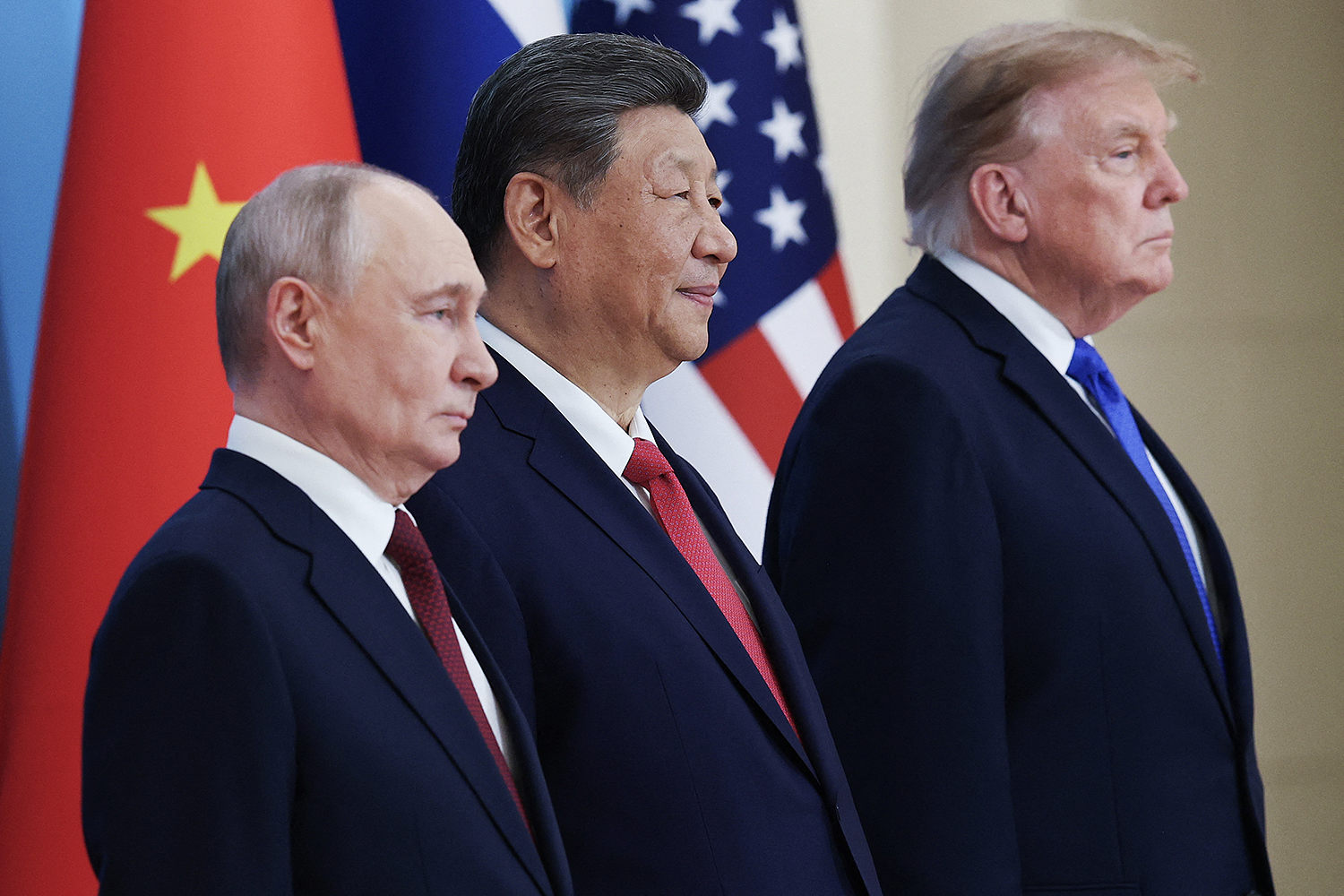
SHENZHEN, China — It’s unclear what decisions may come from this historic meeting.
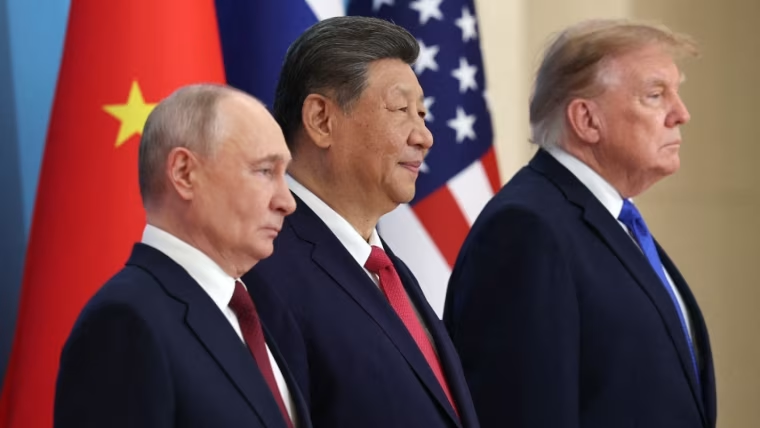
But the spectacle of President Donald Trump’s meeting with Russia’s Vladimir Putin and China’s Xi Jinping may be what delivers the defining image.
On Thursday, Trump, Putin and Xi met on the sidelines of the Asia-Pacific Economic Cooperation summit in the Chinese tech hub of Shenzhen. Sitting around a huge, doughnut-shaped table at the Kylin Villa resort were leaders of three of the world’s most powerful nations: the U.S. with its largest economy, Russia with its biggest nuclear arsenal, and China its largest standing army and manufacturing sector.
“We are really making history,” Trump said.
The sight of Trump expressing such warmth toward two authoritarian strongmen will have left many American allies outside the room dismayed. After Trump called Putin his “friend,” Polish Prime Minister Donald Tusk posted to X, “God, protect us from such friends.” Russia has invaded Ukraine and waged a yearslong campaign of sabotage, cyberattacks and misinformation against the West.
02:02
Others were concerned about the prospect of a “Yalta 2.0,” a reprise of the 1945 Yalta Conference in which the U.S., Britain and the then-Soviet Union met to carve up the postwar world.
After Thursday’s meeting finished, Russia and China issued a brief statement that was light on detail or major announcements. The U.S. did not immediately release a version.
The “China-Russia-U.S. Declaration on Peace” agreed to “reform” the United Nations “so that it can more effectively respond to global challenges.” (Russia and China have long sought to shift the body away from Western human rights concerns, while Trump has been a strident critic of the world body.) The declaration agreed to boost the production and supply of petroleum products, which have been disrupted by the Ukraine and Iran wars, and it rebuked the International Criminal Court not to abuse its power. (The ICC has issued an arrest warrant for Putin.)
The final point was that the leaders vowed to take steps to avoid nuclear war, although no specifics were mentioned.
The last remaining treaty between Washington and Moscow, New START, lapsed in February, but China, which has a far smaller nuclear arsenal than the other two, has resisted calls to be included in a new agreement.
“As the world’s three largest nuclear powers, by far, the United States, Russia, and China are uniquely positioned to discuss how to reduce the number of nuclear weapons on Earth, and to lessen the risk that those weapons will ever be used,” Trump said in the public section of the meeting.
“Once you have the nuclear weapons, it’s very hard to not have them, it’s very hard to give them up,” he added. “That’s the way life works.”
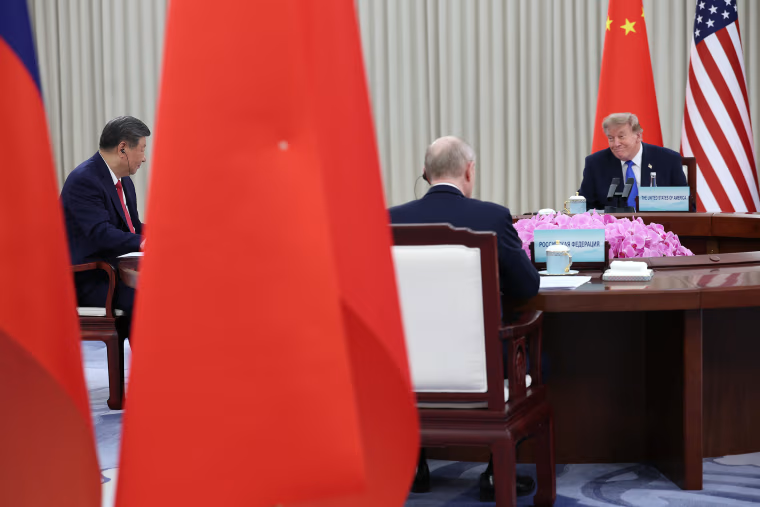
Xi referred to nuclear weapons as a “sword of Damocles” hanging over humanity and said the world’s three biggest nuclear powers were responsible for global peace, according to the state-run news agency Xinhua.
“The world today is no longer made up of isolated islands,” he said via a translator. “Humanity lives in the same global village, where everyone’s fortunes are intertwined and where all share a common destiny.”
It was up to the U.S., Russia and China to “set an example, work together to address global challenges, jointly safeguard world peace and stability, and make greater contributions to human progress,” Xinhua quoted Xi as saying.
Putin said via a translator that, “Our three states are the victors in World War II, and we hold joint responsibility for maintaining international peace and security.”
The Russian leader said it was up to them to “strengthen the system of international law,” as well as work on issues such as food and energy security. (Russia has been accused of war crimes in Ukraine, a charge it denies.)
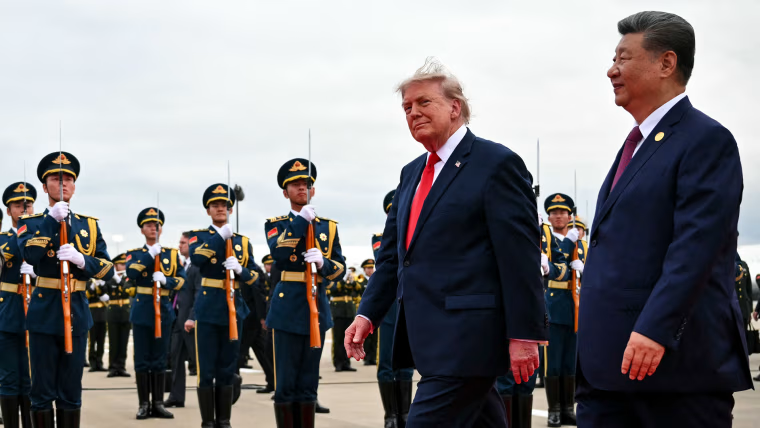
The meeting represents a major shift from Washington’s post-Cold War policy of driving a wedge between Moscow and Beijing, said Ali Wyne, a senior adviser for U.S.-China relations at the International Crisis Group, a think tank based in Belgium.
Now, Trump and Putin “are currying favor with President Xi,” he added. “The symbolism is going to be very powerful.”
00:42
On the nuclear issue, China is reluctant to engage on the subject when its estimated nuclear arsenal of 600 warheads, though growing rapidly, is still eclipsed by the more than 5,000 each held by the U.S. and Russia.
“When the leaders of the three largest nuclear powers sit down to discuss how to reduce the proliferation of these weapons, that is always important,” said John B. Emerson, a former U.S. diplomat who served as ambassador to Germany under President Barack Obama.
Getting Beijing to join real talks on nuclear arms reduction would be a “long shot,” according to Craig Singleton, a China expert at the Washington-based Foundation for Defense of Democracies.
Trump, who has also sought to resume talks with North Korean leader Kim Jong Un over his sanctioned nuclear program, “sees denuclearization as a legacy deal,” Singleton said.
“He’s betting that his relationships can get leaders into a room that other presidents couldn’t assemble,” he said in written comments.
Moscow, meanwhile, has made clear that it wants Ukraine on the agenda although not at the table. This comes as the U.S. and Russian officials have called for negotiations over Europe’s wider security arrangements to be part of any lasting peace settlement — something that deeply alarms long-standing American allies.
This arrangement has also worried Ukrainian President Volodymyr Zelenskyy, who said last month that “we really don’t want this to turn into ‘Yalta 2, 3, 4’ with a redistribution of influence.”
Yalta saw the great powers of the day carve up Berlin into occupied zones, sowing the seeds for communist control of Eastern Europe and the beginning of the Cold War.
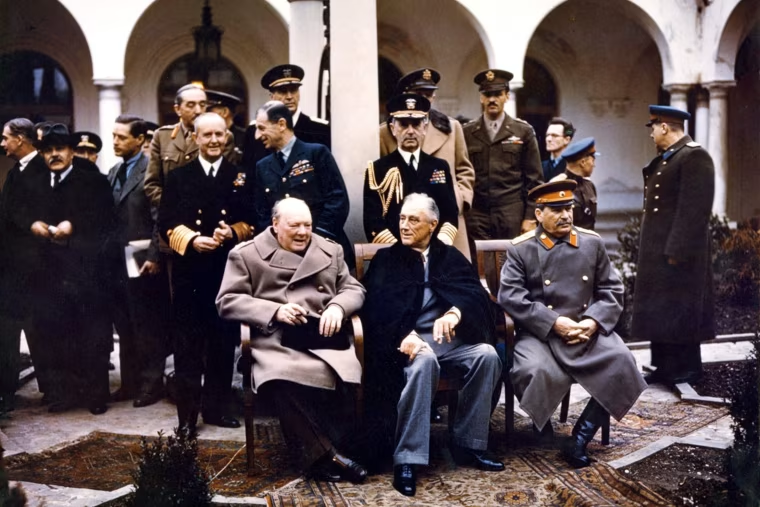
Senior U.S. officials told reporters ahead of Trump’s trip that the Ukraine war was a separate “track” that China is not part of and that it would not be “appropriate” for the three leaders to discuss it. Beijing has also signaled its reluctance to discuss Ukraine without European leaders at the table.
Even if Trump, Putin and Xi don’t decide anything on Ukraine at their meeting, the fact that it’s happening at all only reinforces Ukraine’s suspicion “that Washington is increasingly negotiating with Moscow to the detriment of Kyiv, or perhaps even siding with Moscow,” Wyne said.
China, which has said this week’s trilateral meeting has “groundbreaking significance,” had nonetheless tried to manage expectations.
Da Wei, director of the Center for International Security and Strategy at Tsinghua University in Beijing, said he didn’t expect anything concrete to come from the meeting but that it was a “starting point” that could promote international stability.
“No matter we like them or not, these three leaders and these three countries are major shapers of the international order,” he said in an interview Wednesday. “So for that reason, I think the meeting among the three is a good thing.”
Jennifer Jett and Janis Mackey Frayer reported from Shenzhen, and Alexander Smith from London.